ETH muscle robots jump 5 millimetres – for now only in a nutrient bath
A Zurich team combines cultured tissue with a soft scaffold. The gain in movement is measurable, but the differences between individual actuators are large.
A single electrical impulse is enough, and the small muscle actuator lifts off the bottom of a laboratory dish. The jump measured in the study is 5.1 millimetres – roughly a third of its body length. Researchers at ETH Zurich combined living muscle tissue and a soft artificial scaffold into a single component. Other variants swim, move along the floor or grip an object.
SRF took up the work on 15 November, after RTS had reported on it on 10 November. The results were published in the journal Nature Communications back in September; ETH presented them on 22 October. What is shown is progress in tiny laboratory robots. It is not yet robust proof that they can replace motors in devices or factories.
Muscle and scaffold are designed as one
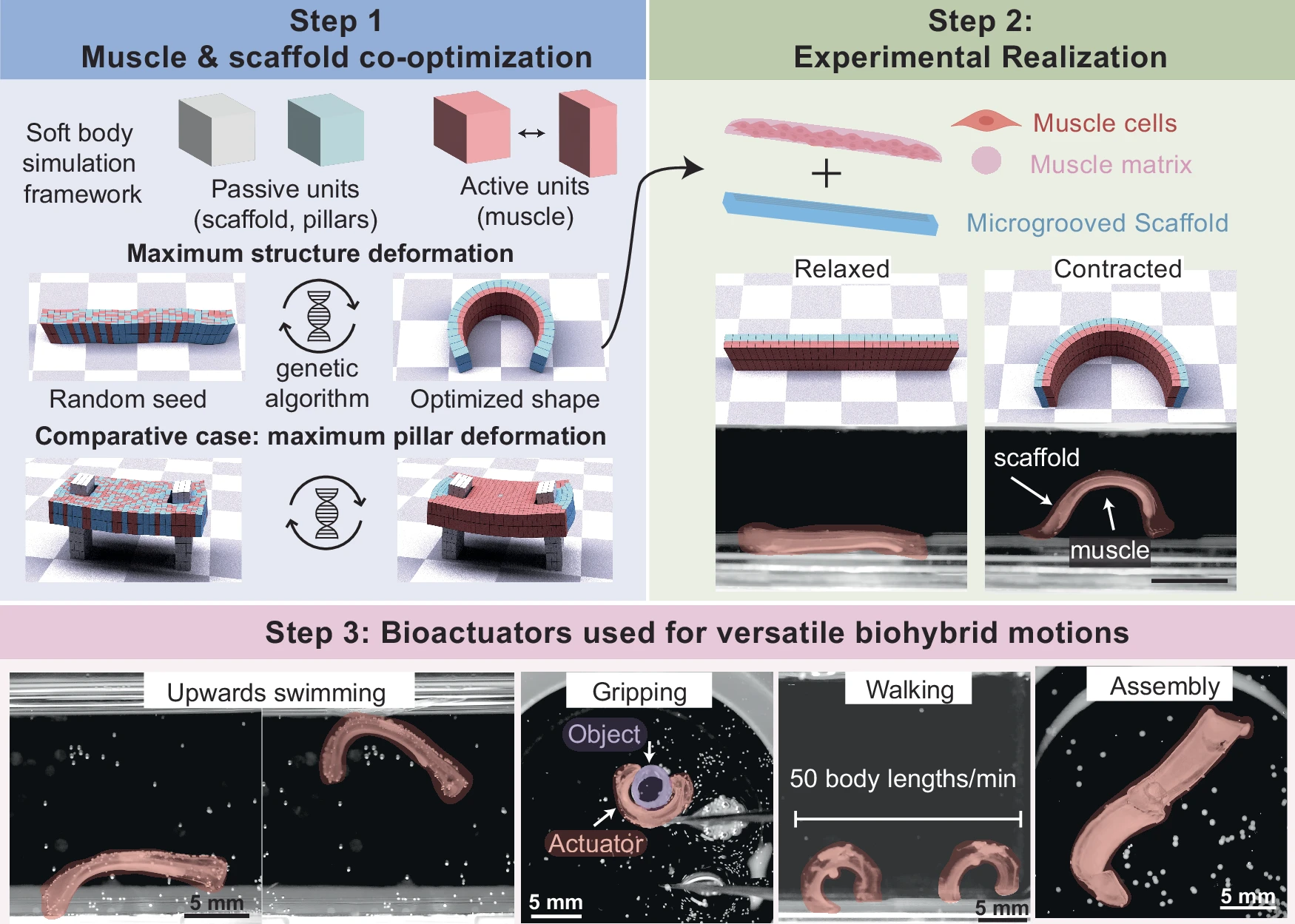
The actuators are around 1.5 centimetres long. The team led by Aiste Balciunaite, Mike Y. Michelis and robotics professor Robert Katzschmann grew skeletal muscle tissue from a mouse cell line on a hydrogel. This water-rich material forms the compliant scaffold. It absorbs the tensile force of the muscle and bends when the muscle cells contract.
The research approach begins before fabrication. A computational method tests different distributions of active muscle material and passive scaffold. The aim is a shape that produces the greatest possible deformation. The researchers then built the designs in the laboratory and compared the movement with the calculations. According to the study, printing a scaffold took about one minute; culturing and maturing the tissue followed a two-week process.
Fine grooves ensure that the fibres align and that the muscle layer adheres to the carrier. The bond is by no means incidental: where adhesion was insufficient, the tissue layer could detach within 48 hours in the experiment. The actuator therefore works only through the interplay of both materials, not through a particularly large amount of muscle alone.
Eleven times more movement is not an eleven times stronger motor
The authors report a range of motion up to eleven times greater than in previously described systems with a similar muscle volume. What is compared is deformation. Neither an elevenfold higher force nor a corresponding improvement in energy efficiency can be derived from this. For choosing an industrial actuator, such properties would be relevant as well.
Even within the new design, the differences are considerable. Across five actuators examined, deformation ranged from 0.5 to 6.6 millimetres. Successive contractions of the same specimen, by contrast, were markedly more uniform. Producing actuators of similarly consistent performance is thus a separate task that remains unsolved.
A walking variant reached an average of 6.2 millimetres per second in the experiment. The speed advantage claimed in the study refers to previously described walking biohybrid robots and their body length. It is not a comparison with all robots. Nor was turning a corner actively controlled navigation: if the actuator met the obstacle unfavourably, it could bounce off it.
In the gripping test, the muscle narrowed the opening of a holder. The system was thus able to grasp an object 3.3 millimetres thick and displace it by 1.8 centimetres. After the stimulus was switched off, it opened again. This documented movement shows a concrete handling task, without yet demonstrating the load capacity of a technical gripper.
Supply limits size
The muscles remain dependent on a nutrient medium. It supplies the cells with the substances they need to live. In larger tissue, oxygen and nutrients do not reach deep enough into the interior. The study describes an accumulation of cells in the uppermost tissue region, which is about 100 micrometres thin.
In the ETH statement, Katzschmann names supply as the central hurdle. In future, larger muscles are to be traversed by small channels. Such an artificial blood supply would have to deliver nutrients and carry away waste products. The work does not present a ready-to-use robot with this circulation.
Nor does it demonstrate a defined service life, maintenance interval or payload in everyday operation. A systematic performance comparison with pneumatics or electric motors is missing. The next development goal lies in the laboratory for now: to supply larger tissues reliably and to reduce the wide performance differences between the cultured actuators.
Sources
- Balciunaite et al.: original study in Nature Communications, 11 September 2026
- ETH Zurich: muscle tissue and scaffold designed together, 22 October 2026; also the source of the lead image
- SRF / RTS: report on muscle robots and the next research goals, 15 November 2026
- Separate article image: Figure 1 of the original study
- Licence of the study and of both images: CC BY 4.0