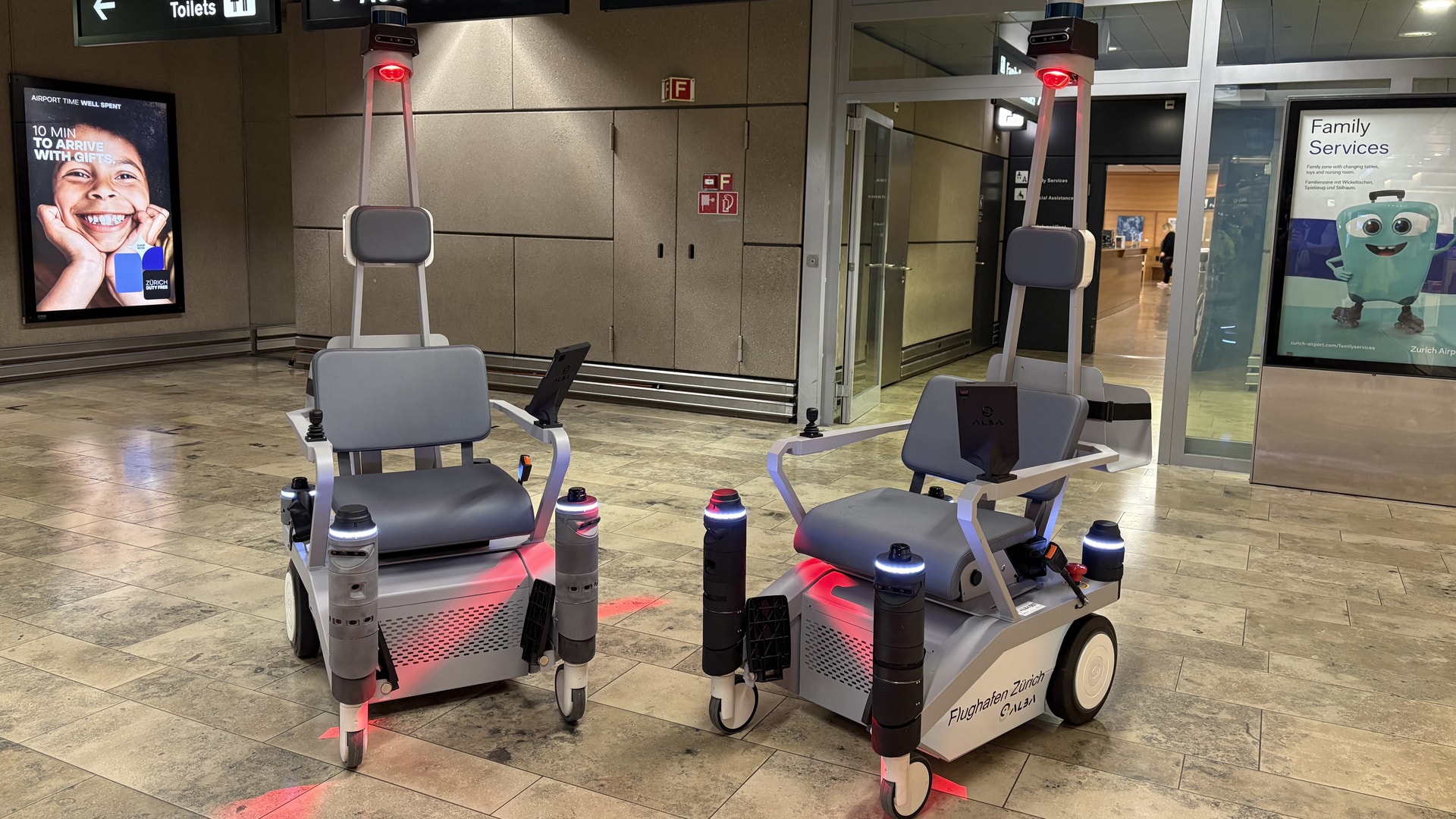
Self-driving wheelchairs take travellers to the gate in Dock A
Zurich Airport is testing four devices over three years. Use is voluntary; personal assistance remains available.
Travellers with reduced mobility should in future be able to cover part of the way to the gate at Zurich Airport without a companion. Four self-driving wheelchairs will be tested for this purpose over three years. They initially run between the airside PRM waiting area and the gates in Dock A, as Flughafen Zürich AG announced on Monday, 16 November 2026.
The ride is voluntary. Anyone who feels more comfortable with a personal escort or needs more support can still use it. The airport sees the devices as a complement to its assistance service. The trial is intended to find out whether the automated rides enable greater independence and give staff additional time for people with more intensive care needs.
The route does not pass through any checkpoint
The wheelchairs operate on fixed routes within the passenger area. No boarding pass, security or passport check may be required on these paths. That limits their use: the trial initially covers a specific section of the journey through the airport, not the entire way from the terminal entrance to the aircraft seat.
Before anyone sets off, staff from the assistance service introduce the wheelchairs and explain how to use them. The device then takes the passenger independently to the gate along the designated route. In a later phase, an extension to Dock B is planned. The announcement does not name a binding date for this step.
The three-year test phase is also meant to show how well the rides fit into existing workflows. A decision on nationwide deployment cannot yet be derived from it. Likewise, the airport publishes no figures in the announcement on working hours already saved or shorter waiting times.
Staff come to the wheelchair if needed
According to the airport, each device has 30 sensors that capture its surroundings. If it detects an obstacle, it can brake automatically. If travellers need support en route, they can request help via an SOS button. Staff then come to the wheelchair on site.
This fallback level is part of the announced operation. An independent ride does not require passengers to go without help. Anyone who does not wish to use the offered ride stays with the personal escort service. The airport explicitly states that the aim is to relieve the workload on its staff while at the same time tailoring care to different needs.
The assistance service is often referred to by the English abbreviation PRM. It stands for «Persons with Reduced Mobility», i.e. people with reduced mobility. At Zurich Airport, staff of Flughafen Zürich AG provide the support. It is free of charge for the passengers concerned; it is financed through airport fees.

Assistance must be registered at least 48 hours in advance
For travel planning, registering the required help in good time remains important. The airport recommends reporting the need for support at the time of booking and no later than 48 hours before departure to the airline or travel agency. This applies to both outbound and return flights. The registration can often be completed in the airline's booking portal.
An email sent directly to the PRM service does not replace this registration. The airport website explicitly points out that support services can only be registered via the airline or travel agency. When registering, travellers should state the care they need and any special features such as an electric wheelchair or an assistance dog.
On the day of departure, they should report to the pick-up point two hours before the scheduled departure time, either to staff or via the call pillar. Such meeting points exist at every check-in. Those arriving by train and needing an escort to the aircraft will find a corresponding call pillar at Check-in 3, directly above the airport railway station.
Your own wheelchair must match the airline
Anyone taking their own wheelchair must also inform the airline. According to the airport, it is carried free of charge in the cargo hold. For electric models, details on the battery type and dimensions are required, among other things; the rules differ from airline to airline. This clarification is part of the preparation regardless of whether an automated ride is offered on site.
The trial in Dock A therefore mainly changes the escort on a delimited stretch of the route. The briefing by staff comes at the start of every test ride offered. During the ride, personal help can be requested via the SOS button.
Sources
- Flughafen Zürich AG: Four self-driving wheelchairs in a three-year trial
- Zurich Airport: Registration and procedure for travellers with reduced mobility
- SRF / SDA: Context on the test operation, 16 November 2026
- Flughafen Zürich AG: Photo offering and prescribed image credit
- Article image: Airside Center, official press offering with usage details


