
Counting calories: why a 100 kcal gap rarely ruins progress
Calorie figures are estimates, body weight fluctuates and plateaus have several causes. What matters is the trend over weeks, not the perfect day.
Counting calories looks like bookkeeping: a number in, a number out, the difference on the scale. In practice, all three quantities are estimates. Foods and portions vary, and daily energy expenditure is not a fixed figure. Even so, counting can be useful — if it is understood as a sufficiently accurate measuring instrument, not as bookkeeping down to the single kilocalorie.
The biggest source of error is the portion
Nutrition figures usually refer to 100 grams or a defined portion. The amount actually eaten can differ noticeably. Oil in the pan, dressing, cheese, nuts, sauces, sugary drinks and small snacks are especially easy to forget when recalling a day. They are not 'bad', but they are energy-dense and therefore relevant to the balance.
At the start it helps to weigh a few typical foods: oats, rice, pasta, oil, cheese and nuts. The goal is not a lifetime of counting grams, but a realistic eye for your own standard portions. Restaurant meals inevitably remain an estimate, because the recipe, the amount of fat and the portion size are unknown. It makes sense to choose a comparable dish, accept a range and look at the longer-term trajectory.
Food labels are not a laboratory analysis of every single package either. The Federal Food Safety and Veterinary Office (Bundesamt für Lebensmittelsicherheit und Veterinärwesen, BLV) points out that natural variation as well as changes during production and storage must be taken into account. Declared values may deviate from the actual content within defined tolerance ranges. Counting calories therefore remains an approximation — even with careful weighing.
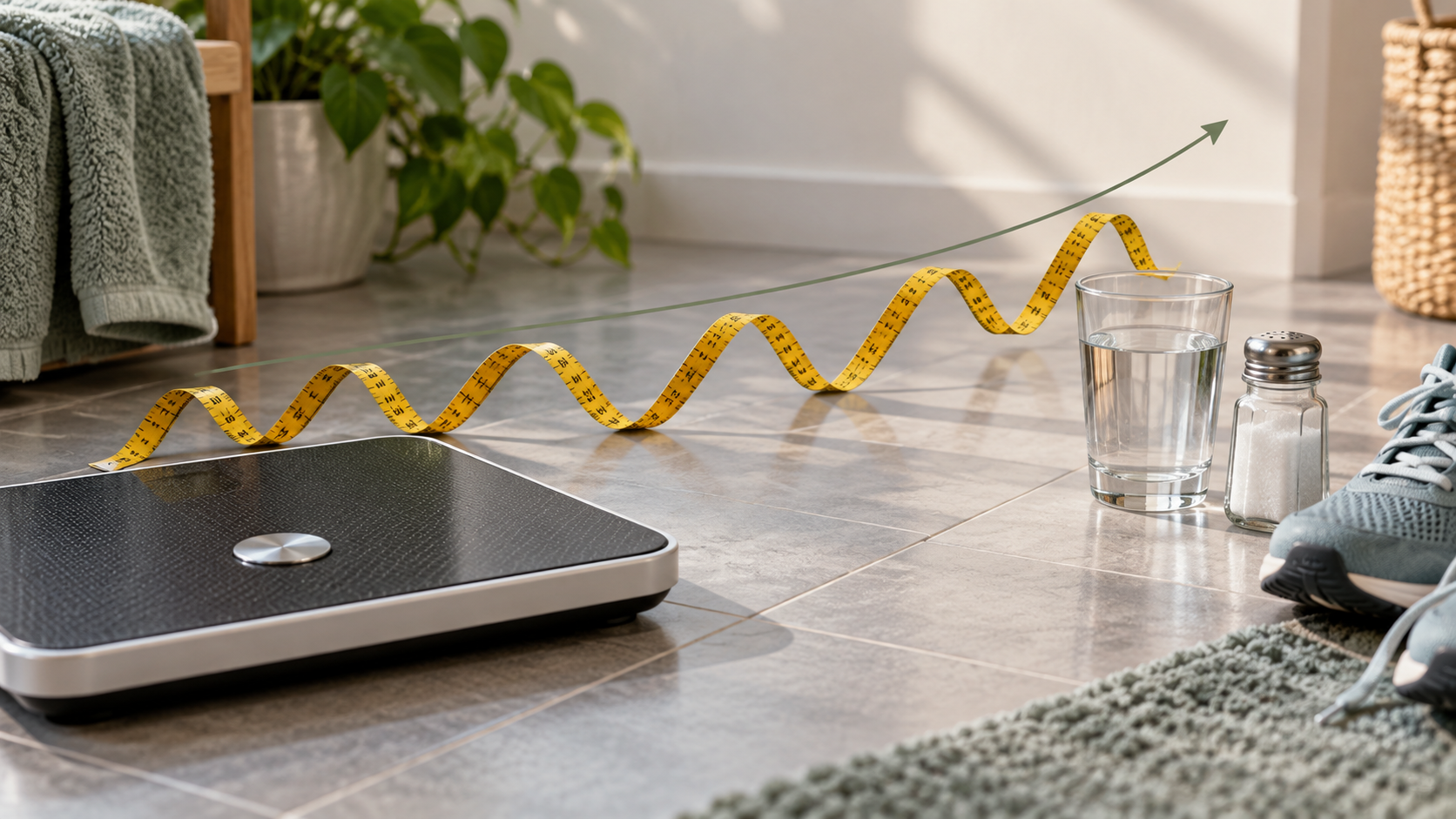
What a 100-kilocalorie gap means
A single difference of 100 kilocalories does not ruin weight loss. If the same deviation repeats every day, however, it becomes relevant:
FrequencyArithmetic total
one-off100 kcal daily for one week700 kcal daily for 30 days3,000 kcal
These totals are not a weight forecast. In particular, they cannot be used to derive a specific number of kilograms with a fixed formula. The dynamic model behind the Body Weight Planner of the US institute NIDDK takes into account that body weight, body composition and energy expenditure influence one another during a change in weight.
What matters is the pattern: an inaccurately estimated restaurant meal once a week is something different from oil or drink calories that go unrecorded every day. Random errors can partly cancel each other out. A recurring underestimate, by contrast, shrinks the planned deficit day by day.
Why the scale can stall despite a deficit
In the short term, the scale measures far more than fat mass. Salt, glycogen and the water bound to it, digestive contents, training and — in people who menstruate — the cycle can influence the reading. A real loss of fat can thus be temporarily hidden on the scale, particularly over individual days and, depending on fluid balance, sometimes for longer. The average of several measurements under comparable conditions is more informative.
With longer plateaus, further factors come into play. A lighter body needs less energy. At the same time, unconscious everyday movement can decline: walking, standing or small movements outside actual training. In research this share is called NEAT, short for 'Non-Exercise Activity Thermogenesis'.
Add to that more hunger, gradually larger portions and metabolic adaptation. Energy expenditure can fall more sharply during weight loss than would be expected from the reduced body mass alone. This is not a 'starvation mode' that cancels out a real energy deficit. But it can shrink the deficit and slow the process down.
Scale not moving: check these five points first
- Are oil, sauces, drinks and snacks included in the count?
- Have portion sizes or restaurant visits changed?
- Has everyday movement decreased?
- Are the measurements taken under comparable conditions?
- Is only a single reading stagnating — or the average over a longer period?
A single stagnant week is usually not yet a reason to change the strategy fundamentally. The trajectory over several weeks under conditions that are as comparable as possible is more informative. If the trend remains unchanged for longer despite consistent implementation, it is worth reviewing portion sizes, drinks, cooking fats and movement again.
Keep muscle mass and health in mind
When losing weight, the number on the scale is not the only thing that counts. A recent meta-analysis of randomised trials in adults with overweight or obesity concludes that strength training during an energy-reduced diet can attenuate the loss of fat-free mass. Another meta-analysis suggests that a higher protein intake can support the preservation of muscle mass. This does not yield a blanket dose for everyone; requirements and health preconditions differ.
Extreme cuts increase hunger and often make long-term implementation harder. Calorie counting is also not suitable for everyone, particularly with eating disorders or compulsive behaviour. Pregnant and breastfeeding women, adolescents and people with illnesses or medications that influence weight and appetite should have changes supervised by a professional.
Accuracy is a question of purpose
Those who are starting out can learn a great deal about portions by tracking carefully for a few weeks. Later, recurring standard meals and occasional check measurements are enough for many people. For weight development, what counts is less whether every single day was recorded exactly, but whether the same sufficiently reliable method is applied long enough to recognise a trend and adjust it if needed.
Sources
- NIDDK: the research behind the Body Weight Planner
- NIDDK: Body Weight Planner
- NCBI Bookshelf: Management of Weight Loss Plateau
- Review: dynamic energy balance and weight plateau
- BLV: information on the food label
- PubMed: strength training during weight loss — systematic review and meta-analysis
- PubMed: protein intake and preservation of muscle mass — systematic review and meta-analysis