AI in healthcare: where responsibility stays with people
Switzerland is working on a general framework for artificial intelligence. In hospitals, however, one thing already applies today: data protection, medical device law and professional responsibility must fit together.
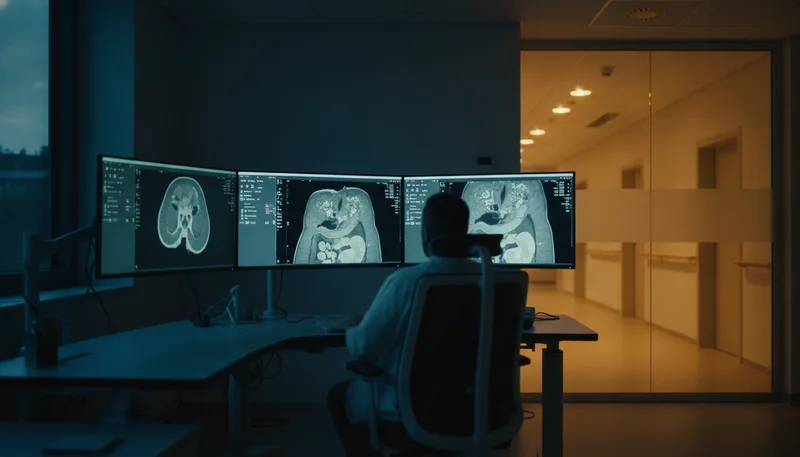
Artificial intelligence is often framed in healthcare as a question of technology: can a system analyse images, summarise texts or predict risks? For patients, another question matters at least as much: who bears responsibility when a recommendation is wrong, incomplete or impossible to follow?
Switzerland so far has no single law that regulates every form of artificial intelligence. The Federal Council is working on an overarching approach. For everyday work in hospitals and practices, this does not mean a legal vacuum exists today. Rules already in force set limits – but they apply on several levels at once.
Medical AI is not simply any piece of software
Whether an AI system counts as a medical device depends on the purpose intended by its manufacturer. Software meant to be used in diagnosis or therapy decisions, for instance, can fall under medical device law. Requirements on safety, performance, risk management and market surveillance then become relevant. A chat function for administrative information is not automatically treated in law the same way as a system that assesses an X-ray.
That distinction is central, because a convincingly written text or a precise algorithm does not yet prove clinical suitability. For care, what counts is whether a system works reliably in the intended patient group, which errors it makes and whether professionals can sensibly verify the results. These questions cannot be answered with general statements about AI alone.
Health data needs more than consent
Health data ranks among the particularly sensitive categories of personal data. Anyone using it for an AI system must consider not only the moment of data collection, but also purpose limitation, access, retention, security and transparency. With learning systems, training data additionally shapes later quality. Data that poorly represents a particular group can lead to unequal results.
The Swiss eHealth Barometer 2026 shows that digital services and automation are becoming more present among the population. Awareness alone, however, says nothing about whether an application is medically effective, compliant with data protection rules or defensible in everyday care. Trust does not arise from an AI label, but from information that can be followed and a way to correct matters.
Professionals remain responsible
Even where a system computes a recommendation, treatment remains a professional task. Doctors, nurses and other health professions must place a result in context, compare it with the individual findings and be able to depart from it when in doubt. This applies in particular when a model does not explain its conclusion understandably, or when the actual care situation differs from the training data.
AI can simplify workflows, ease the burden of documentation or make indications visible. It cannot, however, outsource the clinical relationship, the informed consent discussion and responsibility for a decision. A technically correct prediction can still be unsuitable in an individual case if it fails to take relevant information into account.
The national framework is only part of the answer
The federal government is coordinating the digital transformation of the healthcare system through DigiSanté. At the same time, the federal administration is working on the future regulation of artificial intelligence. A clearer framework may emerge from this. What remains decisive, however, is how it is linked to existing procedures for medical devices, data protection and professional law.
For Switzerland, the real test therefore lies in implementation: who checks an application before it is used? What information do treating professionals and affected persons receive? How are errors documented? And who bears responsibility when a system gives a wrong recommendation? A credible answer to these questions matters more than the claim that AI is either a promise of salvation or a threat.
Procurement and use must be thought together
Hospitals and practices should therefore not compare only the range of functions before deploying an AI application. They need clear processes for selection, training, logging and the reporting of unexpected results. Equally important is whether an application is updated and how changes are documented in a comprehensible way. Only then can a technical possibility become a defensible part of care.