Federal Council candidacies: what public signals really mean
Two SVP National Councillors are keeping a candidacy open. That is a political signal – but not yet a Federal Council election and not an official nomination.
When members of parliament do not rule out a bid for the Federal Council, that is first of all a political positioning. Magdalena Martullo-Giezendanner and Thomas Imark have told SRF that they are keeping a candidacy open in principle. It does not follow that a seat will become vacant, nor that the SVP will nominate them, nor that the United Federal Assembly will elect them. Especially on questions of personnel in the Federal Council, this distinction is easily blurred in the rapid news cycle.
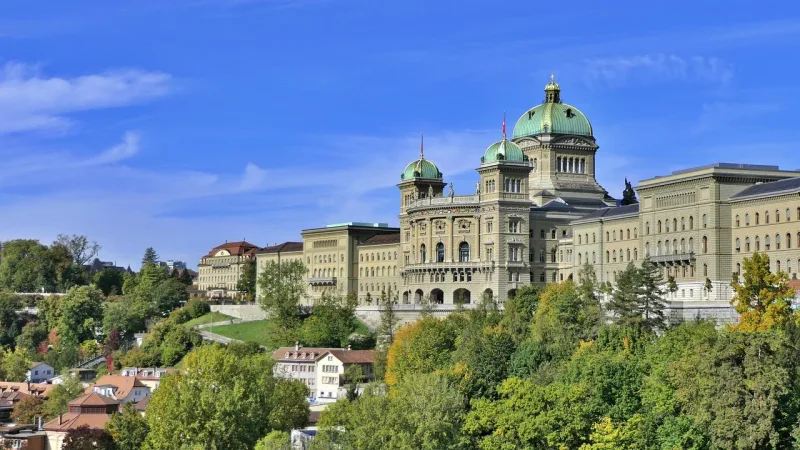
The institutional sequence is clear: first a vacancy is needed. Then the parties decide whom they want to put into the race. The election is then not held by popular vote but by the National Council and the Council of States sitting together. Parliament elects the members of the Federal Council individually and by secret ballot.
Parliament sets the framework
The Federal Assembly deliberately keeps the electoral rules brief and binding. As a rule, the seven members of the Federal Council are elected anew every four years in the winter session after the National Council elections. If a member leaves during the legislative term, the vacant seat is likewise filled by the United Federal Assembly. Anyone regarded within a party as a possible candidate can influence the process politically; legally, that person cannot pre-decide it.
Even an officially proposed ticket is not a binding electoral instruction. The Federal Assembly is not bound by party proposals in the election. In political practice, however, they matter: they bundle interests within a party, make expectations visible and reduce uncertainty ahead of a vote.
Why the early debate still matters
Early debates about personnel are not merely background noise. They show which profiles are perceived within a party as suited to the Federal Council and which issues become tied to them. As an entrepreneur and National Councillor, Martullo-Giezendanner stands for a wing with a strong economic and financial policy profile. In the National Council, Imark represents the canton of Solothurn and is present in political life above all with social and health issues. This classification describes their public roles; it is not a forecast of an electoral decision.
At the same time, the debate carries a downside: it can create the impression that a succession is already settled. On the information known so far, there is no basis for that. Neither an official candidacy nor a binding procedure can be derived from the mere willingness to consider a candidacy.
Transparency instead of a premature campaign
For the public, a sober question is therefore more useful than the search for favourites: what has actually been decided, and by when? What is confirmed at present are public statements about possible ambitions. What remains open are the conditions for an election, possible nominations and the majorities in parliament.
Switzerland does not gain from the earliest possible certainties but from an understandable procedure. As long as no formal election is pending, names are part of the political debate – not its outcome.