Agricultural Policy 2030: Federal Council Launches Consultation
The draft is publicly available – the consultation aims to balance agricultural and environmental interests.
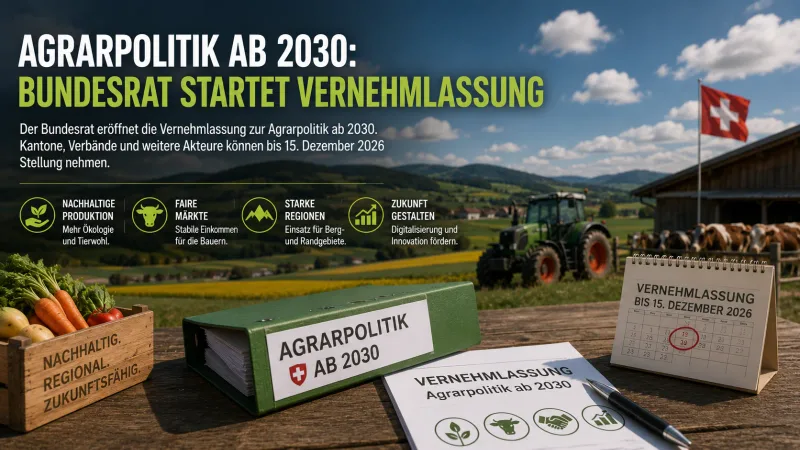
On Wednesday, September 2, 2026, the Federal Council opened the consultation on agricultural policy from 2030. The draft is now publicly available. Cantons, associations, political parties, and other stakeholders can submit their statements in the coming months. Only then will the Federal Council revise the draft and submit the message to Parliament.
Agricultural policy is the central steering instrument for agriculture in Switzerland. It determines direct payments, trade rules, and environmental requirements. For many farms, these state contributions are vital. At the same time, demands for sustainable and animal-friendly production are increasing. With the new draft, the Federal Council aims to bridge the gap between market proximity and ecological responsibility. The consultation will now highlight where the points of contention lie.
A Long Road to Implementation
The consultation is the first formal stage in a multi-step process. After the deadline, the submissions from interested parties will be evaluated. This will be followed by revision by the responsible department and then approval by the Federal Council. Subsequently, the Federal Chambers will debate the draft. However, the matter is not expected to be addressed in the current session. Given the extensive dossier, long deliberations are anticipated. A referendum from farmers or environmental organizations cannot be ruled out. The implementation of the new regulations will be possible no earlier than the end of the 2020s.
The substantive content of the draft was already controversial during internal preparations. Agricultural associations demanded higher budgetary funds and fewer administrative hurdles. Environmental organizations insist on linking services compensated by direct payments with binding sustainability criteria. The present draft represents a middle ground. Whether this will hold up remains to be seen in the consultation. Farming families will insist that their planning security is not jeopardized.
A Topic with Regional Facets
Switzerland is not a homogenous agricultural landscape. In the mountain regions, farms are heavily dependent on alpine farming. In the Central Plateau, arable farming and large livestock facilities dominate. Cantons have considerable leeway in implementation and intend to use it. Therefore, cantonal statements with different priorities are expected in the consultation. The balance between regions is a typical feature of Swiss federalism and will also be reflected in this draft.
What to Expect from the Draft
In terms of content, the Agricultural Policy 2030 could bring a cautious evolution rather than a fundamental shift. The cornerstones of the current agricultural policy – direct payments and customs protection – are unlikely to be questioned. However, adjustments are expected for eco-bonuses and plant protection. Additionally, digitalization is likely to gain greater importance. Data-based evidence could make controls more efficient and simultaneously reduce administrative burden for farms. Whether these ambitions will survive the process unscathed remains to be seen.
For farmers, this means that the applicable requirements remain unclear until the revised message is presented. Farm managers must plan their investments independently of the new agricultural policy. However, the consultation offers them the opportunity to bring their perspective into the process. The Federal Council is called upon to consolidate the various interests. The debate is expected to span several years and will remain groundbreaking for Swiss agriculture. Today's launch is just the beginning of a democratic process.