Calm does not begin at the mountain summit
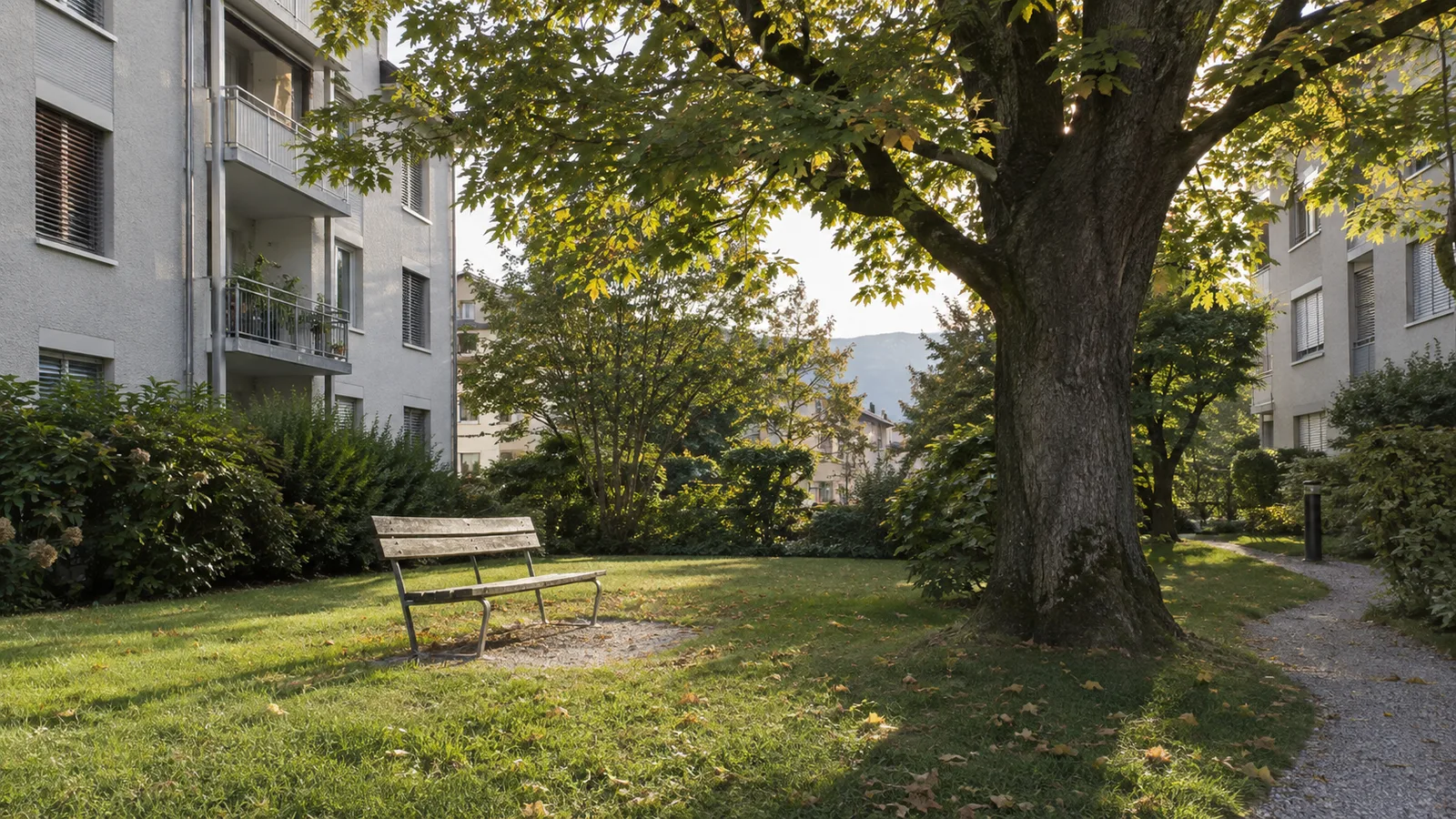
A quiet courtyard or a park within walking distance can matter more in everyday life than a distant excursion destination. Calm is also a question of spatial planning.
On Sunday, many people head to places where they can breathe freely. But the search for calm need not begin at the trailhead car park. A bench behind a building, a green riverbank or a small park can also create distance from everyday life. The decisive difference from an excursion destination: such places are reachable even for a short break.
That makes calm a question of the residential environment. Anyone who sees it only as a private leisure need overlooks the preconditions: it takes an accessible place, a usable route to it and the possibility of staying there. A green patch on the city map is not automatically enough.
The burden at home remains considerable
According to the Federal Office for the Environment, roughly one in ten people in Switzerland is exposed to excessive traffic noise at their place of residence. This figure refers to traffic noise and must not be read as an account of all disturbing sounds. Neighbourhood noise, leisure activities or construction sites are not simply included in it.
The burden is above all an issue in densely populated areas. There, roads, dwellings and different uses meet on little space. Quiet therefore cannot be created merely by advising people to go to the countryside more often. That shifts recovery into leisure time and leaves the everyday residential environment unchanged.
The Zurich environmental report also points out that habituation must not be equated with protection. Someone who barely registers a sound consciously is not automatically spared its effects. Subjective impression and the assessment of noise exposure serve different purposes.
Quiet does not mean noiseless
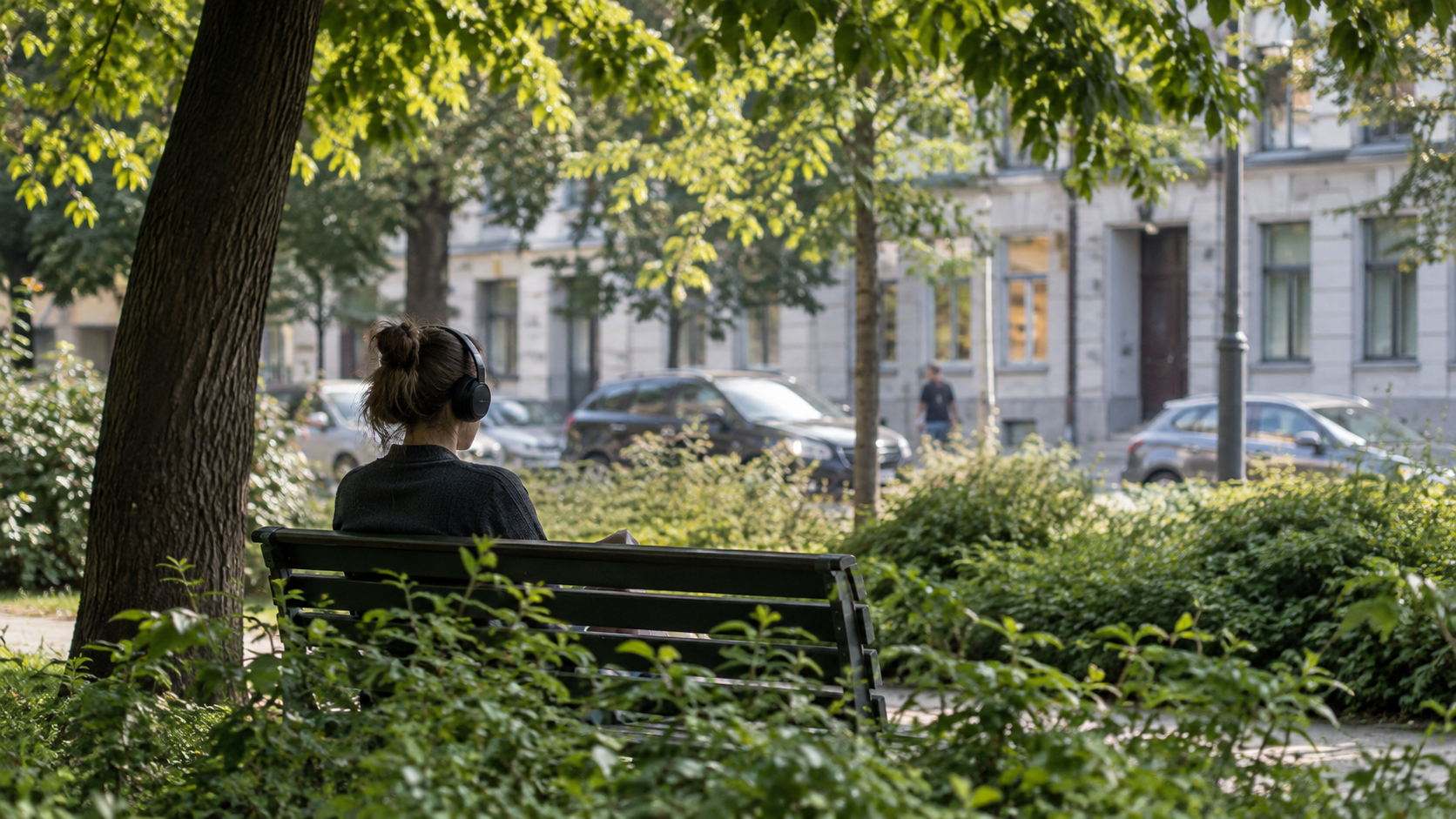
Bafu describes quiet as a quality that goes beyond a single decibel value. The kind of sounds, the visible space and the contrast to the surroundings can influence how restorative a place feels. Birdsong or the sound of water is experienced differently from a technical noise source. A sheltered courtyard can be soothing precisely because a busy street lies next to it.
This perspective is helpful for planning. It makes understandable why a place can work as a retreat despite audible surroundings. At the same time, it is no free pass to ignore limit values or noise sources. Attractive planting does not by itself remove the burden of a heavily used road.
Anyone who wants to create a quiet place must therefore keep two questions apart: How can disturbing sound be reduced? And how can the remaining space be made pleasant and accessible? One answer does not replace the other.
Proximity decides whether a place is usable
In its account of landscape services, Bafu emphasises the importance of reachable recreation areas. In everyday life this is immediately understandable. A distant protected area can be impressive; for a quarter of an hour between two obligations it helps little. A small place within walking distance fulfils a different task.
From this follows a concrete checklist for neighbourhoods: Are there places to sit? Is access clearly public? Must a difficult road crossing be overcome? Can people with limited mobility also use the place? These are practical criteria of accessibility, not a new national ranking of quiet municipalities.
The design of transitions counts too. A retreat that can only be reached via a loud and unpleasant route can have a higher threshold. Planning should therefore look not only at individual areas but also at their connection to dwellings.
Quiet must fit with other needs
A neighbourhood is not an idle space. Children play, people talk, associations organise events. The wish for recovery does not entitle anyone to treat every sign of life as a disturbance. Conversely, a burden does not lose its significance just because others enjoy an activity.
Spatial arrangement, understandable rules and different offerings can help to order these needs. Where everything claims the same small space, more difficult trade-offs inevitably arise. A network of different places to stay creates more possibilities than the expectation that a single facility must satisfy every wish.
For next Sunday, a look at one's own place of residence is therefore doubly worthwhile. Perhaps a good retreat lies closer than thought. And if none exists, that is not merely a personal leisure problem. A liveable municipality should also make quiet possible for those who cannot first travel away for it.


