Food initiative clearly rejected: what the no means
70.15 per cent voted against the constitutional mandate for at least 70 per cent net supply. Supply problems, soils and water remain on the political agenda.
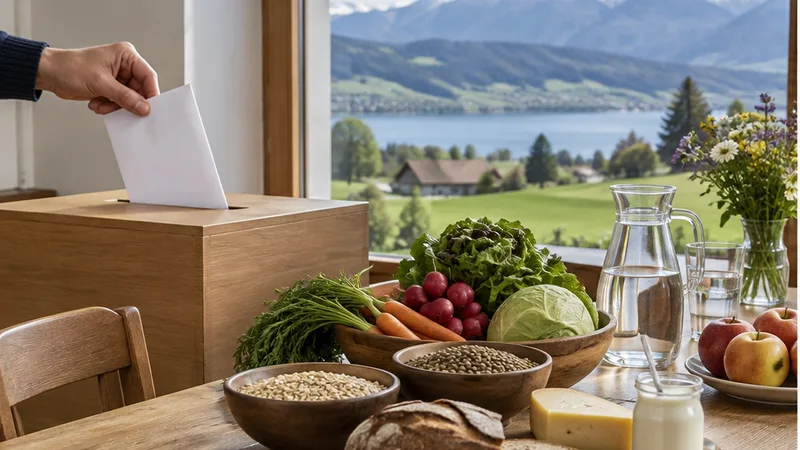
The food initiative failed clearly on 27 September 2026. According to the Confederation's provisional official result, 29.85 per cent voted yes and 70.15 per cent no. The Federal Constitution therefore does not receive a new mandate to raise the net supply rate to at least 70 per cent within ten years.
This clear result closes the concrete project, not the conflicts underlying it. The extent to which Switzerland can secure its own food supply through domestic production, how much animal feed it imports and how agriculture, soils, biodiversity and drinking water are to be protected remain matters for agricultural policy.
The 70 per cent target was at the centre of the text
The initiative «For a secure food supply – by strengthening sustainable domestic production, more plant-based foods and clean drinking water» demanded more than a general declaration of intent. The Confederation would have had to create the conditions for producing at least 70 per cent of the food consumed in Switzerland net on Swiss territory. The deadline was ten years.
The term «net» is decisive: imported animal feed is deducted from the calculation. The figure therefore does not measure only the quantity of food produced by Swiss farms; it accounts for part of the foreign inputs. The initiative committee wanted to increase the share of plant-based foods and protect the production base better, that is, soil fertility, biodiversity and water.
The Federal Council and Parliament recognised several objectives as legitimate, but rejected the combination of a high target and a short deadline. They warned of far-reaching interventions in production and consumption, as well as of additional imports should domestic agriculture fail to meet certain requirements at the same time. The Federal Council pointed to agricultural policy from 2030 onwards and to a net supply target of at least 50 per cent by 2050, over a longer horizon.

What the no does not allow one to conclude
A no share of 70 per cent cannot be read as a rejection of regional food or clean water. A ballot paper records no reason. What was rejected is a specific constitutional mandate, with a quantified target, a deadline and the bundling of several concerns.
It would be just as simplistic to interpret the result as a choice in favour of the status quo. Switzerland imports food, animal feed, fertiliser, energy and other means of production. Supply security therefore depends not only on the volume of domestic production, but also on trade routes, stocks, means of production, eating habits and the ability to withstand climate and market crises.
The initiative linked these questions to a more plant-based diet. It is precisely this association that may have attracted support, but also united resistance. Approving more domestic production did not automatically mean accepting rules on the composition of the offer. Conversely, environmental concerns may have convinced people without the 70 per cent target being considered realistic.
The mandate returns to ordinary politics
After the no, the Constitution in force remains unchanged. The Federal Council and Parliament are now under scrutiny: which elements will they take up in agricultural policy from 2030 onwards? Measurable interim targets will be decisive: how is net supply developing? Is dependence on imported animal feed declining? Are nutrient losses falling without production simply being relocated abroad?
The consumption side also remains relevant. A more plant-based diet can change the need for land and animal feed. This does not, however, automatically mean that policymakers dictate the menu. Between information, prices, production incentives and binding rules lies a broad range of instruments.
A clear no, without a simple answer
The result settles the fate of the initiative: the 70 per cent target and the ten-year deadline are rejected. For long-term food policy, however, it provides no ready-made alternative.
The next debate will therefore focus less on an isolated percentage and more on the question of which dependencies Switzerland wants to reduce and what it is prepared to change in production, trade and consumption to do so. The no refers this negotiation to legislation and agricultural policy – it does not resolve it.