France's protests: prices are the trigger, not a unified movement
Nationwide rallies on 17 October turned violent in several cities. The social causes reach further than the images of looting and fires.
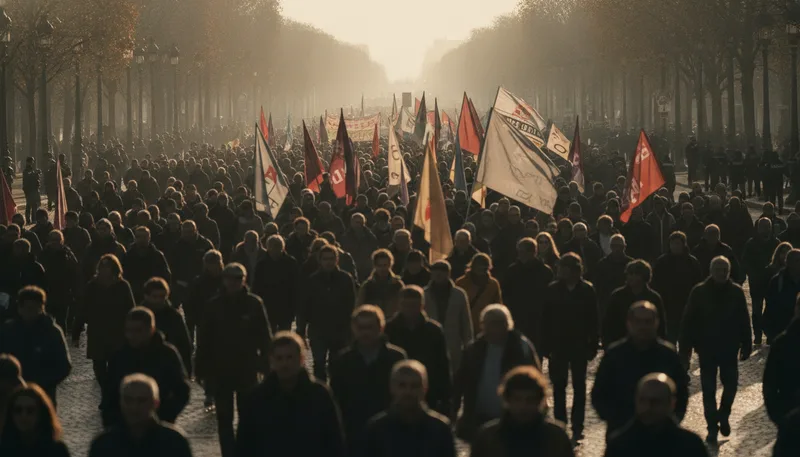
France experienced a nationwide day of protest on Saturday, 17 October, which alongside large rallies also brought looting, fires and clashes with the police. News agencies reported riots in several cities; sources close to the interior ministry spoke of increasing violent incidents. The situation is serious. But it does not permit a blanket narrative of a country in uniform uproar.
The demonstrations brought together people with different concerns: rising living costs, wages, conditions in schools, public services and criticism of police conduct. It is precisely this mixture that explains why images of burning objects or smashed windows show only a fragment. A responsible assessment distinguishes between peaceful protest, concrete criminal offences and the political conflicts from which the mobilisation arose.
Price pressure is measurable
The economic starting point is not merely a feeling. The French statistics office Insee reported annual inflation of 3.1 percent for September; energy prices were 21.3 percent above the previous year's level. Such changes hit low-income households particularly hard, because basic spending accounts for a larger share of their budget.
A weak mood picture comes on top of this. The Insee consumer confidence indicator stood at 86 points in September, well below its long-term average of 100. That is no proof that inflation automatically leads to demonstrations. But the figure shows that many households assess their own financial situation and the economic outlook with restraint.
One movement, several conflicts
The demands of the day cannot be reduced to a single organisation or a single slogan. Trade unions, school pupils, students and local groups set different priorities. For some, wages and purchasing power were central; for others, cancelled lessons, the equipment of public services or relations with the police. Even the figures on the total number of participants differed depending on the source and the time of counting.
That is more than a formalistic caveat. Anyone who describes protests as a closed bloc overlooks the conflicts within the movement and risks equating political demands with criminal acts. Conversely, pointing to diversity must not serve to play down violence. Investigations into looting, arson and attacks on emergency responders must be conducted case by case.
What is established – and what remains open
What is established is numerous rallies and documented incidents. The exact extent of the damage, the definitive number of arrests and possible charges may still change after the first police reports. It is equally open whether this day will produce a sustained mobilisation. That depends not only on the next call to action, but also on price developments, collective bargaining and the government's answers to concrete demands.
In early October, the French judiciary had already pointed to serious violence around school protests in several cities. That is a different, but partly overlapping context. Temporal proximity is not enough to attribute all events to the same cause. For readers, precisely this distinction is decisive: causes, participant groups and individual allegations must be assessed separately.
Why precision matters
For Switzerland, there is no automatic economic or political conclusion to be drawn from this day of protest. As a neighbouring country, France matters, but French price and confidence data are not Swiss indicators. The value lies rather in the method: inflation can be measured statistically, discontent captured in surveys, and violent acts prosecuted under criminal law. None of these levels replaces another.
17 October therefore shows two things. High prices can sharpen social conflicts when they meet worries about wages and public services. But anyone who wants to understand what is moving in France must look more closely than at the loudest scenes of a day of protest.
Between the right to protest and the protection of third parties
A democratic response must do both: protect the right to articulate political discontent in public, and protect people from assault. That requires verifiable police reports, transparent investigations and political answers that go beyond appeals for calm. Whether the next wave of protest will be smaller or larger cannot be seriously forecast from a single day. One thing is certain: anyone who ignores the social causes will not understand the protests; anyone who plays down the violence also misses reality.