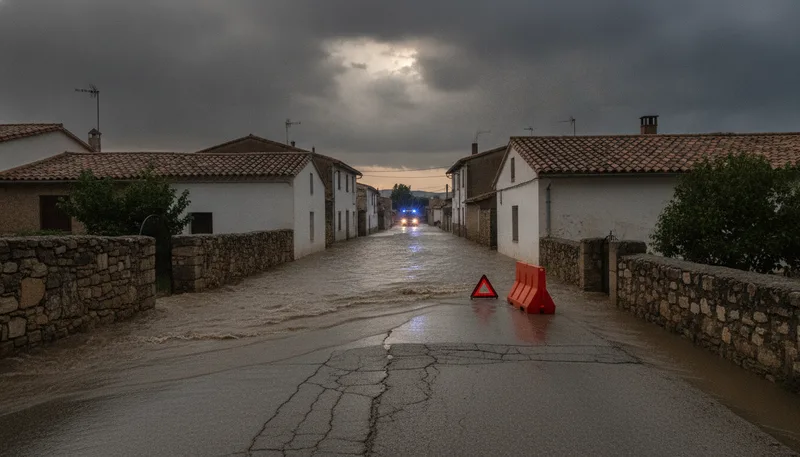
Heavy rain in Catalonia: two dead, 2,469 call-outs, warning limits
Two people died in the storms in Catalonia. The tally of call-outs shows why warnings only work when they arrive in everyday life.
Two people have died after heavy rainfall in Catalonia. The regional government reported deaths in Montornès del Vallès and Tordera. By Sunday evening, fire and rescue services had recorded 2,469 weather-related call-outs, including 228 rescues. The figures convey a sense of the scale — and they show that in torrential rain the most dangerous situations often arise not where the water is most visible.
Small rivers, gullies, underpasses and stretches of road that flood within minutes are particularly risky. The authorities advised people to stay away from watercourses and to cross neither fords nor flooded passages. Such guidance sounds elementary; in a fast-moving situation, it decides between life and death.
A warning is a chain, not a single alarm
Meteorological warnings provide information about the probability and intensity of an event. Their practical value depends on whether municipalities close transport routes, whether schools and businesses respond, and whether people take the situation seriously. With localised torrential rain, only a little time may lie between a general warning and a life-threatening flood.
The Catalan government reported thousands of emergency calls and numerous rescues. At the same time, individual mobility restrictions were adjusted, while parts of the coast and river basins remained under heightened watch. That is no contradiction: a warning situation can end in one area while new cells form further away or swollen waters continue to have an effect.
Lessons for Switzerland as well
Switzerland knows similar risks, above all in narrow valleys, along streams and in densely built-up areas with sealed surfaces. MeteoSwiss and cantonal authorities regularly warn of local flooding and debris flows when heavy rain falls. The comparison with Catalonia is not a claim that the systems are equivalent. It does, however, underline one shared rule: driving through a flooded underpass or walking to a swollen stream is not a risk that can be calculated.
After an event, the less visible work also begins: documenting damage, inspecting buildings, securing transport routes and reaching people at risk. The number of call-outs shows how heavily civil protection depends on functioning emergency call chains and local teams.
Sources
- Generalitat de Catalunya, emergencies: https://web.gencat.cat/en/inici/actualitat/emergencies
- AEMET, warnings: https://www.aemet.es/
- Spanish Ministry of the Interior, civil protection: https://www.interior.gob.es/
- MeteoSwiss, natural hazards: https://www.meteoschweiz.admin.ch/