Magnitude 7 earthquake in Tibet: authorities report deaths
The quake struck the high-altitude Baqen county on 22 October. A reliable death toll is still missing. Measurement data show the strength of the shaking, but not the final extent of the damage.
A strong earthquake shook northern Tibet on Thursday, 22 October 2026. The Chinese news agency Xinhua reported overnight into Friday, citing the affected Baqen county, that people had died. It initially gave no number. The full extent of the damage also remained open.
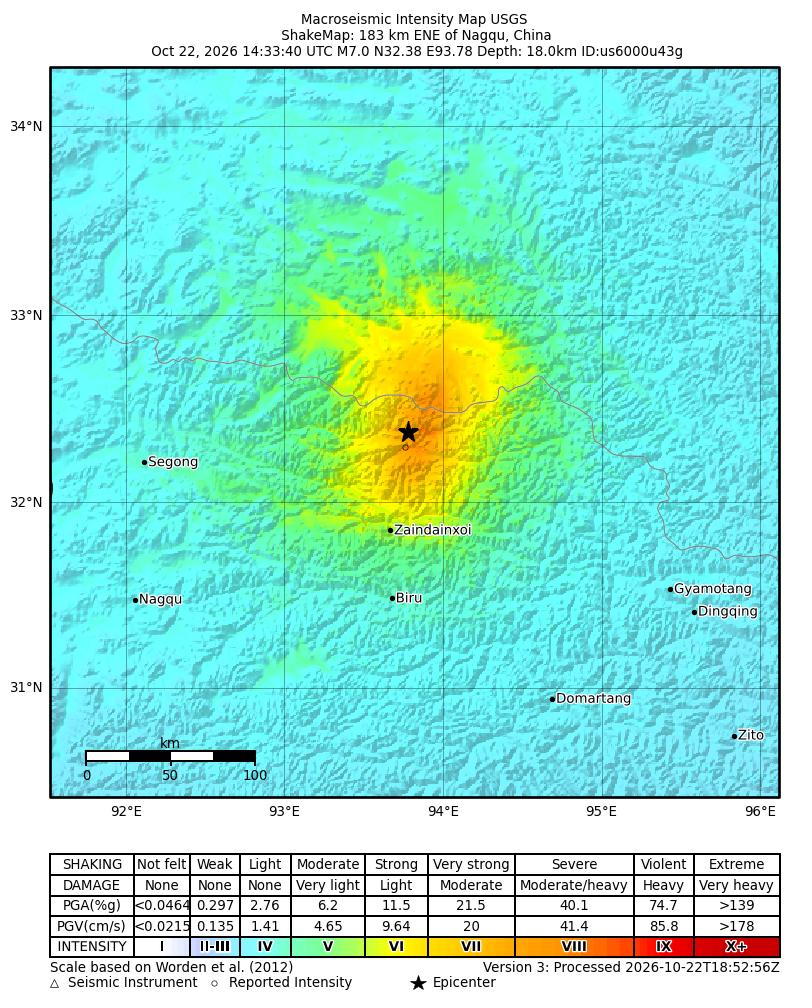
The quake occurred at 22:33 Chinese time, which is 16:33 in Switzerland. The Chinese earthquake authority and the US Geological Survey, or USGS, put the magnitude at 7. The USGS places the epicentre around 191 kilometres east-northeast of Nagqu and the hypocentre at a depth of 18 kilometres. The Chinese authority states ten kilometres.
The first report is not a tally
According to Xinhua, Baqen county saw power outages and disrupted communications. A local official reported cracks in an administrative building and collapsed houses; the villages were being checked. These statements describe initial findings, not a comprehensive damage survey.
The timing is decisive. Early reports contained no information about injuries or deaths. The later report of fatalities supersedes that preliminary information. But it still does not allow any statement about the total number of people affected. Missing reports from a location, especially when communications are disrupted, are no proof that nobody there was harmed.
Relief supplies are being brought to the highland region
In a further statement, the state agency said the Chinese authorities had activated a national disaster relief response and dispatched a working group. Some 5000 units of relief goods such as tents, winter coats, blankets and camp beds were provided from central stockpiles; local deliveries were also coordinated.
According to the Chinese authorities, the epicentral area lies at around 4800 metres above sea level and is sparsely populated. The low population density, however, says little about the situation of individual villages. For relief work, damage to inhabited buildings, usable transport routes and the need for sheltered accommodation must be clarified case by case. The number of goods provided does not equal the number of people already supplied.
The USGS classifies the event as a slip within the Tibetan plateau. In such events, blocks of rock move past one another along a fault plane. The region is shaped by the interaction of the Indian and Eurasian plates. This geological explanation helps to place the quake; it is neither a prediction of further strong quakes nor an all-clear regarding aftershocks.
How magnitude and ground shaking differ
Magnitude describes the size of the quake. What matters for the consequences at a particular place, by contrast, is how strongly the ground shakes there and how vulnerable buildings and infrastructure are. The Swiss Seismological Service at ETH Zurich names the subsoil, the location and the assets affected as decisive factors alongside strength and depth.
Soft deposits can amplify seismic waves. Indirect consequences such as landslides, fires or ruptured pipes are also possible. These are general risk factors, not confirmed damage from this quake. The differing depth figures must likewise be attributed to the respective measuring services; a precise extent of damage cannot simply be derived from them.
The USGS maps and the PAGER system serve to assess possible consequences quickly. They combine measurements with models. A modelled intensity or an alert level replaces neither the inspection of an individual house nor a confirmed list of casualties. Further assessment therefore requires both updated measurement data and verified reports from the affected locations.

What Swiss travellers can conclude from this
Anyone staying in an affected region or planning to travel there should clarify the concrete feasibility with local authorities and the tour operator. That is precisely what the Swiss Seismological Service recommends after major earthquakes abroad. Blanket statements about all of Tibet cannot be derived from the situation at a single epicentre.
Preparation includes an agreed meeting point, accessible documents and a way to bridge power outages. After a quake, instructions from local emergency services take priority; damaged buildings and unnecessary trips into the damage zone should be avoided. For Switzerland the key classification remains the same: the strength of an earthquake can be measured quickly. What it means for people must be established carefully on the ground.
Sources
- USGS: measurement data and situation assessment for the quake
- Swiss Seismological Service: effects of earthquakes
- Swiss Seismological Service: earthquakes abroad
- Swiss Seismological Service: behavioural recommendations
- Xinhua: fatalities reported in Baqen county
- Xinhua: first local damage reports
- Xinhua: provision of relief supplies