Mandatory Reserves Opened: Switzerland's Fuel Supply Vulnerability
The Federal Government releases limited amounts of petrol and diesel. A refinery malfunction and low Rhine water levels are the triggers; the global oil price shock exacerbates the situation.
Switzerland is drawing on its fuel reserves. From September 8 to 20, 2026, importers can withdraw a total of 30,000 cubic meters of diesel and the same amount of petrol from mandatory reserves. This sounds more dramatic than it is: supply remains secured, according to the Federal Government, and the released amount represents less than three percent of the obligatory stocks.
Nevertheless, the step is politically and economically revealing. A technical malfunction at the Cressier refinery coincides with exceptionally low Rhine water levels and strained international oil markets. Three separate risks overlap – mandatory reserves exist precisely for such situations.
Why the Federal Government is Releasing Reserves Now
The Cressier refinery in the Canton of Neuchâtel partially failed due to a technical problem. In normal operation, it covers more than 30 percent of Switzerland's mineral oil product demand. At the same time, tankers on the Rhine can carry less cargo due to drought. The most important import route for liquid energy carriers thus loses capacity.
The Federal Government expects Cressier to operate normally again by mid-September. The release is therefore temporary. It aims to bridge the market and prevent logistics problems from leading to local shortages. Heating oil and jet fuel are currently not affected, according to the Bundesamt für wirtschaftliche Landesversorgung.
It is important to classify: the reserves are not being opened directly because of a single daily price on the oil market. Specific domestic disruptions and transport route issues are decisive. However, the global price shock increases uncertainty and makes replacement procurements more expensive.
What is Held in Mandatory Reserves
Switzerland produces hardly any crude oil itself and has no access to the sea. Companies that import important goods must therefore hold reserves on behalf of the Federal Government. For petrol and diesel, these correspond to approximately four and a half months of average consumption.
These stocks are not state-owned barrels in a single secret depot. They are held by private companies and are part of the economic supply system. The Federal Government decides when quantities may be released. The costs are borne by the system and ultimately by consumers.
A release does not mean that the country is 'running on reserves'. It specifically creates additional goods until normal supply chains function again. The earlier a manageable disruption is cushioned, the lower the risk of panic buying or excessive price jumps.
The Rhine Remains a Bottleneck
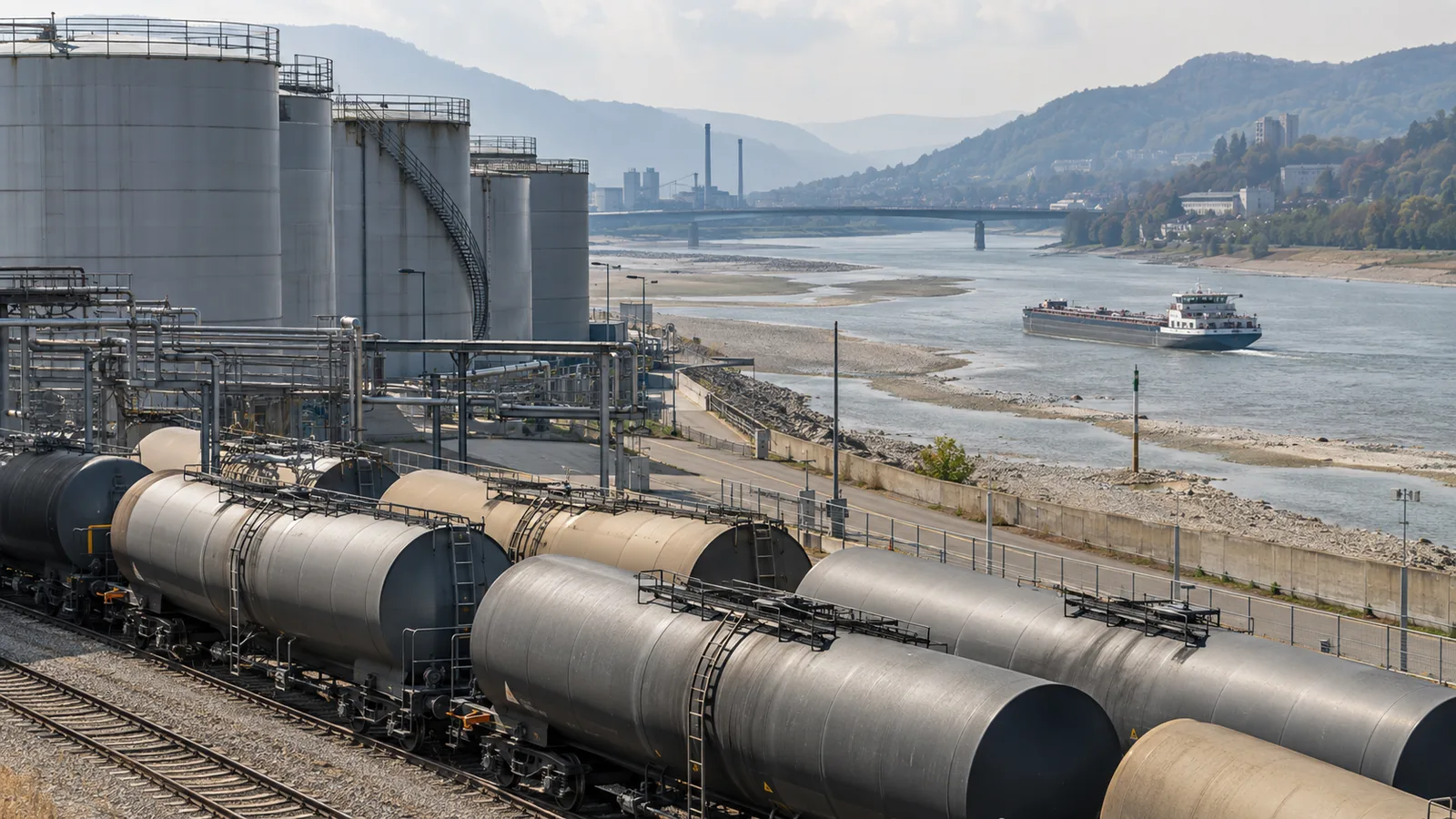
A significant portion of fuels and raw materials reaches Switzerland via the Rhine ports. In low water, ships can only transport a fraction of their usual cargo. The same quantity requires more trips, more personnel, and higher freight rates.
Alternatives via rail, pipeline, and road exist, but cannot be scaled up indefinitely. Wagons, tank trucks, and transshipment facilities are also scarce. Supply security therefore depends not only on the quantity in warehouses but also on several functioning routes.
The dry summer of 2026 makes this vulnerability visible. Climatic extremes are becoming a logistics risk. Low water levels affect industry and energy supply, as well as agriculture and ecosystems.
What the Oil Price Shock Causes
International oil prices were again above 100 dollars per barrel in early September. Already in July, the Internationale Energieagentur had temporarily recorded around 105 dollars. Conflicts in the Middle East and disruptions around the Strait of Hormuz depress supply and increase the risk premium.
However, for Swiss petrol stations, not only the crude oil price counts. The exchange rate, refinery costs, transport, taxes, margins, and the timing of procurement all influence the final price. A stronger franc can dampen part of the dollar price; conversely, scarce logistics capacities add to the cost.
Price movements therefore appear delayed and not one-to-one at the pump. The release of mandatory reserves can alleviate physical shortages but is not intended to guarantee a politically fixed low price.
Consequences for Households and Businesses
Commuters, transporters, and commercial businesses feel high fuel prices immediately. For logistics companies, these flow into surcharges, which can later affect goods and services. Rural households, in particular, often have fewer alternatives for public transport.
The Nationalbank also observes such shocks. Higher imported energy prices initially drive inflation directly. If they persist, second-round effects can occur: transport, tourism, or gastronomy pass on increased costs. At the same time, expensive energy curbs consumption. This complicates monetary policy.
Swiss economic forecasts became more cautious already in the summer. SECO predicted 0.9 percent growth for 2026 in June, citing higher energy prices as a burden.
What Supply Security Demands in the Future
Mandatory reserves remain central, but are not enough on their own. Switzerland needs robust rail and Rhine capacities, functioning refineries, coordinated crisis plans, and a diversification of import routes. At the same time, every more efficient engine, every shifted journey, and every electric vehicle reduces oil dependence in the long term.
There is no reason for Swiss citizens to hoard supplies. The current release proves that the security system works. However, it also shows that supply security has a price – and that fossil dependence makes Switzerland vulnerable to technical malfunctions, low water, and geopolitical conflicts.
Sources
- Bundesamt für wirtschaftliche Landesversorgung: Release of petrol and diesel from mandatory reserves – https://www.bwl.admin.ch/de/newnsb/ZTAGOgBfi7Kr
- Internationale Energieagentur: Oil Market Report, August 2026 – https://www.iea.org/reports/oil-market-report-august-2026
- Associated Press: Oil price over 100 dollars early September 2026 – https://apnews.com/article/7538e6386a819bcdc2547d530ec3472e
- Staatssekretariat für Wirtschaft: Economic Forecast, June 2026 – https://www.seco.admin.ch/de/newnsb/uu-B-GxWFqc9y6ngnPwzq
- Schweizerische Nationalbank: Monetary Policy Assessment, July 2026 – snb.ch/de/publications/communication/summaries/zus_20260716…
As of: September 9, 2026.