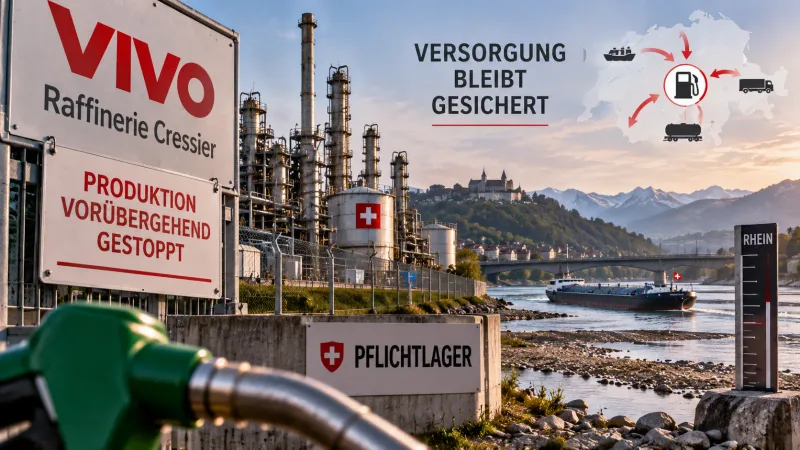
Swiss Inflation Rises to 0.8 Percent – SNB Now in Focus
Inflation doubled in August. Energy, fuel, and rents drive prices, but inflation remains clearly within the price stability range.
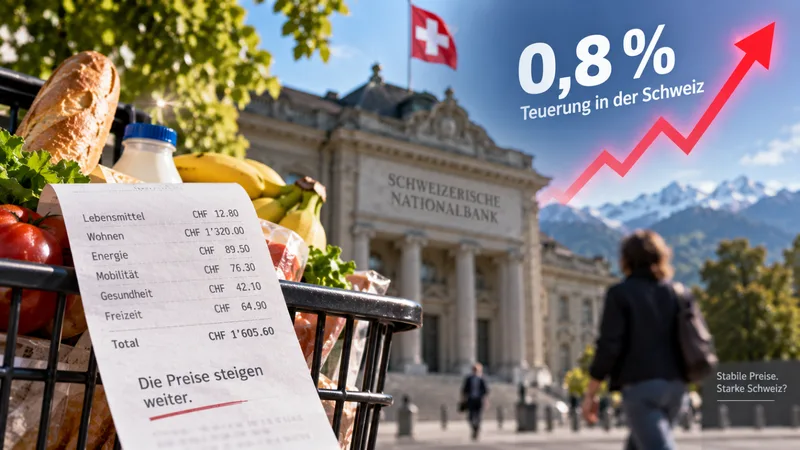
Inflation Picks Up Again
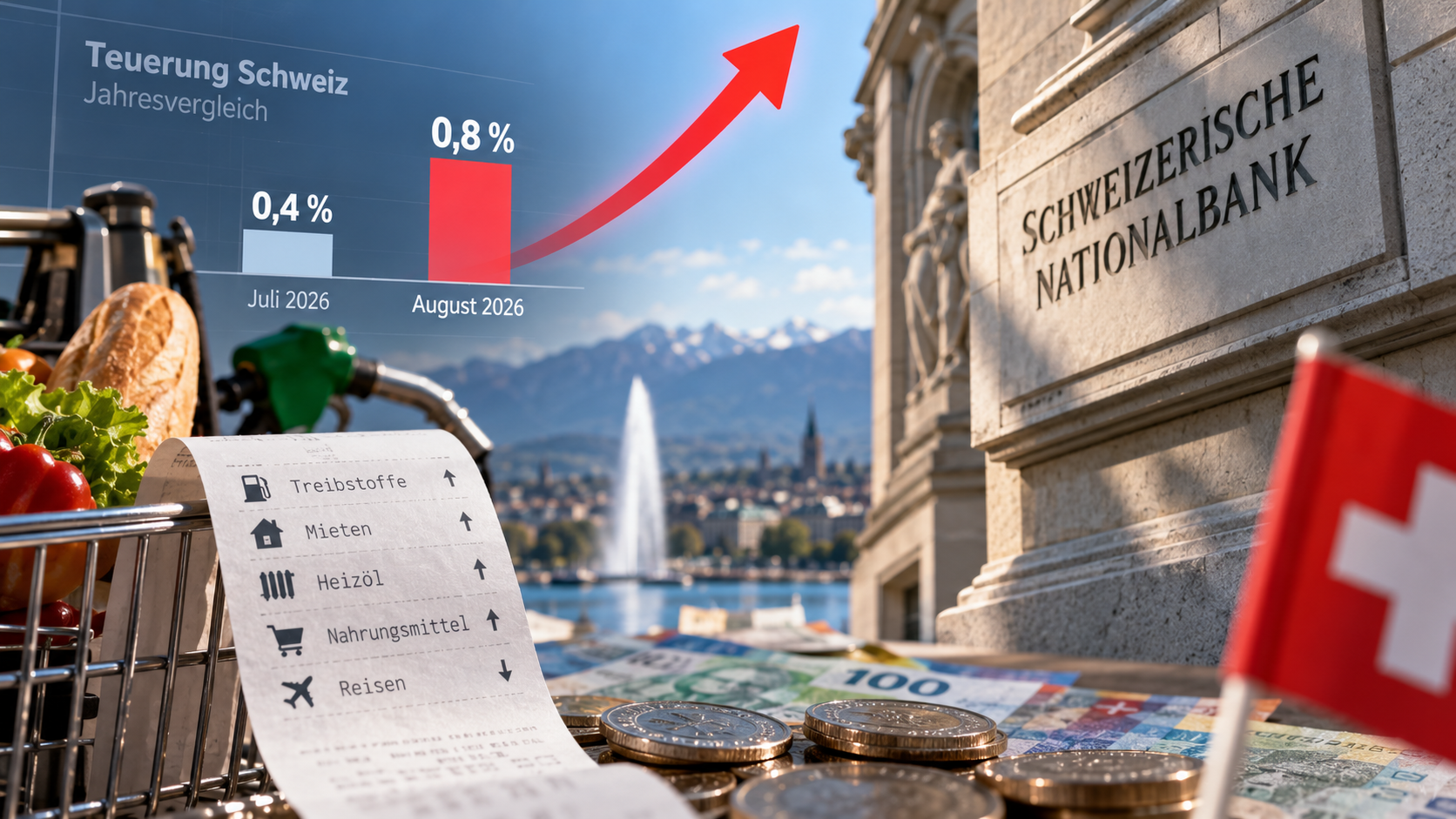
Swiss consumer prices rose noticeably in August. The CPI reached 101.5 points. Compared to the previous month, the increase was 0.4 percent. Year-on-year, inflation stood at 0.8 percent – twice as high as in July.
However, the increase comes from a still low level. At 0.8 percent, annual inflation is well below the 2 percent threshold, which the SNB defines as price stability. Therefore, based on the August figures, a new wave of inflation cannot be discussed.
At the same time, the movement is relevant for monetary policy: inflation accelerated significantly within a month, reaching its highest level since August 2024.
Energy and Rents Drive Prices
The increase was not limited to a single area. According to the Federal Statistical Office (FSO), gasoline, diesel, and heating oil, among other things, became more expensive. Residential rents and inpatient hospital services also contributed to the higher price level.
At the same time, there were also price-dampening factors. Package tours abroad, car rentals, car sharing, and prices in alternative accommodation became cheaper.
The development of energy prices is particularly important for the SNB. In its monetary policy assessment in June, it had already pointed out that higher inflation was primarily driven by rising energy prices. Medium-term inflationary pressure, however, had hardly changed at that time.
Core Inflation Remains Significantly Lower
An important distinction lies between overall inflation and core inflation. The latter attempts to exclude particularly volatile price components. In August, core inflation rose year-on-year from 0.3 to 0.4 percent.
This is an important indicator for classifying the current development: not only are energy prices moving, but the underlying price pressure remains comparatively low.
For the SNB, this means that the rise in overall inflation does not automatically trigger a monetary policy reaction. More crucial is how inflation is likely to develop over the coming quarters.
The SNB Keeps the Policy Rate at 0 Percent
The SNB policy rate is currently 0 percent. The National Bank had kept it unchanged in June. At that time, it declared that monetary policy remained appropriate to keep inflation within the price stability range and support the economy.
The SNB considers more than just the latest published CPI value. For its decisions, it analyzes economic developments, financial markets, exchange rates, energy prices, and other factors. The medium-term inflation forecast is central.
Precisely for this reason, the increase to 0.8 percent does not yet imply that the National Bank will change its course.
September 24 Will Be Interesting
The next monetary policy assessment will take place on September 24, 2026. The SNB will then publish its next monetary policy decision and present its new conditional inflation forecast.
This forecast is likely to be more important for classifying the August figures than the single monthly value. The question is: Does the National Bank assume that higher energy prices will only temporarily affect inflation – or will they lead to more sustained second-round effects?
In June, the SNB initially expected a further slight increase in inflation before forecasting a decline again for the first half of 2027. Its forecast at the time for the 2026 annual average was 0.6 percent and was based on a constant SNB policy rate of 0 percent.
Why a Rate Cut Is Still Not Ruled Out
At first glance, higher inflation might argue against lower interest rates. However, the SNB's monetary policy does not have to react to every short-term price increase with higher interest rates.
Should it become apparent that inflation remains low in the medium term, the National Bank could maintain its expansive course. In the event of strong upward pressure on the Swiss franc, it also has the option to intervene in the foreign exchange market.
SNB Governing Board member Petra Tschudin explicitly confirmed in August that interest rate cuts below zero remain fundamentally possible. She stated that if it became necessary to lower interest rates below zero to keep inflation in the 0 to 2 percent range in the medium term, the SNB would do so.
For Savers, Mortgage Holders, and Consumers, the Question Remains Open
The SNB's decision is not only relevant for financial markets. The policy rate influences, among other things, short-term money market rates and thus indirectly also the financing costs for companies and households.
For mortgage holders, it is therefore crucial how expectations for future monetary policy develop. For savers, in turn, lower policy rates generally mean lower returns on short-term investments.
At the same time, August inflation shows that individual expenditure areas for households can rise significantly more than the average inflation rate. For example, those who spend a lot on fuel, housing, or other more expensive goods may personally feel higher inflation than the official 0.8 percent.
No New Wave of Inflation Yet
The August figures are therefore a signal, but not proof of a new wave of inflation. Annual inflation remains clearly within the SNB's price stability range. Core inflation also remains low at 0.4 percent.
At the same time, price pressure has increased compared to spring. Higher energy prices can affect other goods and services with a delay. Precisely these potential second-round effects are likely to be more important for the National Bank than the single figure of 0.8 percent.
The decisive answer therefore does not come from August statistics alone. It will become clear on September 24 when the SNB publishes its new inflation forecast and decides whether the policy rate remains at 0 percent.
Conclusion
Swiss inflation rose surprisingly sharply to 0.8 percent in August. Energy prices, fuel, and rents moved the price level upwards. At the same time, core inflation remains low, and overall inflation is well below 2 percent.
For the SNB, this means: Observe carefully – but no reason for an automatic change of course yet. It will be crucial whether the price increase proves to be a temporary effect or if inflationary pressure strengthens on a broader basis.
Sources
- Federal Statistical Office (FSO): National Consumer Price Index, August 2026, published September 3, 2026.
- Swiss National Bank (SNB): Monetary policy assessment of June 18, 2026.
- Swiss National Bank (SNB): Calendar – Monetary policy assessment of September 24, 2026.
- Swiss National Bank (SNB): Interview with Petra Tschudin, August 2026.