Cressier Refinery Stands Still – Swiss Fuel Supply Remains Secure
Cressier halts production, but compulsory reserves and alternative imports maintain stable supply.
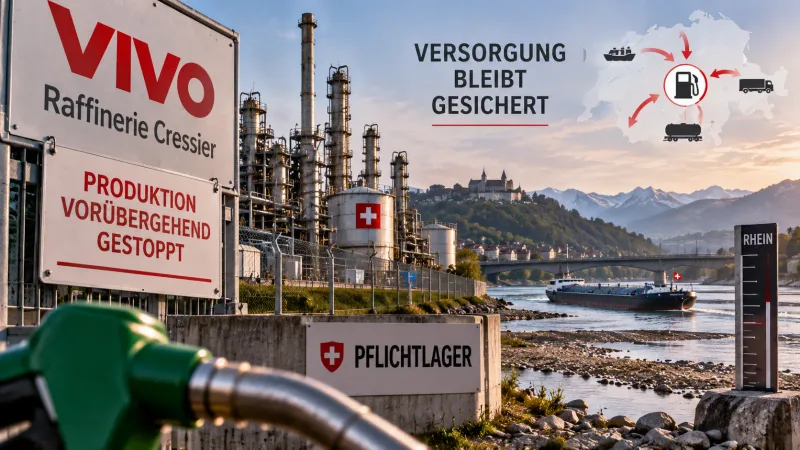
The Cressier refinery in the canton of Neuchâtel has temporarily ceased operations due to a technical defect. The facility covers just over 30 percent of Switzerland's mineral oil product demand. Concurrently, the supply situation has been strained for several weeks due to low water levels on the Rhine. Nevertheless, the Competition Commission (WEKO) currently sees no supply gap: petrol, diesel, and other mineral oil products remain available. Should the situation worsen, compulsory reserves could be deployed.
Cressier Temporarily Fails as Key Production Source
The petroleum refinery in Cressier had to halt its production this week due to a technical defect. According to WEKO, the facility is expected to remain out of operation next week as well.
This outage is significant for Switzerland. Cressier covers just over 30 percent of Switzerland's demand for mineral oil products. These include petrol, diesel, heating oil, and other petroleum processing products.
If domestic production is temporarily unavailable, larger quantities must be procured from abroad. However, these very imports are currently not fully possible.
Low Water Levels on the Rhine Worsen Situation
For several weeks, the Rhine has carried little water due to persistent drought. Ships can therefore only navigate with significantly reduced cargo or must partially cease operations.
This is particularly relevant for Switzerland's mineral oil supply. The Rhine is a crucial import route for mineral oil products. When ships can carry less, the volume entering Switzerland via this transport route decreases.
Thus, two challenges converge: the Cressier refinery is temporarily not producing, while simultaneously, a vital transport route for additional imports is restricted.
Two Factors Coincide
- Cressier: The refinery is temporarily unavailable as a domestic production source.
- Rhine: Low water reduces transport capacity for imports.
- Compulsory Reserves: They are available as a backup if a supply bottleneck develops.
Why Supply is Still Considered Secure
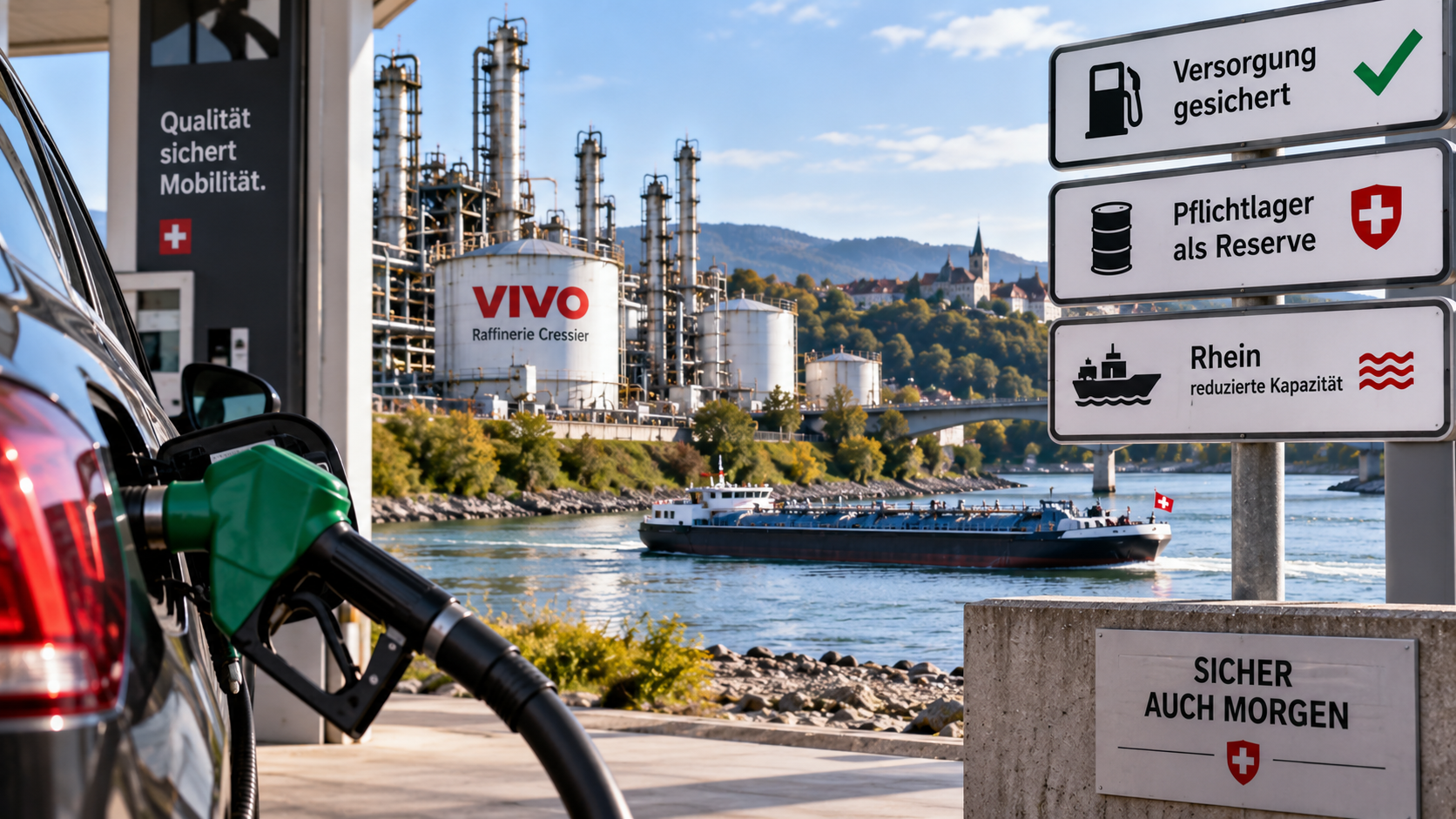
Despite this combination of challenges, Switzerland's supply of petrol, diesel, and other mineral oil products is currently secured, according to WEKO's assessment.
Crucially, Switzerland is not solely dependent on Cressier's production or the Rhine. Mineral oil products can also be imported via other transport routes. At the same time, companies hold their own stocks, and compulsory reserves are available for severe shortages.
The National Economic Supply monitors developments in conjunction with the industry. Should temporary bottlenecks emerge, compulsory reserve stocks could be released, bringing additional quantities to the market.
However, such a release is not currently necessary.
Compulsory Reserves Theoretically Sufficient for About 4.5 Months
For petrol and diesel, compulsory reserves generally correspond to approximately four and a half months of average Swiss demand each.
However, this figure should not be understood as an exact forecast. The duration of compulsory reserves is a theoretical calculation. It is based on the assumption that no further imports would be possible, and consumption would remain at current levels.
In an actual supply crisis, these conditions are unlikely to remain unchanged. Even with restricted import options, deliveries can still arrive. Simultaneously, consumption typically decreases when products become scarcer or more expensive.
What Do the 4.5 Months Mean?
This figure describes the theoretical demand coverage of compulsory reserves for petrol and diesel. It does not mean that Switzerland would run out of fuel after exactly four and a half months.
No Compulsory Reserve Release Yet
Despite the tense situation, there is currently no decision to release petrol or diesel compulsory reserves.
The system is deliberately structured so that the economy initially ensures supply. Only when a severe shortage appears imminent can the National Economic Supply intervene with additional measures.
A release of compulsory reserves would not mean the state distributes fuel to the population at a fixed price. The goods enter the market through usual channels and are generally offered at prevailing market prices.
Current Situation Recalls 2015
The combination of a refinery outage and restricted transport options via the Rhine is not entirely new.
Already in autumn 2015, Switzerland experienced a mineral oil shortage. At that time, Cressier was out of operation for several weeks due to a technical defect. Concurrently, the Rhine experienced low water levels due to an extended dry period, which meant ships could only carry reduced cargo.
The situation was so tense then that the Federal Government temporarily released compulsory reserves. Additionally, alternative transport options were organized, including extra deliveries by rail.
The historical comparison thus shows why current developments are being closely watched: The outage of Cressier alone is not decisive. The situation becomes more critical when possibilities for substitute imports are simultaneously restricted.
Duration of Cressier Shutdown is Crucial
Therefore, two factors are key for future developments: How quickly can the refinery resume production—and how will the Rhine's water level evolve?
A short production interruption is much easier to manage with additional imports and existing stocks than a prolonged outage. Simultaneously, an improvement in the Rhine situation could facilitate the procurement of extra quantities.
Conversely, a longer shutdown of Cressier combined with persistently low water levels would increase pressure on supply. In this scenario, compulsory reserves could play an important role.
What Does This Mean for Motorists?
For motorists, there is currently no reason to anticipate an immediate fuel shortage. Authorities continue to assess the supply as secure.
However, it is crucial that the situation is continuously monitored. The duration of compulsory reserves is a safety mechanism in case market supply actually deteriorates.
Whether and when such a measure becomes necessary depends particularly on the duration of the refinery outage, import possibilities, and further developments of the Rhine's water level.
The Real Test Comes with a Prolonged Outage
The situation is currently under control. However, the combination of the production outage in Cressier and restricted Rhine transport demonstrates how heavily Switzerland's mineral oil supply relies on functioning international supply chains.
Existing compulsory reserves significantly reduce this risk. However, they are not intended to permanently replace a normal market. Their purpose is to bridge a severe or temporary shortage until regular supply stabilizes again.
Thus, the current message is not that Switzerland is running out of fuel. Rather, it is: Supply remains secure despite two concurrent challenges – but developments must be closely monitored.
Conclusion: No Shortage Yet – But a Warning Signal
The shutdown of the Cressier refinery comes at an inconvenient time. The facility covers over 30 percent of Switzerland's demand for mineral oil products, while low water levels on the Rhine simultaneously complicate the import of additional quantities.
Nevertheless, supply remains secure according to current official assessments. Switzerland possesses alternative import routes, company stocks, and, as a crucial last reserve, compulsory stocks.
These reserves do not need to be tapped into currently. However, should Cressier remain offline longer and the Rhine continue to be only partially navigable, the situation could change.
There is no reason for a rush to petrol stations yet. But the Cressier case shows how quickly multiple disruptions can become relevant simultaneously – and why Swiss compulsory reserves are part of national supply security.
Sources
- Competition Commission (WEKO): 'Switzerland's supply of mineral oil products is currently secured', September 4, 2026.
- Federal Office for National Economic Supply (BWL): Current supply situation and information on mineral oil products and compulsory reserves.
- Federal Office for National Economic Supply (BWL): Deployment example 'Cressier 2015'.