Nvidia Acquires Hugging Face for $12.9 Billion – What's Behind It?
Nvidia Boosts Open AI Influence with Hugging Face Acquisition.
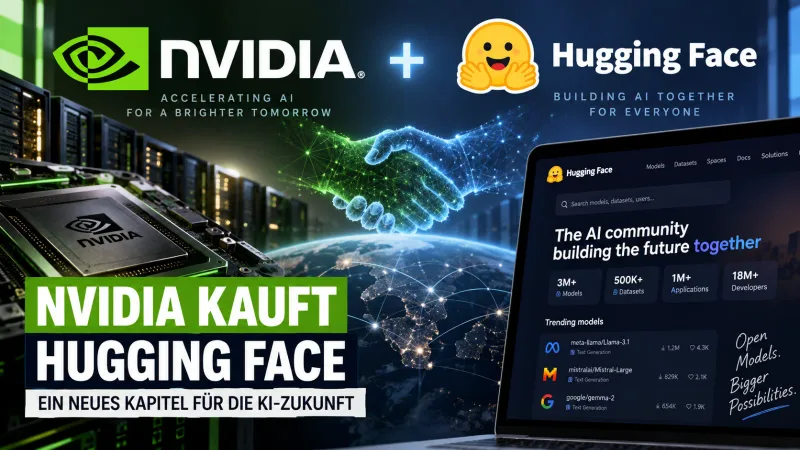
Santa Clara – Nvidia is digging deep into its coffers: The US corporation is acquiring AI platform Hugging Face for 12.93 billion US dollars. This marks one of the largest acquisitions in the chipmaker's history and a clear signal of Nvidia's evolving AI strategy.
Nvidia is not simply buying a company that develops AI software. The corporation gains access to one of the most significant platforms for the global developer community focused on open AI models. The acquisition is expected to close in the first half of 2027, subject to necessary regulatory approvals.
What is Hugging Face?
Hugging Face is a platform where developers, researchers, and companies can share, test, and develop AI models, datasets, and applications. The so-called Model Hub is particularly important.
According to Nvidia, over 18 million developers, researchers, and creatives use the platform. It hosts more than three million models, approximately 500,000 datasets, and about one million applications. Over 200,000 companies utilize Hugging Face to discover, adapt, and deploy AI models.
Thus, for AI development, Hugging Face is akin to what major developer platforms are for other areas of the software world: a place where knowledge, tools, and projects converge.
Nvidia Aims Beyond Chips
The deal aligns with a fundamental development at Nvidia. The company is primarily known for its powerful chips and accelerators used in AI data centers. However, as artificial intelligence gains importance, the focus extends beyond just hardware.
Crucial elements also include the models running on this hardware, the underlying software, and the developers creating new applications from it.
With Hugging Face, Nvidia can therefore expand its position in the AI ecosystem: from computing power to models, software, and developers.
This is precisely where the strategic significance of the acquisition lies. Nvidia is not just buying current revenue; it is acquiring a platform where some of tomorrow's AI applications will be developed.
Is This Against OpenAI?
This does not create direct competition with OpenAI or Anthropic. Companies like OpenAI and Anthropic develop their own, predominantly proprietary AI models and operate large infrastructures.
Hugging Face, however, pursues a different approach. The platform is strongly associated with open and so-called open-weight models. Model weights can be publicly accessible, downloaded, adapted, and operated by developers themselves. However, the specific rights depend on the respective license.
This particular area is gaining importance. Companies do not necessarily need to develop every AI model themselves or rely entirely on closed systems. Open models can be adapted and run on their own infrastructure.
This is interesting for Nvidia because it creates a growing market for AI computing power. The more companies deploy open models, the more computing power will be required.
The Delicate Question of Independence
The acquisition, however, raises an obvious question: Can Hugging Face truly remain independent if the platform belongs to one of the world's leading providers of AI chips?
Nvidia promises exactly that. According to the corporation, Hugging Face will remain open. Developers should continue to decide for themselves which models, frameworks, cloud and inference providers, and computing platforms they use.
Nvidia explicitly states that Nvidia hardware should not be a prerequisite for developing or deploying models via Hugging Face.
This is crucial for the developer community. Hugging Face's appeal stems precisely from bringing together diverse models and technologies. If the platform were to prioritize Nvidia technology in the future, trust in its neutrality could suffer.
China Also Plays a Role
The platform also holds geopolitical significance. Nvidia itself points out that some of the world's successful open AI models originate from China and are downloaded, adapted, and tested by developers in the US and other countries.
Hugging Face thus becomes an important arena for global AI competition. The platform connects models from different countries with developers and companies worldwide.
For Nvidia, this is both an opportunity and a risk: New regulatory requirements could restrict the handling of certain models or datasets, thereby also impacting the platform.
Why is Nvidia Paying Almost $13 Billion?
The purchase price indicates the strategic value Nvidia places on Hugging Face. Approximately 11.9 billion dollars are slated to go to existing shareholders. Additionally, a stock-based program of up to around one billion dollars is planned to retain employees.
This sum is notable because Nvidia is primarily buying access to an ecosystem, not just a traditional software business.
The long-term rationale is this: As AI increasingly becomes characterized by open models, specialized applications, and so-called AI agents, Nvidia aims to remain as close as possible to this development.
Nvidia Secures Multiple Options
The corporation does not need to know which AI model will ultimately prevail. This makes the acquisition strategically interesting.
Whether OpenAI, Anthropic, Google, Meta, or open model developers – all require computing power. With Hugging Face, Nvidia is additionally attempting to establish a position where developers select, modify, and deploy models.
The company thus becomes less dependent on which individual AI platform ultimately wins. Simultaneously, Nvidia can benefit from the growth of various model types.
What Does the Deal Mean for the AI World?
The acquisition shows that the competition for artificial intelligence is no longer just between individual chatbots.
It concerns the entire chain: chips, data centers, software, models, developers, and applications.
Nvidia is already a dominant force in hardware. With Hugging Face, the corporation now seeks to extend its position to another part of this chain.
Whether this strategy pays off will only become clear in the long term. However, it is certain: With the 12.93-billion-dollar deal, Nvidia sends a clear signal for open AI – and for its claim to play a central role in the next stage of artificial intelligence development.
Conclusion
Nvidia is not simply buying Hugging Face for a well-known AI platform. The corporation is acquiring access to millions of developers, millions of models, and an ecosystem that could become increasingly vital for the future development of artificial intelligence.
Therefore, the deal is not a classic attack on OpenAI or Anthropic. It is rather a bet that open AI systems will also have a significant future alongside closed top models.
The decisive question now is: Will Hugging Face truly remain an open platform – or will it eventually become a strategic instrument of the Nvidia ecosystem?
Sources
- Reuters – Report on Nvidia's acquisition of Hugging Face
- Nvidia – Official announcement of the planned acquisition
- US Securities and Exchange Commission (SEC) – Nvidia Form 8-K