Iran War Intensifies Saudi-UAE Rivalry
Iran War Escalates Gulf Rivalry, Affecting Region and Switzerland.
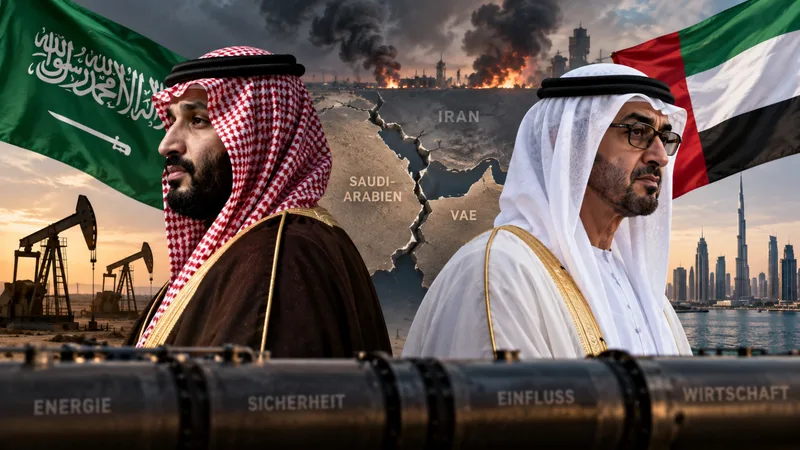
Saudi Arabia and the United Arab Emirates are major powers in the Gulf. Both are affected by the Iran war. Both fear further regional destabilization and seek to protect their economic interests.
A shared threat should ideally unite the two states more closely. However, the situation is more complex. A recent Deutsche Welle report describes growing rivalry between Riyadh and Abu Dhabi. The Iran war did not cause these tensions, but it makes the differing interests of the two Gulf powers more apparent.
Rivalry Began Before Iran War
Saudi Arabia and the UAE remain partners and members of the Gulf Cooperation Council. However, they no longer pursue the same line on all issues.
This is particularly evident in Yemen. Saudi Arabia generally advocates for a unified state, while the UAE has previously supported forces seeking greater autonomy or secession for the South. Both countries also pursue differing interests in Sudan. Saudi Arabia supports the national armed forces, while the UAE stands accused of backing the paramilitary Rapid Support Forces. Abu Dhabi denies these allegations.
Additionally, competition for economic influence exists. Both states aim to diversify their economies away from oil and become hubs for technology, financial services, logistics, and investment.
UAE's OPEC Withdrawal Was a Warning Sign
The UAE's growing independence became particularly clear in spring 2026. Abu Dhabi announced its withdrawal from OPEC and OPEC+, ending almost six decades of membership.
The decision was based on its own economic interests and expanded long-term production capacities. Saudi Arabia, in contrast, is by far the most important producer within OPEC and has traditionally relied more on collective control of oil supply.
This step also occurred amidst the Iran war. The UAE experienced attacks and viewed its economic and security situation as immediately threatened. Experts believe the war was not the sole cause for the OPEC withdrawal, but it acted as a catalyst for a decision already prepared beforehand.
Riyadh Favors Restraint, Abu Dhabi Seeks Autonomy
Differences also emerge in security policy.
Despite attacks from Iran and Iran-aligned groups, Saudi Arabia seeks to avoid a direct escalation of the war where possible. Riyadh primarily relies on diplomacy and new regional security cooperation, alongside limited military responses.
The UAE, however, has pursued its own strategic path. Abu Dhabi maintains close ties with the USA and Israel but simultaneously aims to preserve its economic and political flexibility regarding other major powers.
This pits two similar, yet increasingly assertive, models against each other: Saudi Arabia seeks to expand its position as the leading power in the Arab world. The UAE aims to secure its own role as the region's economic and logistical hub.
Why This Matters for the Global Economy
The rivalry is not merely a political matter. Both countries are among the most important economic and energy nations in the region.
Saudi Arabia and the UAE are deeply interconnected. Simultaneously, they compete for companies, investments, logistics, tourism, financial services, and new technologies. A permanent economic rupture would therefore be costly for both sides. Experts currently deem a complete economic decoupling unlikely.
However, the Iran war increases pressure. Attacks on energy facilities and restrictions on shipping traffic through the Strait of Hormuz demonstrate the vulnerability of the Gulf economy. Saudi Arabia is therefore examining additional capacities for its pipeline to the Red Sea, for instance, to partially reroute oil past the Strait of Hormuz.
Thus, the rivalry also becomes a matter of global energy supply.
What Does This Mean for Switzerland?
For Switzerland, this development is not merely a geopolitical observation.
With a trade volume of 49 billion Swiss francs in 2025, the UAE is Switzerland's most important trading partner in the Near and Middle East. Swiss companies export precious metals, watches and jewelry, as well as chemical and pharmaceutical products to the Emirates, among other goods.
Saudi Arabia follows with a trade volume of 6.5 billion Swiss francs as Switzerland's second most important trading partner in the region. Swiss exports include precious metals, pharmaceutical and chemical products, watches, jewelry, machinery, and electronics.
The economic significance is therefore substantial. Simultaneously, Switzerland conducts economic and export promotion in both countries. The Swiss Business Hub Middle East maintains offices in Dubai, Riyadh, and Doha.
For Swiss companies, increasing rivalry could therefore create both risks and opportunities. Different trade, investment, and economic policies might alter market access. Simultaneously, the two states compete for international companies and investments, which can create new business opportunities.
Iran War Shifts the Balance
The crucial point is not that the Iran war suddenly turned Saudi Arabia and the UAE into adversaries. The rivalry already existed.
Instead, the war changes the conditions under which both states pursue their interests. Energy supply, security, trade routes, and relations with the USA suddenly become more urgent. Simultaneously, both must secure their economies against the conflict's consequences.
The war can thus amplify a competition that had already begun.
No Split – But More Competition
An open division between Saudi Arabia and the UAE cannot currently be discussed. Both remain economically closely intertwined and share a common interest in not further destabilizing the Gulf.
However, the direction is discernible: Riyadh and Abu Dhabi coordinate where their interests align – and compete where their national goals diverge.
The Iran war exacerbates this divergence. The UAE's OPEC withdrawal, differing positions on regional conflicts, and competition for international investments indicate that the former close partnership is increasingly becoming a strategic rivalry.
Economic Stability Matters for Switzerland
For Bern, it is therefore less crucial which of the two Gulf states politically prevails. What is decisive is that the region's economic and security ties remain stable.
Switzerland has close economic relations with both countries. Further escalation between Riyadh and Abu Dhabi could therefore indirectly affect Swiss companies – via energy prices, trade routes, investments, or regional supply chains.
Such a development is not yet foreseeable. The rivalry remains, for now, a competition within a closely intertwined Gulf region.
However, the Iran war shows how quickly interests can shift. Two close partners do not automatically become adversaries. But they can become competitors – and precisely this development is likely to become more important for the region and for Switzerland.
Sources
- Deutsche Welle: "The Increasing Rivalry Between Saudi Arabia and the UAE", September 6, 2026
- EDA: Bilateral Relations Switzerland–United Arab Emirates, August 28, 2026
- EDA: Bilateral Relations Switzerland–Saudi Arabia, August 28, 2026
- House of Commons Library: "The UAE exits OPEC and Saudi-UAE tensions in 2026", May 28, 2026
- Reuters: Analysis on the UAE's OPEC Withdrawal and Relations with Saudi Arabia, April 29, 2026
- Reuters: Saudi Arabia's Security Strategy in the Iran War, August 12, 2026