Record Gas Prices in US: Fueling Up Also Significantly More Expensive in Switzerland
US gasoline hits record prices; fueling up in Switzerland has also become significantly more expensive.
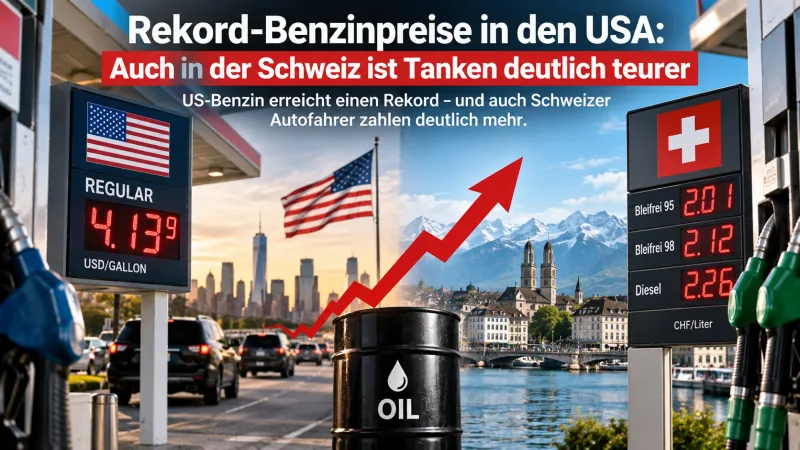
For American motorists, the 2026 Labor Day weekend will be the most expensive ever. According to price tracker GasBuddy, the national average gasoline price is expected to be around 4.03 dollars per gallon. This would surpass the previous Labor Day record of 3.83 dollars from 2012.
As of Thursday, September 3, the average tracked by GasBuddy was approximately 4.13 dollars per gallon. This meant US gasoline prices once again significantly exceeded the four-dollar mark.
However, the record is not an isolated US phenomenon. International energy markets are also under pressure. For Swiss motorists, a different question arises: What does the current development mean for prices at Swiss gas stations?
US Gasoline Reaches Record High on Labor Day
The previous record for the Labor Day weekend was set in 2012. At that time, the national average was approximately 3.83 dollars per gallon.
According to GasBuddy, the four-dollar mark could be surpassed for the first time on this holiday in 2026. GasBuddy analyst Patrick De Haan described the current development as exceptional: while not an all-time historical record, the price is the highest ever for this time of year.
Several factors contribute to the high prices simultaneously. Crude oil prices have risen significantly, refineries operate at high capacity, and gasoline inventories have decreased. Concurrently, the US exports large quantities of refined products to a tight global market.
Crude Oil, Refineries, and a Tense Global Market
The most important common factor for fuel markets is the price of crude oil. Brent recently exceeded 90 dollars per barrel. This development is influenced by geopolitical tensions in the Middle East and uncertainties regarding key transport routes, among other factors.
At the same time, US refineries are operating at a very high level. Capacity utilization recently reached approximately 98 percent, the highest since 2018.
Nevertheless, American gasoline inventories decreased by approximately 1.2 million barrels in the reporting week. Inventory levels were thus below the five-year average.
Exports also play a role. The US supplies large quantities of refined products abroad. If international demand increases, American refineries can adjust their production and exports accordingly. This, in turn, influences the available quantity and prices in various markets.
Fueling Up Has Also Become Significantly More Expensive in Switzerland
For Swiss motorists, the crucial point is not the US record itself, but the development of domestic prices.
According to current average values from the Touring Club Switzerland (TCS), one liter of unleaded 95 cost an average of 2.01 Swiss francs on September 3, 2026. At the beginning of January, it was 1.65 Swiss francs.
Thus, unleaded 95 has become approximately 22 percent more expensive since the start of the year.
The development for diesel is even more pronounced. The average price rose from 1.78 Swiss francs at the beginning of January to its current 2.26 Swiss francs per liter. This corresponds to an increase of approximately 27 percent.
[[media:c1fbba57-e6fe-43a6-a2f0-71a0580db2b5]] Fuel Type 01.01.2026 03.09.2026 Change Unleaded 95 CHF 1.65 CHF 2.01 +22 % Unleaded 98 CHF 1.75 CHF 2.12 +21 % Diesel CHF 1.78 CHF 2.26 +27 %
Average Swiss fuel prices according to TCS. Values refer to January 1 and September 3, 2026.
Why the US Record Cannot Be Simply Transferred to Switzerland
The fact that gasoline is currently particularly expensive in the US does not automatically mean that Swiss gas station prices will rise to the same extent.
The two markets operate differently. In Switzerland, according to TCS, prices depend particularly on product prices at the Rotterdam stock exchange, global oil prices, the US dollar exchange rate, refinery costs, and freight rates for Rhine shipping.
Therefore, the American gas station price itself is not the decisive factor. Rather, the international prices for crude oil and refined petroleum products are relevant.
A high US gasoline price can thus be a sign of a strained international energy market, but it is not a direct price indicator for Swiss gas stations.
The Rhine Becomes a Crucial Factor for Switzerland
Besides oil prices, logistics also play a significant role for Switzerland.
A large portion of imported petroleum products enters the country via the Rhine. During low water levels, tanker ships can carry less fuel. This necessitates more trips for the same transport volume.
This increases transportation costs and can impact prices.
This exact situation currently exists. The TCS identifies the Rhine's water level as one of the factors influencing Swiss fuel prices.
Additional Pressure from Cressier Shutdown
Concurrently, a specifically Swiss factor emerges: the Cressier refinery in the canton of Neuchâtel had to temporarily halt its production at the beginning of September due to a technical defect.
According to authorities, the refinery covers slightly more than 30 percent of Switzerland's petroleum product demand. This outage impacts a supply situation already tense due to low Rhine water levels.
However, authorities have given the all-clear for supply. According to the National Economic Supply, the supply of gasoline, diesel, and other petroleum products is currently secured.
Should temporary bottlenecks occur, Switzerland's mandatory reserves could be utilized. The mandatory reserves for gasoline and diesel generally correspond to an average demand of approximately four and a half months each.
No Current Supply Shortage
The shutdown of Cressier does not mean Switzerland is running out of fuel. Authorities are monitoring the situation alongside the industry. Mandatory reserves can bridge temporary supply gaps if needed.
What Does This Mean for Swiss Gas Stations?
The current development shows: Swiss motorists are already paying significantly more than at the beginning of the year. At the same time, it cannot be inferred that prices will automatically continue to rise due to the US record.
Crucial will be how international crude oil prices, prices for refined products in Europe, refinery availability, and transportation options develop.
Additionally, the exchange rate and the situation on the Rhine play a role. The temporary shutdown of Cressier can also affect Swiss market supply as long as the refinery remains offline.
The current situation should therefore be understood as a combination of several price drivers rather than a direct consequence of high US gasoline prices.
Why Diesel Prices Have Risen More Than Gasoline
The trend for diesel is particularly striking. While unleaded 95 has become about 22 percent more expensive since the start of the year, the increase for diesel is approximately 27 percent.
This is also related to the fact that diesel and other middle distillates like heating oil have their own international market. Refineries must divide their production among various products, while demand and availability can vary regionally.
Internationally, the diesel market is also currently under pressure. Reuters recently reported new record prices for diesel and heating oil in the US. Attacks on Russian refineries have further strained the supply of certain refined products.
The US Gasoline Price Is Therefore Primarily a Warning Signal
For Swiss motorists, the Labor Day record is less relevant because of the specific figure of 4.03 dollars per gallon. More important is what lies behind this price.
High crude oil prices, geopolitical risks, limited refinery capacities, scarce product inventories, and rising transport costs can reinforce each other.
Precisely such factors also affect the European and thus indirectly the Swiss market.
At the same time, Switzerland possesses its own buffers: it can import fuel, has mandatory reserves, and is not solely dependent on the production of the Cressier refinery.
What Motorists Need to Know Now
An immediate fuel shortage is not currently apparent. Swiss authorities continue to describe the supply as secured.
Regarding prices, the situation is already noticeable: unleaded 95 averages over two Swiss francs per liter, diesel 2.26 Swiss francs.
Whether prices will continue to rise, fall again, or remain at current levels largely depends on international developments. Particularly important factors include crude oil prices, refinery availability, European product prices, and transport routes.
A direct transfer of the US record to Switzerland would therefore be incorrect. However, current gas station prices clearly show that international price pressure has already reached Switzerland.
Conclusion: US Record and Swiss Price Increase Share Common Causes
The US is experiencing a record gasoline price on Labor Day 2026. Approximately 4.03 dollars per gallon would be the highest average for this holiday since records began. Concurrently, Swiss fuel prices have also risen significantly since the start of the year.
However, Switzerland is not simply at the mercy of American gasoline prices. International crude oil and product markets, the dollar-Swiss franc exchange rate, refineries, and logistics are decisive.
In Switzerland, additional factors are currently at play: low water levels on the Rhine complicate the import of petroleum products, while the Cressier refinery is temporarily out of operation.
Nevertheless, supply remains secured according to authorities. Mandatory reserves offer an additional buffer.
For Swiss motorists, the most important message is therefore twofold: a fuel shortage is not currently imminent, but the price burden is already significantly higher than at the start of the year.
Sources
- Reuters: Development of US gasoline prices for Labor Day 2026 and international oil market trends.
- Touring Club Switzerland (TCS): Current Swiss gasoline and diesel prices and price development in 2026.
- Competition Commission / National Economic Supply: Current supply situation for petroleum products and the shutdown of the Cressier refinery.