Czechia Rearms Against Russia – What Does This Mean for Switzerland?
Czechia Plans for Potential Escalation – What Does This Mean for Neutral Switzerland?
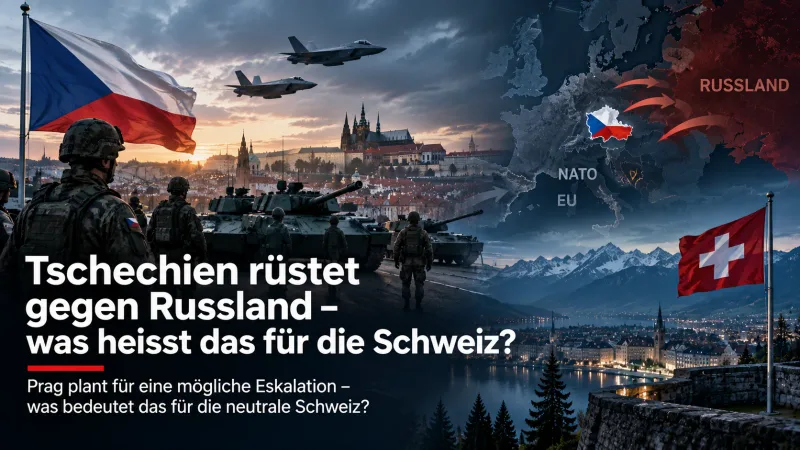
While the USA is currently trying again to initiate talks about ending the Ukraine war, Czechia is simultaneously preparing for a potential failure of diplomacy. A new long-term defense paper from the Czech Ministry of Defense describes Russia as the greatest threat to the country's security and warns of a worsening European security situation.
The «Long-Term Outlook for Defense 2045» is not a prediction of war by 2045. The year indicates the planning horizon of the document. The paper aims to define which military and civilian capabilities Czechia will need in the coming two decades.
The central message, however, is clear: Prague wants to align its defense capabilities for a possible long-term conflict with a technologically advanced adversary.
For Switzerland, Czech rearmament is less interesting than the underlying question: What does a permanently heightened security situation mean for a neutral state in the middle of Europe?
Prague Sees Russia as Greatest Threat
In its new strategy paper, the Czech Ministry of Defense assumes that the likelihood of complex security crises is increasing. This explicitly includes the possibility of an attack on NATO and EU states without long warning times.
At the same time, the document describes a shift in responsibility for Europe's conventional defense: European NATO states must increasingly take care of their own security in the future.
Czechia is responding with long-term defense planning. The paper was approved by the Czech State Security Council and is to be discussed by the government in autumn. It builds on Czechia's 2023 defense strategy, which had already identified Russia as the gravest threat.
Besides a possible conventional war, the draft also names cyberattacks, disinformation, espionage, sabotage, and economic pressure as security policy risks.
It's About More Than Tanks and Fighter Jets
It is remarkable how broadly Czechia defines the concept of defense capability.
By 2030, a modern system for the population's security preparedness is to be established. By 2032, the expansion of indigenous space reconnaissance capabilities is planned. By 2038, additional reserves of weapons, technology, and military equipment are to be built up.
The armed forces themselves are also to be further modernized. Czechia is committed to purchasing 24 F-35 fighter jets and plans two modernized brigades – a heavy brigade with main battle tanks and a medium brigade with wheeled armored personnel carriers.
Behind this lies a fundamental idea: A modern conflict is not decided by soldiers and weapons alone. Ammunition and spare parts, logistics, industrial production capacities, reconnaissance, communication, cyber defense, and a state's ability to remain functional even under crisis conditions are equally crucial.
2045 Is Not a War Date
The year in the document's name can easily be misunderstood. Czechia is not predicting that a war with Russia will occur by 2045.
2045 is the long-term planning horizon.
Precisely this long-term perspective is crucial for security policy. Military capabilities cannot be built up within a few months. Fighter jets, air defense, ammunition, vehicles, communication systems, and military infrastructure require years for planning, procurement, training, and establishment.
Czechia is therefore trying not to react to a specific war date, but to orient its capabilities so that it remains capable of action even in the event of an unexpected deterioration of the situation.
Trump Assesses the Danger Differently
The Czech assessment stands in remarkable contrast to statements by US President Donald Trump.
Trump recently stated that he does not expect Vladimir Putin to attack NATO territory. He referred to his direct contacts with the Russian president.
Thus, two different risk assessments clash: Washington's president currently sees no reason to assume a planned Russian attack on NATO territory. Prague, on the other hand, explicitly plans its defense for a scenario where the European security situation escalates further.
This does not have to be a contradiction. A state can consider an attack not to be imminent and still take precautions for a possible long-term risk.
The Threat Does Not Begin Only With War
For Czechia, the security policy challenge is not limited to a classic military attack anyway.
Cyberattacks, espionage, disinformation, and sabotage can already occur in peacetime. Precisely these so-called hybrid threats make the line between peace and open conflict less clear.
A current example comes from Germany. On August 4, 2026, an explosive-laden drone was discovered at Leipzig/Halle Airport. According to its own statements, the German government concluded, based on police investigations, crime patterns, and intelligence findings, that Russia was responsible for the attempted hybrid attack. Russia denies the allegations.
The case shows why European states now understand their security planning more broadly. Critical infrastructure, airports, energy supply, communication networks, and authorities can become targets of attacks without a classic war being declared.
What Does This Mean for Switzerland?
Switzerland is not a NATO member. It is militarily neutral and therefore cannot count on an automatic mutual assistance obligation from an alliance.
However, this does not mean it would be isolated in terms of security policy. Switzerland cooperates with European states and NATO, among others, within the framework of the Partnership for Peace. For the years 2025 to 2028, the cooperation goals with NATO were further expanded – including interoperability, space, resilience, and communication.
At the same time, the Swiss Security Policy Strategy 2026 states that the security policy environment has significantly deteriorated. It names military risks as well as cyberattacks, disinformation, espionage, and sabotage as threats that can affect Switzerland.
Switzerland pursues a comprehensive security approach: In addition to the army, civilian authorities, cantons, critical infrastructures, and international cooperation are part of security preparedness.
The Swiss Question Is Not Just: How Many Soldiers?
The discussion about Czechia's rearmament could therefore fall short if it is transferred solely to the size of the army in Switzerland.
For a neutral state, several questions arise simultaneously: Can Switzerland adequately protect its airspace? Does it have sufficient means for ground defense? Are ammunition and material reserves sufficient? How resilient are power supply, communication, and other critical infrastructures?
And how quickly could Switzerland expand its capabilities in the event of a sudden deterioration of the situation?
This is precisely one of the biggest challenges of long-term security policy. An army cannot be adapted to a new threat situation in the short term.
Switzerland Has Already Reacted
Switzerland has already adjusted its security planning in recent years. The VBS refers to a series of foundational works on air defense, ground troops, cyberspace, and the future orientation of the army.
Armament policy has also been reoriented. The Federal Council wants to preserve the remaining defense-critical industrial base in Switzerland and strengthen the security-relevant technology and industrial base. Research, development, and international armaments cooperation are to be expanded.
The question is therefore less whether Switzerland is reacting to the changed security situation. It already is.
The political debate rather revolves around how far this reaction should go – and how much it should cost.
The Population Is Also Rethinking Security
The «Security 2026» study by the Military Academy at ETH Zurich and the Center for Security Studies shows how much perception has changed.
83 percent of respondents consider the Swiss army absolutely or rather necessary. At the same time, 86 percent rate the global political situation as pessimistic or very pessimistic.
The question of international cooperation is also changing: 56 percent advocate for closer ties with NATO. At the same time, approval for neutrality remains high at 85 percent.
This is precisely where the Swiss dilemma lies. The population holds onto neutrality but simultaneously sees a growing need for international security policy cooperation.
Neutrality Does Not Mean Security Policy Isolation
Swiss neutrality does not fundamentally exclude international cooperation. The Confederation explicitly states that a neutral state can participate in international military exercises outside a wartime context. Cooperation with other states for the defense of Switzerland would also be possible in the event of an armed attack.
The crucial question is therefore what capabilities Switzerland must provide itself and what it can build together with partners.
Precisely this balance is likely to become more important in the coming years: independent defense capability on the one hand, international cooperation on the other.
What Czechia Truly Shows Switzerland
The Czech defense plan is therefore not a model that Switzerland could simply adopt. Czechia is a NATO member and can align its defense planning with the collective security of the alliance. Switzerland, on the other hand, pursues a neutral security policy course.
Nevertheless, the strategic lesson is comparable: Defense capability does not arise only when a crisis begins.
Those who want to prepare for a possible conflict must invest in personnel, material, infrastructure, industry, training, and resilience long beforehand.
This also applies to threats below the threshold of open warfare. Cyberattacks, sabotage, and disinformation require different capabilities than a classic military attack – but they also cannot be conjured up only in an emergency.
Europe Negotiates – And Rearms Simultaneously
Especially in conjunction with current diplomatic efforts regarding the Ukraine war, the Czech strategy becomes interesting.
The fact that the USA is again talking with Moscow and Kyiv about a possible end to the war does not automatically mean that Europe can scale back its long-term defense plans.
Conversely, increased defense planning does not mean that war is considered inevitable.
Diplomacy and deterrence pursue different goals – and can simultaneously be part of the same security policy.
This is exactly what Czechia is currently demonstrating. Prague is preparing for a potential emergency without treating war as a fixed future.
The Real Question for Switzerland
For Switzerland, the crucial question is therefore not whether it should copy Czechia's defense model.
Rather, it is: How much self-resilience does a neutral state need when Europe's security order changes permanently?
The answer does not only concern the army. It ranges from air defense and ammunition reserves to cyber defense, critical infrastructure, and international cooperation.
Czechia has extended its planning horizon to two decades. Switzerland faces a similar strategic task – albeit under completely different political and legal conditions.
The central lesson from Prague is therefore not that war is imminent. It is that defense capability takes years – and that states must establish their security preparedness before a crisis forces them to.
At a Glance
- Russia: Czechia designates Russia as the greatest threat in its new long-term defense outlook.
- 2045: The year indicates the document's planning horizon, not an anticipated war date.
- 2030: Czechia aims to create a modern system for civilian security preparedness.
- 2032: The expansion of indigenous space reconnaissance capabilities is planned.
- 2038: Additional reserves of weapons, technology, and military equipment are to be built up.
- Air Force: Czechia is committed to purchasing 24 F-35 fighter jets.
- Switzerland: The Security Policy Strategy 2026 foresees a deteriorating security situation and increasing hybrid threats.
- NATO: Switzerland remains neutral but further expands its security policy cooperation with NATO.
Sources
Czech Ministry of Defense / iROZHLAS.cz: «Dlouhodobý výhled pro obranu 2045».
Swiss State Secretariat for Security Policy (SEPOS): Security Policy Strategy 2026.
VBS: «Security 2026» Study.
VBS: Switzerland-NATO Cooperation 2025–2028.
German Federal Government: Reaction to the attempted hybrid attack at Leipzig/Halle Airport.
VBS: Federal Council's Armament Policy Strategy.