Industrial Exodus: Is Switzerland Losing Its Production?
Companies relocate production abroad – Wars increase location pressure.
Is industry leaving Switzerland? There is no complete statistic for this. The federal government and authorities do not maintain a public time series that records all production relocations, company departures, and the resulting job losses.
However, concrete cases exist. A key KOF survey shows: Swiss companies are increasingly planning production investments abroad. This shifts the question. Not only: Which companies are leaving Switzerland? But also: Where will the next production facility be built?
More Production Planned Abroad
In a KOF investment survey, 13 percent of companies stated they planned direct investments abroad. A year prior, this figure was 4 percent. Approximately three-quarters of these planned foreign investments were intended for production activities.
This does not automatically mean departure. A company can build a new factory in Germany or Italy while retaining its Swiss site. However, it shows that the international distribution of production is becoming more important for Swiss companies.
For individual companies, this is already becoming a reality. Shoe manufacturer Kybun is relocating part of its production from Sennwald to Italy. Findus is closing its production in Rorschach, affecting 45 full-time positions, and moving it to Italy and Spain.
The reasons vary. In these two cases, no link to the Iran or Ukraine war is proven. Production costs, productivity, regulation, or strategic corporate decisions also play a role.
The Ukraine War Increased Pressure
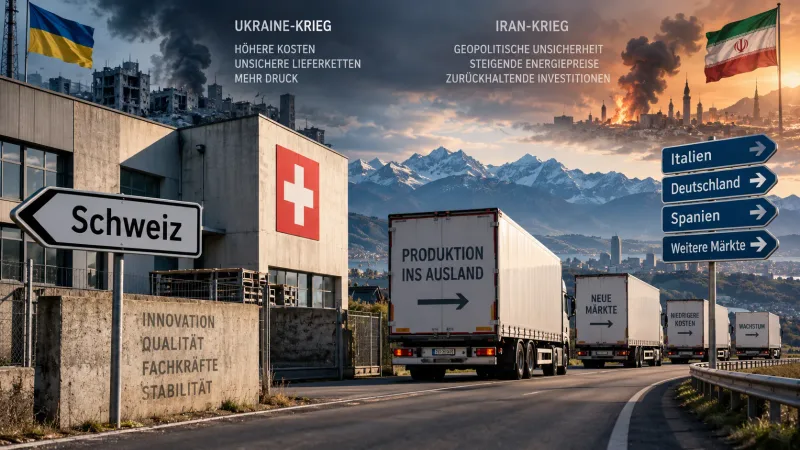
Since the Russian attack on Ukraine in 2022, conditions for Swiss industry have tightened: energy and raw material prices rose, supply chains became more uncertain, and the strong franc burdened export-oriented companies.
Swissmem already warned in 2022 about impacts on investment goods demand and higher energy and raw material costs. However, a figure on how many Swiss companies actually relocated their production abroad due to this cannot be derived.
The war was thus an additional burden factor – not demonstrably the trigger of a specific wave of departure.
The Iran War Adds to Pressure in 2026
The economic effect of the Iran War can now be measured more precisely. KOF compared investment plans of companies surveyed before and after the attack of February 28, 2026.
Before the attack, approximately 25 percent of companies intended to reduce their equipment investments compared to earlier plans. Afterwards, this rose to about 30 percent. A dampening effect was also evident for construction and research investments.
The Iran War has therefore demonstrably made investment decisions more cautious. Higher energy prices, transport costs, and geopolitical uncertainty are additional factors.
However, one cannot yet speak of a wave of departure triggered by this. Simultaneously, Swiss companies expect an overall increase in their investments of 10.2 percent for 2026. The manufacturing sector also anticipates higher investments again after a decline in the previous year.
Switzerland Is Not Simply Losing Its Industry
The picture is therefore contradictory. Companies are relocating individual production steps abroad and planning to invest there more frequently. At the same time, Switzerland and its industry remain attractive for research, development, high-quality production, and specialized skilled workers.
The decisive danger, therefore, may not lie in a sudden exodus. It lies in the fact that new production capacities are increasingly emerging outside Switzerland.
If existing factories are maintained but new facilities are primarily built abroad, industrial value creation slowly shifts – without a company having to give up its Swiss headquarters each time.
What Do the Two Wars Mean?
The Ukraine War has increased location pressure since 2022 – primarily through energy, raw materials, supply chains, and geopolitical uncertainty. However, a direct acceleration of company departures cannot be quantified.
The Iran War has a similar effect in 2026, but with a measurable additional impact on investments: companies are revising their investment plans downwards and contending with higher energy and transport costs.
Both wars are thus significant burden factors. However, they do not explain every production relocation. Costs, regulation, skilled labor, the franc, and access to international markets also remain crucial.
Conclusion
Switzerland is currently experiencing no proven industrial exodus. Reliable overall figures are lacking. However, there are concrete production relocations and significantly more planned production investments abroad.
The Ukraine War has increased pressure on Switzerland as an industrial hub since 2022. The Iran War exacerbates it in 2026 and measurably slows investment decisions.
The crucial question for Switzerland is therefore not just, how many companies are leaving the country. It is: Where will the next factory be built?
Because if Swiss companies retain their existing sites but increasingly build new production capacities abroad, Switzerland can gradually lose industrial value creation even without a major wave of departure.
Sources
- KOF/ETH Zurich: Investment Development 2026 and Impact of the Iran War
- KOF/ETH Zurich: Foreign Investments by Swiss Companies
- Swissmem: Impact of the Ukraine and Iran Wars on the Swiss Tech Industry
- Company information on Kybun and Findus