Putin Receives Trump Envoys; Switzerland's Role Unclear
Ukraine Mediation Resumes: US Envoys Meet in Moscow
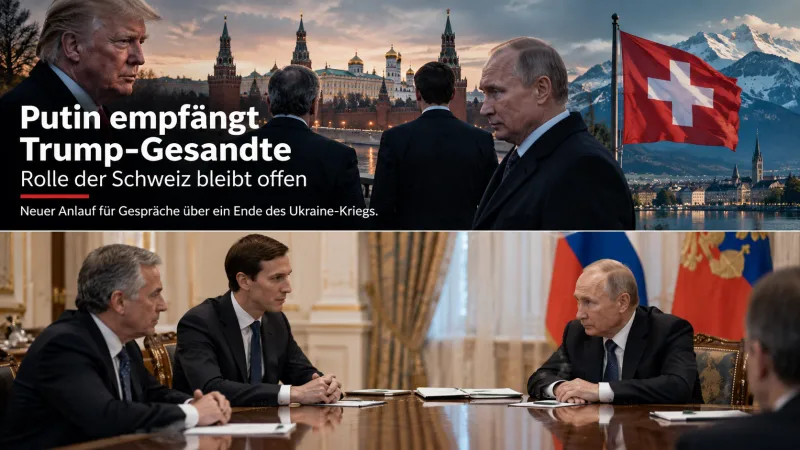
The US is attempting to restart stalled talks aimed at ending Russia's war of aggression against Ukraine. On Saturday, September 5, 2026, US Special Envoy Steve Witkoff and Jared Kushner, son-in-law of US President Donald Trump, met with Russian President Vladimir Putin at the Kremlin.
This encounter is part of a new diplomatic initiative by Washington. According to reports from Kyjiw, Witkoff and Kushner are scheduled to travel to Kyjiw on Sunday, marking their first visit there as part of these current mediation efforts. This would involve both warring parties in direct, successive discussions for the first time.
For Switzerland, another question arises: Does Bern play a role in this new discussion format – or will the next phase of diplomacy initially proceed without Switzerland?
Putin Hosts US Envoys at Kremlin
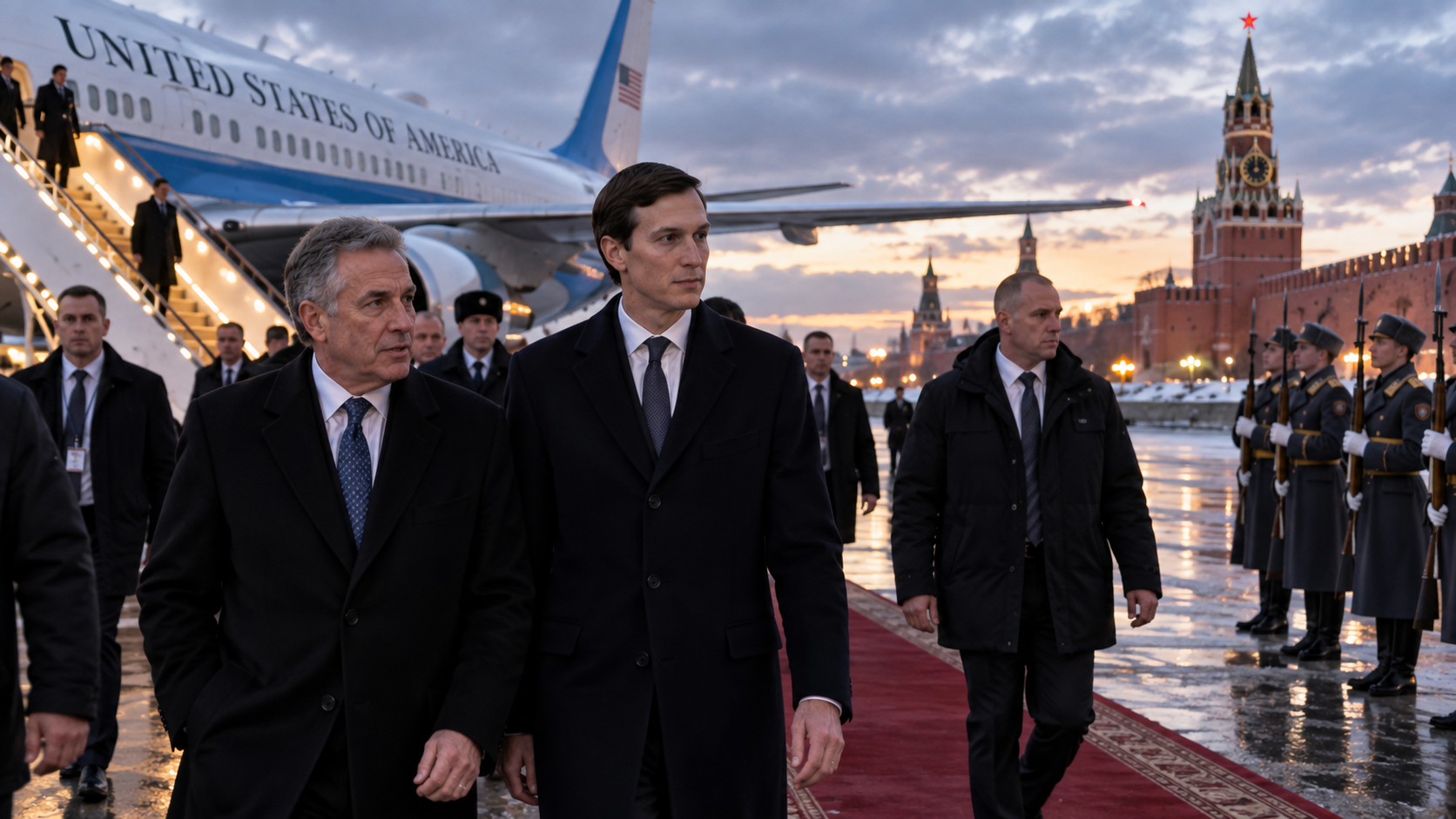
Witkoff and Kushner travelled to Moscow on Saturday and subsequently met Putin at the Kremlin. The two US representatives are reportedly tasked by Trump with exploring new progress towards ending the war.
Before the trip, Trump stated that the US delegation would bring a proposal for ending the war. Details of this proposal have not yet been made public.
Putin described the contacts between Moscow and Washington as useful, stating that cooperation with Witkoff and Kushner was straightforward for Russia. Witkoff conveyed greetings from Trump to the Russian President and thanked him for the promised restraint in attacks during the visit.
72-Hour Pause in Attacks on Kyjiw
The visit is accompanied by a limited military de-escalation. According to the Kremlin, Putin ordered a 72-hour pause in Russian attacks on Kyjiw. The measure is set to begin at midnight and coincide with the planned visit of the US envoys to the Ukrainian capital.
Ukraine also announced it would refrain from attacking Moscow during the American envoys' visit.
Therefore, one cannot speak of a comprehensive ceasefire. The announced pause is time-limited and applies to attacks on the respective capitals. Meanwhile, military clashes continued in other locations.
Important:
The 72-hour pause is not a general ceasefire. It is a limited, time-defined measure related to the visit of the US envoys.
From Moscow to Kyjiw
Particularly noteworthy is the planned second leg of the trip. Witkoff and Kushner are scheduled to travel to Kyjiw on Sunday. For both, it would be their first visit to the Ukrainian capital as part of their current mediation efforts.
This step is politically significant: Washington is thus attempting to maintain direct exchange with both Moscow and Kyjiw simultaneously. However, whether this will lead to concrete negotiations remains uncertain.
The positions of the two warring parties continue to diverge widely. Russia demands, among other things, far-reaching territorial concessions from Ukraine and a waiver of NATO membership. Kyjiw rejects these conditions.
The trip to Moscow and the planned onward journey to Kyjiw are therefore primarily a sign that Washington is intensifying direct diplomatic contact again.
Why Switzerland Becomes Relevant Now
Switzerland is not at the center of this new round of talks. Specific involvement of Bern in the discussions between Putin and the US envoys is not publicly known at this time.
However, this does not mean that Switzerland has disappeared from the diplomatic process.
On the contrary: Switzerland holds the chairmanship of the Organization for Security and Co-operation in Europe (OSCE) in 2026. Bern has explicitly stated for its chairmanship year that it will use its mediation experience for dialogue, trust, and security, and contribute to a just and lasting peace in Ukraine.
This gives Switzerland institutional access that extends beyond its role as host of the Bürgenstock Summit.
Bürgenstock Was a Different Format
In June 2024, Switzerland organized an international peace conference on Ukraine at Bürgenstock. Russia was not represented at that time. The summit primarily aimed to consolidate international support for key principles of a potential peace process.
The ongoing talks follow a different approach. Washington is first speaking directly with Moscow and Kyjiw. A multilateral format like the one at Bürgenstock is not currently the focus.
This is precisely the open question for Bern: Should a broader peace process later emerge from the bilateral contacts between the USA, Russia, and Ukraine, Switzerland could again be sought after as a host or mediator. Whether this will actually happen cannot be confirmed at present.
Switzerland Holds a Diplomatic Advantage
Switzerland can refer to its long-standing experience with so-called Good Offices. These include mediation, providing channels for discussion, and supporting the implementation of international agreements.
In 2026, Bern also did not completely break off dialogue with Russia. In early February, Federal Councillor Ignazio Cassis, as the acting OSCE Chairperson, travelled to Moscow and met with Russian Foreign Minister Sergei Lavrov. During this visit, Switzerland emphasized the OSCE's readiness to support a negotiated solution and its implementation if sustained international engagement becomes necessary.
This gives Bern a diplomatic advantage: Switzerland continues to have channels for discussion and an international platform, without being a party to the war itself.
A Place at the Negotiating Table Is Not Guaranteed
However, neutrality alone does not automatically mean that Switzerland will become part of a future peace process.
Crucially, it depends on whether the conflict parties and the mediating states actually desire an additional actor. If Washington, Moscow, and Kyjiw initially rely on a direct communication channel, Bern might only have a complementary role for now.
This is precisely what makes the current situation politically interesting for Switzerland. On the one hand, it possesses experience, international platforms, and established diplomatic contacts. On the other hand, the initiative currently lies clearly with Washington.
A New Effort – But No Breakthrough Yet
The talks at the Kremlin are therefore not to be equated with a peace agreement. It is still unclear whether Washington, Moscow, and Kyjiw will even move closer on the central points of contention.
The limited pause in attacks should also not be overinterpreted. While it shows that both sides are willing to exercise temporary restraint in connection with the American mediation mission, a robust ceasefire has not yet emerged from it.
At the same time, direct contact between Washington and Moscow is politically significant. After months of little movement, the US government is attempting to revive the diplomatic process.
The Next Test Follows in Kyjiw
The crucial factor will therefore be what happens after the meeting with Putin. If Witkoff and Kushner travel on to Kyjiw as announced, they can directly compare the positions of both sides.
Only then will it be possible to better assess whether the new American initiative can truly lead to a new round of negotiations.
For Switzerland, the situation remains open for now. Bern is not known to be a participant in the current talks in Moscow. At the same time, Switzerland holds a special diplomatic position in 2026: It chairs the OSCE and has explicitly announced its intention to use its mediation experience for a just and lasting peace in Ukraine.
However, whether this results in a seat at the negotiating table is not decided in Bern. First, Washington, Moscow, and Kyjiw must show whether their new communication channel becomes more than a diplomatic attempt.
At a Glance
- September 5, 2026: Steve Witkoff and Jared Kushner meet Vladimir Putin at the Kremlin.
- September 6: An onward journey of the US envoys to Kyjiw is announced.
- 72 Hours: Russia announced a limited pause in attacks on Kyjiw.
- Ukraine: Kyjiw also declared a temporary restraint on attacks on Moscow.
- Switzerland: Involvement in the current US-Russian talks is not yet publicly confirmed.
- OSCE: Switzerland holds the chairmanship in 2026 and aims to use its mediation experience for a just peace in Ukraine.
- Bürgenstock: Switzerland hosted an international peace conference on Ukraine in 2024.
Sources
Reuters, September 5, 2026: Talks between Steve Witkoff and Jared Kushner with Vladimir Putin in Moscow.
Associated Press, September 5, 2026: Kremlin meeting, planned trip to Kyjiw, and limited attack pause.
Swiss Federal Department of Foreign Affairs (FDFA): Swiss OSCE Chairmanship 2026 and priorities for peace and dialogue in Ukraine.
FDFA: Trip by acting OSCE Chairperson Ignazio Cassis to Moscow and Kyjiw in February 2026.
Coverage of the Bürgenstock Summit and Switzerland's mediation role in the Ukraine war.