Saxony-Anhalt Votes: Why an AfD Success Interests Switzerland Too
What the September 6 Election Means for Germany, the Ukraine War, and the Neutrality Debate.
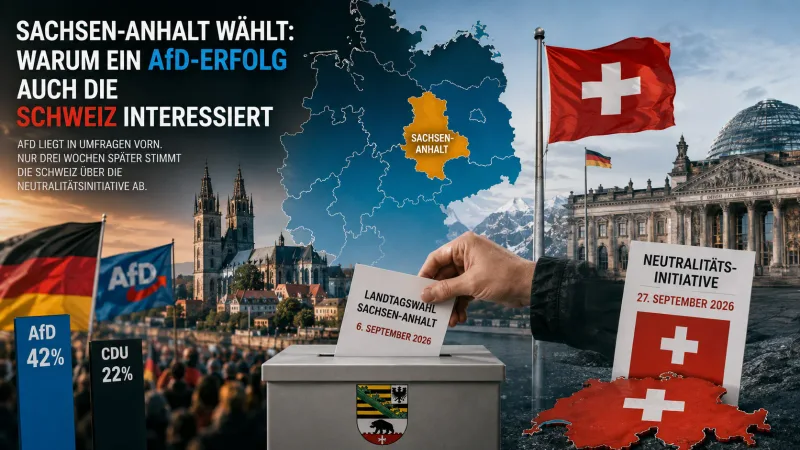
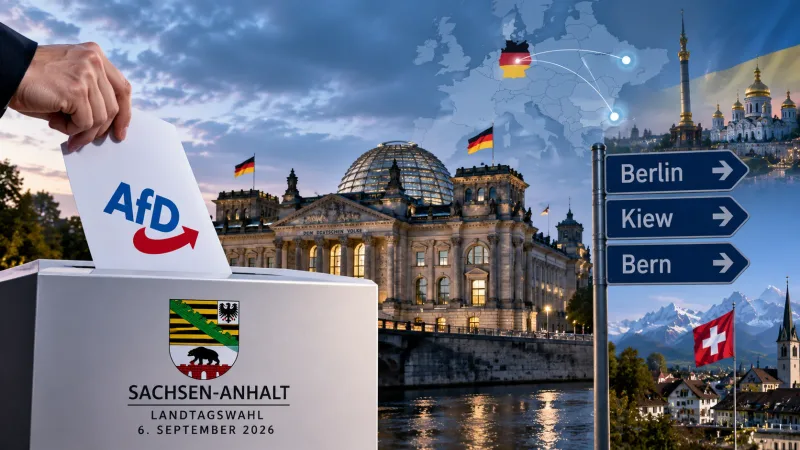
It is an election in a German federal state – yet Switzerland is also looking to Saxony-Anhalt. On September 6, the eastern German state will decide on a new state parliament. According to recent polls, the AfD leads significantly ahead of the CDU. This election not only focuses on state politics. It is also considered a litmus test for political developments in Eastern Germany and could have an impact beyond Saxony-Anhalt.
The timing is particularly interesting: just three weeks later, Switzerland will vote on the neutrality initiative. While there is no direct political connection between the two votes, questions dominating the German election campaign also play a role in Switzerland: How should a European state deal with the war in Ukraine? How far should cooperation with other countries extend? And what is the significance of neutrality in an increasingly uncertain world?
AfD Ahead of CDU
The starting position in Saxony-Anhalt is unusually clear. In the last representative poll by Infratest dimap, commissioned by ARD, MDR, Mitteldeutscher Zeitung, and Volksstimme, the AfD reached 42 percent. The CDU of Minister President Sven Schulze stood at 22 percent. Die Linke followed with 11 percent, the SPD with 8 percent, and the Greens with 6 percent. BSW and FDP were below the five-percent hurdle.
A poll by Forschungsgruppe Wahlen for ZDF also placed the AfD in the lead – albeit with a slightly lower figure of 40 percent compared to 23 percent for the CDU. These polls are snapshots and not election results. Things can still change until September 6.
Nevertheless, the political starting position is clear: The AfD enters the final stretch as the strongest force. However, an absolute majority is not in sight according to the polls.
An Election Victory Would Not Yet Be an AfD Government
This is precisely where an important difference lies between a strong election result and actual governmental responsibility. Even if the AfD becomes the strongest party on Sunday, it would need to organize a majority in the state parliament to form a government.
The other major parties have ruled out cooperation with the AfD. At the same time, forming a government without the AfD would be difficult given the current balance of power. According to the latest poll, the CDU would depend on several partners for a majority without the AfD.
Saxony-Anhalt could thus face a complicated government formation. Different coalition or minority models would be possible. The actual result on election night will therefore be more important than the current percentage figures alone.
Why the Election is Important for Berlin
Nevertheless, the political significance extends beyond Magdeburg. A very strong AfD result would increase pressure on federal politics. The party could present its success as proof that its political positions resonate with a large part of the population.
Particularly controversial are migration, economic development, and how to deal with the war in Ukraine. The AfD advocates a significantly different course towards Russia than the federal government and calls, among other things, for an end to support for Ukraine.
The election will therefore also be a test of how strongly such positions are rooted in an eastern German state. However, this does not automatically lead to a change in German Ukraine or Russia policy. A federal state cannot unilaterally determine German foreign and security policy. An election success can, however, change the domestic political debate and increase pressure on the federal government.
The AfD Also Looks to Switzerland
An unusual connection to Switzerland exists regarding direct democracy. The AfD has advocated for years for popular votes modelled on the Swiss system. The party sees Swiss popular rights as an example of how citizens can more directly influence political decisions.
In this context, Switzerland serves as a political example for the AfD. However, the Swiss system cannot be easily transferred to Germany. Switzerland has a historically developed interplay of popular initiative, referendum, parliament, and a consensus government. It is therefore not just about the possibility of voting more frequently, but about a different political system altogether.
The AfD refers to Swiss popular rights, but does not automatically adopt the entire Swiss model.
And Then There's the Neutrality Initiative
For Switzerland, the German election is also interesting because on September 27, 2026, a vote will be held on the popular initiative 'Safeguarding Swiss Neutrality'.
The initiative calls for a stricter interpretation of Swiss neutrality. Among other things, it proposes that the Federal Constitution should stipulate that neutrality is perpetual and armed. Switzerland should not join or cooperate with any military or defence alliance, except in the event of a military attack or an immediately prepared attack.
Particularly relevant for the Ukraine conflict is another demand: Switzerland should generally not impose sanctions against belligerent states. Exceptions would be UN sanctions and measures against their circumvention.
This would significantly change Switzerland's current scope of action. The Federal Council and Parliament reject the initiative. Current Swiss neutrality allows Switzerland to adopt sanctions under certain conditions. Following the Russian invasion of Ukraine, Switzerland largely adopted the EU sanctions against Russia.
Cassis: "Our Neutrality Works"
Federal Councillor Ignazio Cassis defends the current interpretation of neutrality. In a speech in June, he said:
"Our neutrality works. Therefore, we do not need to reinvent it."
Cassis argues that neutrality is not a rigid set of rules, but an instrument of Swiss foreign and security policy. Precisely because the international situation is changing, Switzerland must remain capable of action.
Upon launching the voting campaign in August, the Federal Council reaffirmed this position. In its assessment, the initiative would limit Switzerland's flexibility in security matters and international cooperation.
What Does This Have to Do with Saxony-Anhalt?
At first glance, very little. Saxony-Anhalt is deciding on a state parliament, Switzerland on a constitutional amendment. The political systems are also completely different.
More interesting is the temporal and political proximity of the debates. In Germany, the focus is on relations with Russia, support for Ukraine, migration, and the extent to which political decisions should be shaped by established parties or popular will. In Switzerland, a few weeks later, the focus is also on the consequences of the changed European security environment.
However, a direct influence of the Saxony-Anhalt election on the Swiss vote would be speculation. Swiss voters do not decide which party wins in Saxony-Anhalt. Conversely, the result in Magdeburg has no immediate legal effect on Swiss neutrality.
What Does This Mean for Switzerland?
Little in the short term – yet politically, the development is relevant. An election result in Saxony-Anhalt neither immediately changes Swiss neutrality nor German foreign policy. However, it can show how much support positions gain that represent a different stance on Russia, Ukraine, migration, and established political institutions.
Germany is an important neighbour and economic partner for Switzerland. Political shifts in the northern neighbour are therefore closely monitored in Bern. This is especially true when they concern issues that affect both countries: security in Europe, relations with Russia, migration, or the relationship with the EU.
At the same time, a look at Saxony-Anhalt shows how much the war in Ukraine has changed European domestic politics. In Germany, there is debate about arms aid, defence spending, and relations with Russia. In Switzerland, the central question is how far a neutral country should go with sanctions and international cooperation.
Thus, both debates share a common background but have different political consequences.
September 6 Will Be Decisive
It remains to be seen how Saxony-Anhalt will actually vote. Current polls indicate a clear AfD lead, but they do not guarantee an election victory, let alone assuming government.
Should the AfD indeed achieve a historic success, the discussion would likely extend beyond who governs Magdeburg in the future. The question would then also arise as to how much the political landscape in Eastern Germany has changed – and what pressure this exerts on federal politics in Berlin.
For Switzerland, another question remains: How much will the European dispute over war, security, and sanctions also influence its own neutrality debate? Saxony-Anhalt will not provide the answer. The Swiss electorate will provide it on September 27.
Sources
- MDR – current polls and information on the Saxony-Anhalt state election
- Forschungsgruppe Wahlen / ZDF – Saxony-Anhalt election poll
- Reuters – reporting on the political situation in Saxony-Anhalt
- SWI swissinfo.ch – AfD and direct democracy modelled on Switzerland
- Federal Council / admin.ch – information on the popular vote of September 27, 2026
- EDA / Federal Council – information on the neutrality initiative and Ignazio Cassis's position