Home Travel with Refugee Status: Why Status S Rules Differ
Recognized refugees risk losing their status if they travel to their home country. Different rules apply to individuals with Status S.
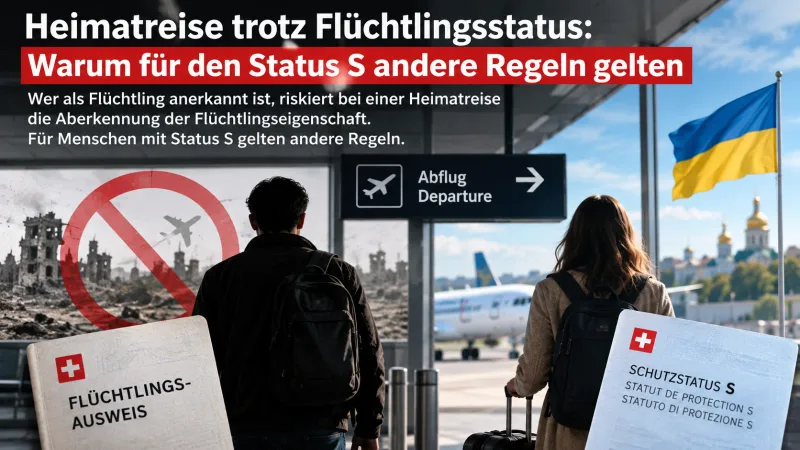
Individuals granted protection from persecution in Switzerland generally cannot simply return to their home country. A recognized refugee risks losing their refugee status and thus their asylum by voluntarily traveling home.
At the same time, people with protection Status S are generally allowed to travel abroad. For individuals from Ukraine, travel to Ukraine is even possible under specific conditions.
At first glance, this seems contradictory: if someone needs protection from a dangerous state, why can they return there at all?
The answer lies in a crucial difference: Swiss law does not treat individual persecution and temporary protection for a large group equally.
Asylum Does Not Automatically Mean Protection
Anyone applying for asylum in Switzerland is initially an asylum seeker – not automatically a refugee.
The State Secretariat for Migration (SEM) examines each application individually. The decisive factor is whether the legal requirements for refugee status are met.
Refugees are individuals who face or have well-founded fears of serious disadvantages due to their race, religion, nationality, membership of a particular social group, or political opinions.
Therefore, fleeing a war zone does not automatically lead to recognition as a refugee. War, violence, and general threats can be relevant for assessment but do not replace individual examination.
Asylum Is Not Automatic
An asylum application is a request for protection. Only after examination does the SEM decide whether the person concerned is recognized as a refugee and granted asylum.
Why Home Travel Is Problematic for Recognized Refugees
For a recognized refugee, the situation is fundamentally different. Their protection status is based on the fact that they cannot or do not want to avail themselves of the protection of their home or country of origin because they face persecution there.
If such a person voluntarily returns to that state, a key question arises: Why do they still need Switzerland's protection if they voluntarily return to the state from which they received protection?
Swiss law draws a clear consequence from this. If recognized refugees travel to their home country or country of origin, this generally leads to the revocation of refugee status and the withdrawal of asylum.
The SEM explicitly states that no permit can be issued for recognized refugees to travel to their home country or country of origin.
The Rule Was Tightened in 2019
The current regulation has not always existed in this form. The legislator tightened it.
Since the June 1, 2019, an expressly tightened rule applies: If a recognized refugee travels to their home country or country of origin, refugee status is generally revoked. An exception exists if the person concerned can credibly demonstrate that they had to travel there due to coercion.
The background to the legal amendment was the introduction of a legal presumption: anyone who travels to their home country or country of origin is generally voluntarily placing themselves under the protection of that state again. The corresponding legal amendment was adopted by Parliament on December 14, 2018, and came into force for this area on June 1, 2019.
What Applies Since 2019?
A recognized refugee's home country travel generally leads to the revocation of refugee status and the withdrawal of asylum. An exception exists if the person can credibly demonstrate that they had to travel to the home country or country of origin due to coercion.
This is an important difference from the previous legal situation: the legislator explicitly wanted to regulate the consequences of home country travel more clearly and strictly.
Does Home Travel Automatically Mean No Persecution?
No.
Home travel can have various reasons. Family emergencies or situations where a person comes under significant pressure are conceivable, for example.
This is precisely why the law provides an exception for credibly demonstrated coercion. The SEM mentions, for example, visiting a severely ill close relative as a possible case of such a coercive situation. citeturn1search7
Therefore, home travel is not automatic proof that a previous asylum application must have been false. However, for a recognized refugee, it is legally so significant that it can fundamentally trigger the loss of protection status.
Why Are Ukrainians Allowed to Return to Ukraine?
This is where protection Status S comes into play.
Status S is not a normal asylum procedure. It was created to quickly grant temporary protection to a defined group of people facing a severe general threat.
Switzerland activated this instrument in March 2022 after the start of the large-scale Russian attack on Ukraine.
The crucial difference: with Status S, it is not necessary to first prove in a full asylum procedure for each individual person that they are personally persecuted. Protection is directed at a defined group considered in need of protection due to the general situation.
The SEM explains that in the first six weeks after Status S was activated, more than 40,000 protection seekers from Ukraine were registered in Switzerland. Status S was therefore also intended to prevent the ordinary asylum system from being overwhelmed by the exceptionally large influx. citeturn2search1
Why Is Status S Not Available for Syrians or Iranians?
This question is legitimate – and the answer is not that people from Syria or Iran are inherently less at risk.
The Federal Council does not automatically activate Status S for every country experiencing war, persecution, or severe human rights violations. The legal prerequisites and the specific situation of the affected group are decisive.
The SEM explicitly explains why Status S was not applied, for example, to refugees from Syria or Afghanistan: the number of asylum applications from these countries has so far remained within a magnitude that the existing Swiss asylum system can manage.
The situation was different for Ukraine. Switzerland experienced an influx of unprecedented scale. Status S allowed a large number of people to be granted protection quickly without overwhelming the ordinary asylum system.
The Difference
Syrians, Iranians, or Afghans are not excluded from the Swiss protection system. They can submit a normal asylum application. What they do not automatically receive is group-based protection Status S.
Status S Is Temporary – And That Is Crucial
Status S was created as temporary protection. It is intended to remain in effect as long as a severe general threat persists. The Federal Council decides on its revocation.
Unlike for recognized refugees, the same individual persecution situation is not the focus.
This also explains why travel abroad is generally possible. Persons with protection Status S may travel abroad without a travel permit and return to Switzerland.
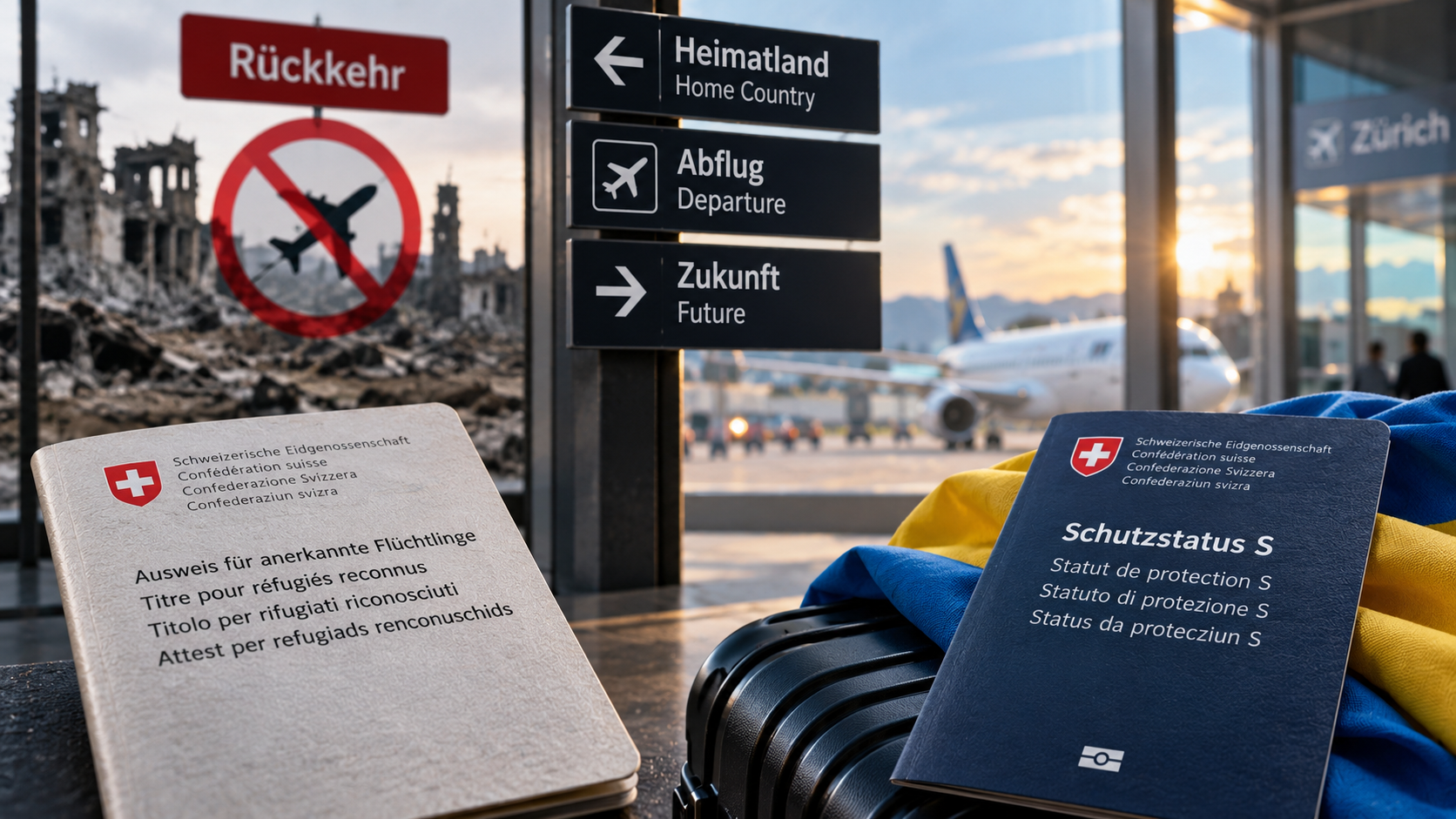
How Long Can Ukrainians Return to Ukraine For?
Here, too, the situation is less free than sometimes portrayed.
According to current SEM information, Ukrainian nationals with protection Status S may generally travel to Ukraine for up to 15 days within a six-month period.
The border crossing into Ukraine is decisive for the calculation. During the stay in Ukraine, there is also no entitlement to social assistance. A prior travel permit from the SEM is not required.
Thus, such travel is legally entirely different from the voluntary home country travel of a recognized refugee.
Important: Status S Is Not Equal to Refugee Status
A person with Status S does not automatically have the same legal standing as a recognized refugee. Status S is an independent, temporary protection mechanism.
New Restrictions for Status S Also Apply in 2026
Status S has also not remained unchanged.
Since August 20, 2026, new requirements apply to new applications. Ukrainian nationals and certain other groups of persons must, in particular, meet the current requirements of the Federal Council's new general ruling.
This includes, among other things, that individuals subject to military obligations in Ukraine must comply with these obligations to be able to obtain Status S. The new regulation affects new applications and does not automatically change the situation of already recognized persons with Status S.
The region of origin within Ukraine now also plays a role. Since November 2025, the SEM differentiates between regions where return is considered reasonable or unreasonable for new applications.
So, What Is the Actual Difference?
StatusWhat is it about?Home Country TravelAsylum SeekersIndividual application is examinedCan question credibility and need for protectionRecognized RefugeesIndividual protection from persecutionGenerally not allowed; home travel usually leads to revocationStatus STemporary protection for a defined groupTravel abroad generally possible; specific limits apply for Ukraine
What About Syria?
Syria, in particular, shows why the different forms of protection must not be confused.
The SEM has been processing Syrian asylum applications again according to usual procedures since May 1, 2026. The situation is assessed individually. The SEM no longer assumes a nationwide situation of general violence but simultaneously points to significant regional differences and the still volatile security situation.
For recognized Syrian refugees, the general rule still applies: travel to Syria can lead to the revocation of refugee status and the withdrawal of asylum. The SEM explicitly states that it cannot approve travel to the home country or country of origin for recognized refugees.
At the same time, Switzerland organizes voluntary returns to Syria and offers return assistance. This is not a contradiction: a voluntary definitive return is different from home country travel while retaining refugee protection.
Can Home Travel Indicate Asylum Abuse?
It can be an indication – but it does not automatically prove abuse.
This is precisely where clear journalistic distinction is important. A single case cannot lead to the conclusion that an entire group is abusing refugee protection.
Legally, however, the matter is clear: for a recognized refugee, voluntary home travel is so relevant that it can fundamentally trigger the revocation of refugee status.
The decisive question is therefore not just: “Has someone traveled back?”
But: “Why did the person travel back – voluntarily, under coercion, or as part of a definitive return?”
Why This Appears Contradictory at First Glance
The apparent contradiction arises mainly because in everyday language, "refugees" are often spoken of, even though legally different categories are meant.
A recognized refugee has an individual protection status. The basis is their refugee status.
A person with Status S, on the other hand, receives temporary protection because they belong to a defined group classified as in need of protection due to a severe general threat.
These are two different legal constructions – and therefore different rules apply to home country travel.
Figures Do Not Provide a Simple Answer on Abuse
The number of recognized refugees who actually travel to their countries of origin cannot be easily read as a single total from publicly available federal statistics.
This is journalistically important: individual cases or individual revocations do not allow for a reliable statement on how frequently home country travel occurs among all recognized refugees.
Conversely, the absence of a comprehensive figure does not mean that the phenomenon does not exist. Swiss law explicitly treats home country travel as a relevant fact and provides for corresponding consequences.
Conclusion: No Contradiction – But Two Very Different Protection Systems
Why can a recognized refugee not simply take a holiday in their home country, while a person with Status S is allowed to travel there under certain conditions?
Because the two forms of protection are based on different legal foundations.
For recognized refugees, protection is based on individual refugee status. A voluntary return to the home country or country of origin fundamentally contradicts this protection logic and can lead to revocation since the legal tightening in 2019.
Status S, on the other hand, involves temporary, group-based protection in the face of a severe general threat. The status was created in 2022 specifically to quickly manage the exceptionally large influx from Ukraine without overwhelming the ordinary asylum system. citeturn2search1
Therefore, home country travel is not automatic proof that someone never needed protection. However, for a recognized refugee, it is a legally serious signal – and can cost them their protection status.
The decisive point is therefore not nationality alone, but the type of protection: individual refugee status on one side, temporary group protection on the other.
Precisely this distinction explains why Switzerland applies different rules to recognized refugees, Ukrainian protection seekers, and asylum seekers from Syria or Iran.
Sources
- State Secretariat for Migration (SEM): Questions and Answers for Refugees from Ukraine, current as of September 2026.
- State Secretariat for Migration (SEM): Information on Syria, current asylum and removal practices.
- State Secretariat for Migration (SEM): Amendment to the Foreign Nationals and Integration Act, entry into force of the new regulation from June 1, 2019.
- State Secretariat for Migration (SEM): Handbook on Asylum and Temporary Protection, regulations on home country travel and protection Status S.