Witkoff, Kushner Meet Putin: US Talks of Concrete Plans
USA speaks of concrete plans – but a breakthrough is not in sight.
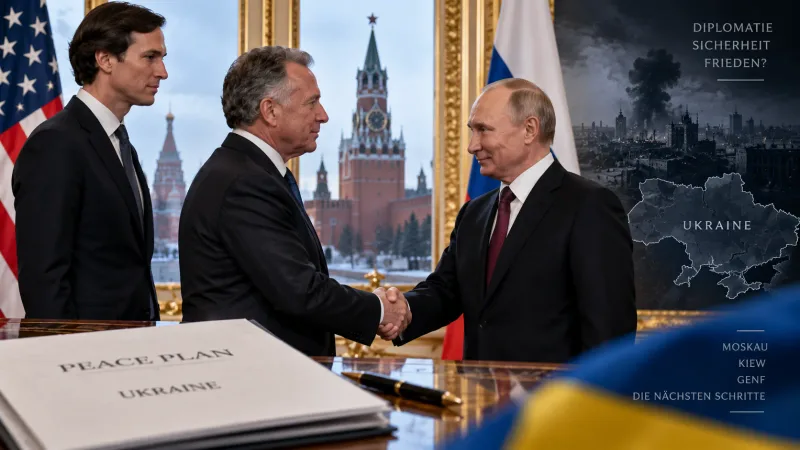
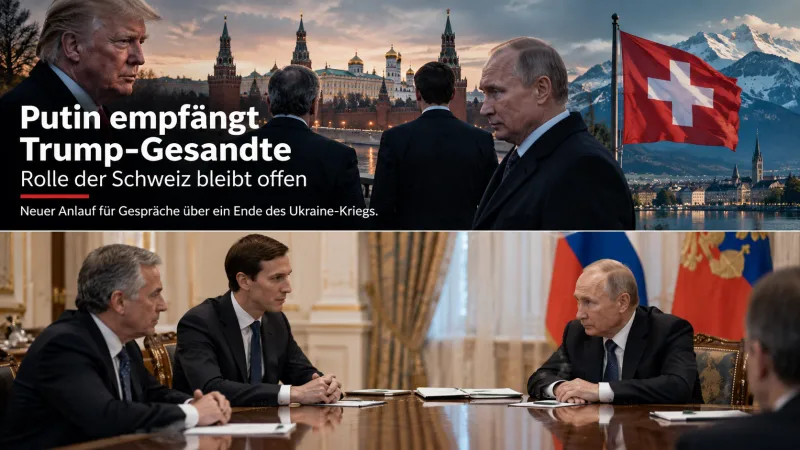
Diplomacy in the Ukraine war is active again. US Special Envoy Steve Witkoff and Jared Kushner, son-in-law of US President Donald Trump, met Russian President Vladimir Putin in Moscow on Saturday, September 5, 2026. The discussion in the Kremlin lasted over three hours.
The US government subsequently speaks of progress and "concrete plans" for the next steps. The exact content of the American proposal remains confidential, however. Even after the meeting, there is no indication of a breakthrough.
For the USA, the trip is part of a new attempt to restart stalled peace efforts. After talks with Putin, Witkoff and Kushner are scheduled to travel on to Kyiv. A meeting with Ukrainian President Volodymyr Zelenskyy is planned there.
Washington Speaks of Concrete Plans
US President Donald Trump announced the trip on Friday. He stated his negotiators would deliver a proposal to the Kremlin to end the war. Trump did not disclose details of this proposal.
Even after the meeting, Washington remained cautious. The White House stated that the interlocutors had discussed concrete plans for the next steps. Further details are to be announced in the coming weeks.
This leaves a central question open: What exactly is on the table?
In the past, Trump had indicated that territorial issues could be part of a possible peace agreement. Whether the current US proposal includes territorial concessions from Ukraine or what other concessions are demanded is not currently publicly known.
Kremlin Speaks of Useful Talks
Russia also presented the meeting positively. Kremlin advisor Yuri Ushakov described the more than three-hour talks as very useful. According to Russian sources, various ideas for a possible settlement of the conflict were discussed.
However, there can be no talk of a concrete breakthrough. Russia maintains its key demands. The Kremlin described its previous position as unchanged: Moscow demands, among other things, the abandonment of Ukraine's NATO perspective and territorial concessions.
Ukraine rejects the cession of territories it considers its sovereign territory. Thus, the crucial difference between the two sides remains.
After Moscow Comes Kyiv
The trip by the US envoys is also noteworthy because it involves both sides of the conflict. After the meeting with Putin, Witkoff and Kushner are expected to travel to Kyiv to speak with Zelenskyy.
Zelenskyy had signaled a willingness to talk before the Moscow visit. At the same time, the Ukrainian government made it clear that it is awaiting concrete proposals.
The order of the trip is politically relevant: Washington is trying to coordinate a possible proposal first with Moscow and then with Kyiv. Whether this can lead to a common basis for negotiation is uncertain.
The Front Remains Far From Peace
Diplomatic contacts are taking place against the backdrop of ongoing intense military confrontation. Russia and Ukraine have expanded their air attacks in recent months. Kyiv also continues to be regularly attacked with drones and missiles.
According to Ukrainian reports, a Russian drone attack on Friday hit, among other targets, the headquarters of the Ukrainian SBU intelligence service in Kyiv. Zelenskyy announced retaliation.
At the same time, the front line remains largely stalemated. According to Western observers, Russia is making only slow territorial progress, while Ukraine continues to try to repel Russian advances and also attacks targets deep within Russian territory.
The military reality thus stands in stark contrast to the new diplomatic activity: While Washington discusses possible next steps, the war continues simultaneously.

Limited Ceasefire for Talks
In connection with the trip, a limited pause in attacks on the respective capitals was also announced. According to the Kremlin, Putin ordered a three-day suspension of Russian attacks on Kyiv.
The Ukrainian side also signaled readiness to suspend attacks on Moscow during the visit of the US envoys. However, such an agreement would not be equivalent to a comprehensive ceasefire.
Precisely this distinction is crucial: A temporary and geographically limited pause in attacks creates better conditions for talks but does not end the war.
Switzerland's Role
For Switzerland, the new diplomatic initiative is nevertheless significant. In February 2026, trilateral talks between the USA, Ukraine, and Russia took place in Geneva. Federal Councillor Ignazio Cassis received the delegations and officially opened the discussions.
Switzerland itself was not a party to the negotiations. It provided the framework and offered its good offices. The FDFA explicitly described this role as Switzerland's traditional mediation function.
Geneva thus has a concrete precedent for talks between the three states. However, it is not yet decided whether the city will play a role again in a further round of negotiations.
For Swiss diplomacy, it is crucial that communication channels remain open. Switzerland can offer a neutral framework if the parties to the conflict and the states involved desire it. However, it cannot force peace.
Why a Breakthrough Is Not Yet Evident
The current situation can therefore only be assessed with caution. There are new diplomatic contacts, an announced US proposal, and apparent discussions about concrete next steps. At the same time, fundamental differences persist.
Russia demands far-reaching political and territorial concessions. Ukraine wants to preserve its territorial integrity and its freedom of action in security policy. A significant gap still exists between these positions.
Another uncertainty remains: Even if Washington, Moscow, and Kyiv could agree on a political framework, such a framework would need to be translated into concrete agreements on ceasefires, territories, security guarantees, and their implementation.
What Happens Now in Kyiv Is Decisive
The meeting in Moscow is therefore less a peace breakthrough than a new diplomatic test. The USA is trying to move Russia and Ukraine towards a common next step. Whether this succeeds depends on how far both sides are willing to adjust their previous positions.
The US envoys' discussion with Zelenskyy will now be particularly important. Only if the Ukrainian side also finds the American proposal acceptable can it form a basis for further negotiations.
Currently, one thing is certain: The communication channel is open again. However, this does not mean an end to the war has been reached.
Conclusion
Witkoff and Kushner discussed possible next steps to end the Ukraine war with Putin. Washington speaks of concrete plans, the Kremlin of useful talks. However, there is no concrete result or agreement yet.
The onward journey to Kyiv is therefore the next decisive step. Only when it becomes clear whether Ukraine can also work with the American proposal can it be assessed whether the new diplomatic initiative could truly lead to a negotiation process.
For Switzerland, Geneva remains a possible platform. The February talks showed that Switzerland can create a framework for direct discussions between the parties to the conflict. However, whether this framework will be needed again is ultimately decided not by Bern but by the states involved.
Sources
- Reuters – Talks between Witkoff and Kushner with Putin, September 5/6, 2026
- Reuters – Announcement of the trip and the US peace proposal, September 4, 2026
- Federal Department of Foreign Affairs (FDFA) – Trilateral talks USA–Ukraine–Russia in Geneva, February 2026
- Swissinfo – Talks between Ukraine and Russia in Geneva