F-35 Fixed Price: Control Report Reveals Serious Management Deficiencies
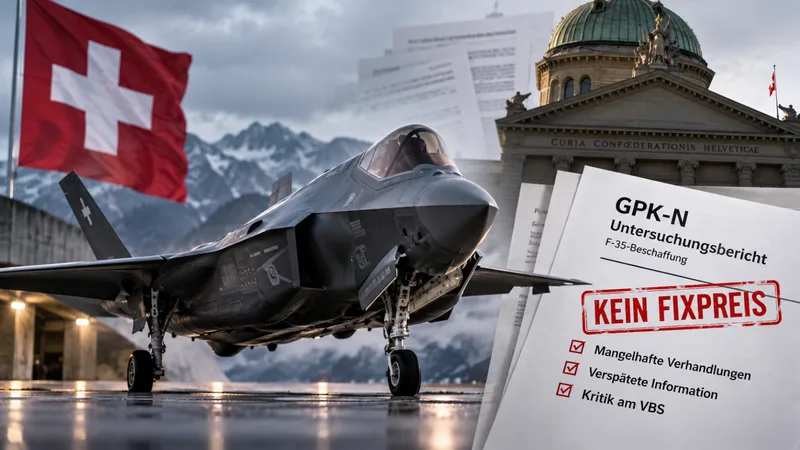
The Parliamentary Control Committee found no reliable basis for the fixed price promised for years. The report highlights inadequate negotiation management, unclear responsibilities, and a lack of control.
Switzerland presented the F-35A to the public as a fixed-price deal. This certainty does not withstand parliamentary scrutiny. The Swiss National Council's Parliamentary Control Committee (GPK-N), in its report dated September 8, 2026, concludes that no reliable basis existed for a guaranteed lump sum price.
The criticism extends beyond a mere figure. It addresses the manner in which the Department of Defence managed a multi-billion-franc transaction, communicated risks, and organised political accountability.
No Fixed Price in the Swiss Sense
When purchasing the F-35A, Switzerland does not directly negotiate all costs with manufacturer Lockheed Martin. The central element is the American Foreign Military Sales (FMS) procedure: the US government procures and charges for aircraft for partner nations. The prices of individual production lots are determined between the USA and the manufacturer.
Nevertheless, the Swiss side maintained for years that the contract guaranteed a fixed price. By 2025 at the latest, it became clear that the USA did not share this interpretation. Price developments for production lots, inflation, and other cost components remained a risk for Switzerland.
The GPK-N states that it cannot comprehend the categorical public statements made by the VBS (Department of Defence, Civil Protection and Sport). This is politically serious: for a procurement of this magnitude, a hope must not be sold as a secured contractual reality.
What Went Wrong in Management
The report describes an inadequate negotiation organisation. At times, there was no sufficiently clear negotiation mandate. The group conducting the talks was very small, and the flow of information to management was insufficient. In certain phases, even the four-eyes principle was missing.
These points sound technical but are fundamental. A negotiation mandate defines objectives, red lines, and permissible concessions. The four-eyes principle reduces risks of error and abuse. A clear flow of information ensures that political decisions are based on the actual status of discussions.
The Committee thus criticises not a single misleading media statement, but a systemic problem: responsibility, control, and communication were insufficiently coordinated.
What the Federal Council Now Plans
The Federal Council has adjusted its strategy. Instead of adhering strictly to the originally planned 36 aircraft, Switzerland will purchase only as many jets as can be financed within the approved financial volume. For already apparent additional costs, the Federal Council requested a supplementary credit of 394 million Swiss francs in March 2026, partly due to inflation.
The final number of aircraft is to be determined by the first quarter of 2027 at the latest. This shifts the central question: no longer just 'What do 36 aircraft cost?', but 'How many fully operational aircraft will Switzerland receive for the approved funds?'
This calculation is also complex. A fighter jet is more than just the airframe. Training, armament, spare parts, infrastructure, software, maintenance, and decades of operation influence military utility and overall costs. A smaller fleet could also mean higher costs per aircraft or reduced availability.
Separating Procurement and Military Need
The control report does not determine whether the F-35A is the militarily correct aircraft. It examines management and oversight. This distinction is important. One can support the jet's capabilities and still criticise the procurement management. Conversely, management deficiencies do not automatically prove that any other aircraft would have been cheaper or more suitable.
For the democratic debate, however, it is crucial that voters approved a credit framework for new fighter aircraft in 2020. If central price assumptions later change, it must be transparently explained what performance will still be delivered within this framework.
What This Means for Taxpayers
In the short term, the risk increases that Switzerland will either pay more or receive fewer aircraft. Both have consequences. Additional costs burden the federal budget and compete with other tasks. A smaller fleet can alter operational planning and necessitate additional collaborations.
In the long term, it is about trust. The federal government regularly procures complex systems – from IT to infrastructure to the army. If risks are identified internally but presented publicly as resolved, credibility suffers beyond the individual project.
For the Swiss public, this case is thus a lesson in large-scale government projects. What is crucial is not only competition and price tags, but clear responsibilities, independent control, and communication that reveals uncertainty.
What Needs Addressing Now
Firstly, a complete cost-benefit analysis is needed for every realistic fleet size. Secondly, responsibilities and escalation paths in international procurements must be definitively regulated. Thirdly, Parliament should be regularly informed about risks before financial decisions become practically irreversible.
The report primarily demands a correction of political culture: complexity can be explained. An honest 'The price depends on American negotiations' would have been less convenient but more reliable than a promise that cannot be kept later.
The F-35 debate is therefore not over. Until the number of aircraft is set, the Federal Council must demonstrate what capabilities it will receive at what price. Only then can it be assessed whether the deal remains within the popular vote's mandate – financially and in terms of security policy.
Sources
- Swiss Parliament: Reports of the Parliamentary Control Committees, 'Fixed Price F-35A' dated September 8, 2026 – https://www.parlament.ch/de/organe/Seiten/berichte-gpk.aspx
- Federal Council: Further procedure for the procurement of the F-35A, March 2026 – https://www.frb.admin.ch/de/newnsb/t7b6NzF5spfq9Zs5wp9sL
- VBS: Classification of the American price position, August 2025 – https://www.kbob.admin.ch/de/newnsb/RDltqKeOFRJxTHJqFQPcB
Status: September 9, 2026.