Electricity Prices 2027 to Fall, Relief Varies by Location
Median basic supply price drops by four percent. A typical household saves around 53 francs annually, but grid costs and local procurement cause significant variations.
After significant price jumps during the energy crisis, many Swiss households can expect further relief. The median price for basic supply in 2027 will decrease by four percent to 26.5 centimes per kilowatt-hour. For a typical household consuming 4,500 kilowatt-hours annually, this results in a bill of approximately 1,194 francs – 53 francs less than in 2026.
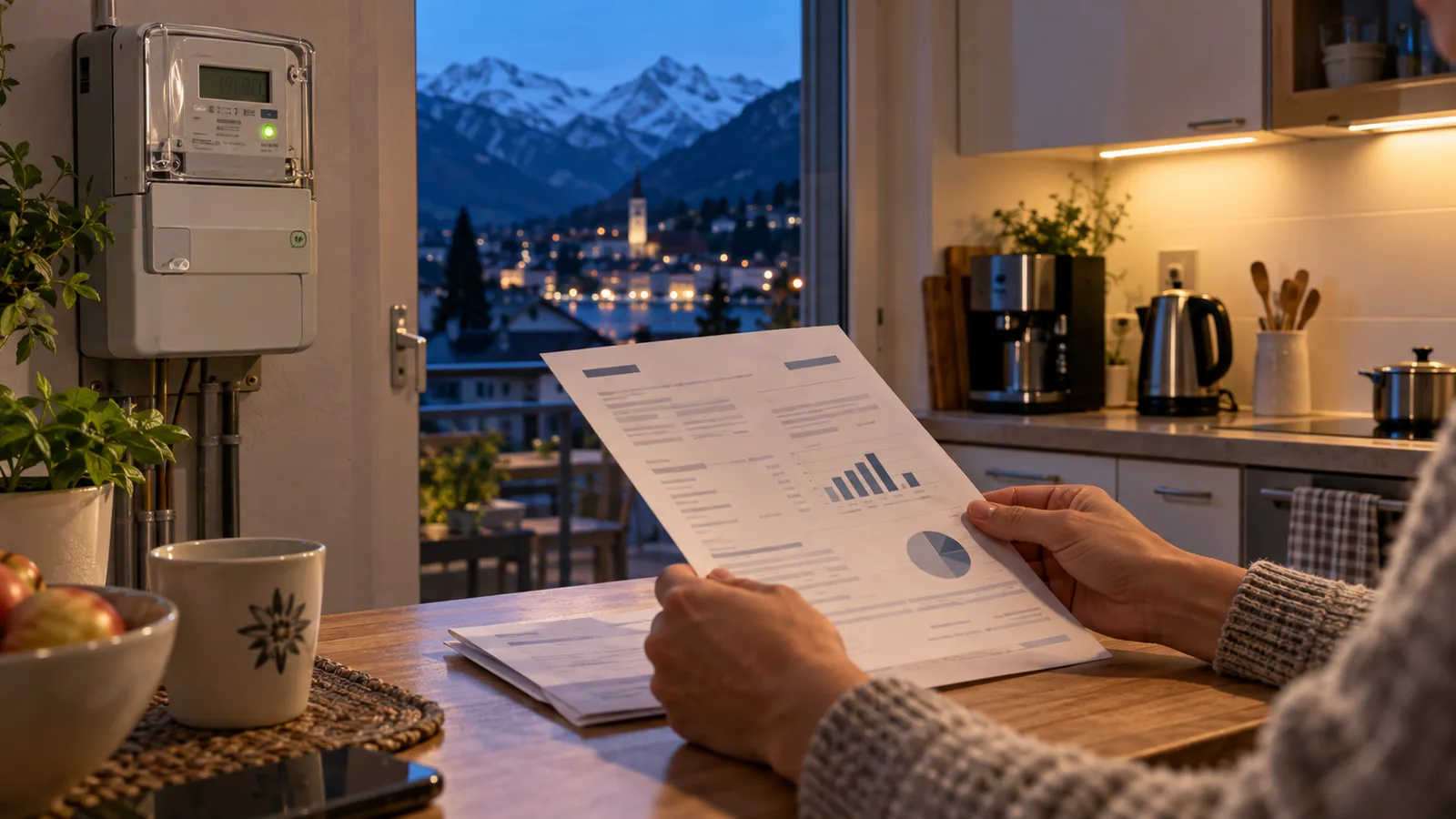
This figure seems clear. However, for individual households, it is not. In Switzerland, electricity prices vary significantly by place of residence. To understand one's bill, four components must be distinguished: energy, grid usage, metering, and taxes and surcharges.
Cheaper Energy, More Expensive Grid
The median energy tariff drops from 12.11 to 11.35 centimes per kilowatt-hour. This represents a decrease of over six percent and is the main reason for the relief. Many suppliers procure electricity in staggered stages over several years. Consequently, the extremely expensive purchases from the crisis years are gradually exiting their portfolios.
For grid costs, the trend is reversed. The median slightly increases from 10.73 to 10.94 centimes. The grid requires expansion, digitalization, and preparation for increasingly decentralized production. Solar installations, heat pumps, and electric vehicles alter load flows. This necessitates new lines, transformers, control systems, and reserves.
Metering costs are also reported more transparently since the reform. For a typical household, they increase from a median of 74.40 to 78.48 francs per year. While not a significant amount, this shows that a lower energy price does not automatically reduce all parts of the bill.
Why Location Matters
Switzerland has approximately 580 grid operators. Some produce a large portion of their electricity themselves, while others purchase it entirely from the market. Some procured long-term and early, others were more exposed to high market prices. Topography, grid age, and customer density also influence costs.
Therefore, bills can differ significantly between two neighboring municipalities. The nationwide median describes the average value, not the tariff for every address. ElCom publishes a tariff comparison for each municipality. This allows households to see if their relief is greater or smaller.
This is particularly relevant for private customers, as they generally cannot freely choose their basic supply provider. The place of residence determines the responsible local supplier. Savings opportunities primarily come from consumption, the chosen product, and – where available – time-variable tariffs.
Taxes and Surcharges Also Change
A portion of the electricity bill is politically determined. Costs for the electricity reserve will decrease in 2027 from 0.41 to 0.17 centimes per kilowatt-hour. Conversely, the so-called solidarized costs will rise from 0.05 to 0.19 centimes. These include expenses distributed nationwide, which are not intended to remain with a single grid area.
In addition, there are communal charges and the grid surcharge for promoting renewable energies. The amount of local charges can vary widely. Therefore, comparing only a supplier's energy price does not provide a full bill comparison.
Implications of the New Oil Price Shock
Recent disruptions in energy markets have raised the question of whether lower tariffs are already outdated. For 2027, the direct effect is limited. Most basic suppliers purchase in staggered stages; thus, a short-term price surge does not directly translate to the next annual tariff.
However, if high gas, oil, and wholesale prices persist, this could impact later procurement periods. Despite increasing renewable production, electricity prices in Europe still depend on fuel costs, power plant availability, weather, and cross-border capacities. The current relief is real but does not guarantee permanently falling prices.
What Households Can Do
The most important step is a comparison on the ElCom tariff platform. This requires the residential municipality, consumption data, and the appropriate customer profile. A typical four-person household corresponds to profile H4; small apartments or houses with heat pumps fall into other categories.
When saving, not only the quantity but increasingly the timing matters. Washing machines, water heaters, or electric cars can be shifted to cheaper hours, provided tariffs and technology allow. Stand-by devices, however, are rarely the biggest lever. Heating, hot water, and large electrical consumers have a greater impact.
Self-consumption from a solar system can reduce grid demand. However, investment costs, feed-in tariffs, and the proportion of electricity used directly in the house are economically crucial. Blanket promises are not worthwhile; an individual calculation is better.
Small Relief, Major System Challenge
The average saving of 53 francs is welcome, but it will hardly fundamentally change a household budget. More significant is the signal that procurement prices are normalizing. Simultaneously, costs are rising for a grid that needs to become more reliable, smarter, and climate-resilient.
For Swiss citizens, the sober conclusion is: in 2027, electricity bills are likely to decrease in many places, but not uniformly everywhere. Those who know their tariff and break down the bill into its components will better understand where the relief comes from – and which costs will remain long-term.
Sources
- Federal Electricity Commission ElCom: Electricity Tariffs 2027 – https://www.elcom.admin.ch/de/newnsb/1miE201yRzoA
- ElCom: Tariff Data and Visualizations by Municipality – https://www.elcom.admin.ch/de/tarifdaten-und-visualisierungen
- ElCom: Frequently Asked Questions on Electricity Tariffs and Basic Supply – https://www.elcom.admin.ch/de/faq-stromtarife
Status: September 9, 2026.