Nobel Prize for optogenetics: How light sharpens brain research
The awarded method can control selected nerve cells in a targeted way – but it does not read thoughts, and it is not yet everyday medicine.
The 2026 Nobel Prize in Physiology or Medicine goes to Karl Deisseroth, Peter Hegemann and Georg Nagel. They were honoured for their findings on light-controlled ion channels and on optogenetics. The word sounds technical, but it describes an idea with great impact: researchers can use light to influence selected cells in a targeted way and observe what happens afterwards.
That is more than a particularly elegant way of looking at the brain. Optogenetics makes it possible to study cause and effect in neural networks. If a specific group of nerve cells is active while an animal remembers something, shows fear or carries out a movement, that does not yet prove that these cells trigger the behaviour. Optogenetics allows their activity to be changed in a targeted way. Only then can one examine far more precisely what role a network actually plays.
How the method works
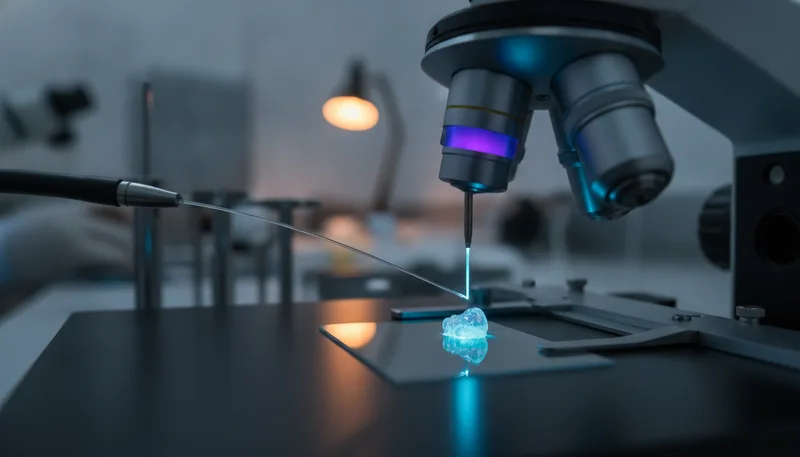
The first part of the story begins with a single-celled green alga. Hegemann and Nagel studied the protein channelrhodopsin, which reacts to blue light. When light falls on it, a channel in the cell membrane opens; charged particles can flow and an electrical signal arises.
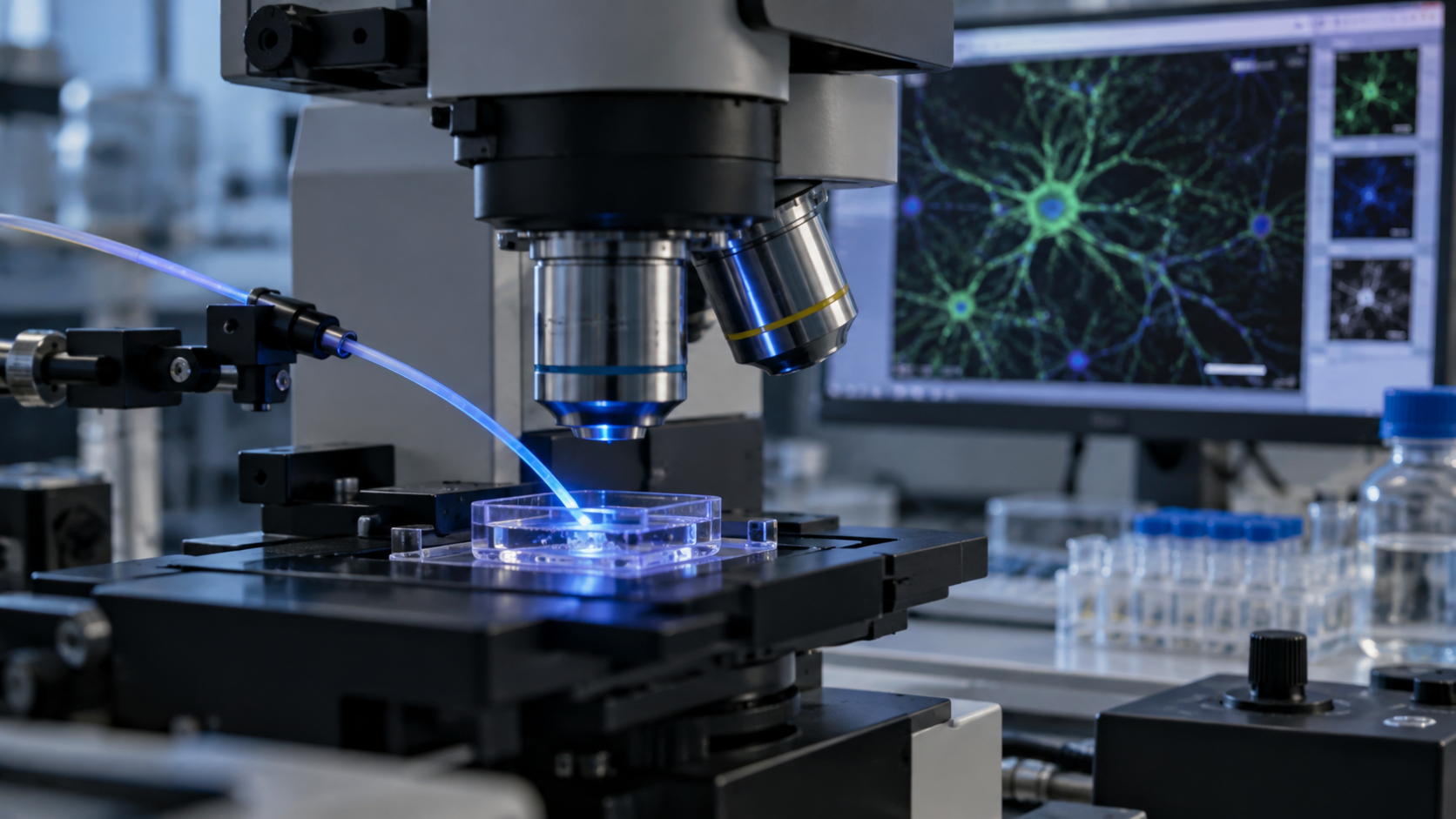
Deisseroth and his team then showed that the gene for this protein can be introduced into selected nerve cells. These cells thereby become light-sensitive. A precise pulse of light can trigger their activity; other optogenetic tools can dampen activity. Two building blocks are decisive: genetic targeting precision and optical control. Light alone does not turn an ordinary nerve cell into a switch.
This also makes clear what optogenetics is not. It cannot read thoughts, cannot control an entire brain at will and does not replace MRI or other imaging procedures. It is above all a research tool, often used in cell cultures and animal models. Its value lies in the precision with which questions about memory, movement, perception or psychiatric disorders can be studied.
Hope for patients – with clear limits
In medicine, work focuses particularly on applications for retinal diseases. A study published in 2021 reported partial restoration of visual function in a blind patient after gene therapy and with a specially developed pair of glasses. That was an important proof of feasibility, but not a standard treatment: it involved a single patient, a specific clinical picture and a complex procedure.
For people in Switzerland, the Nobel Prize therefore does not mean that a light therapy against dementia, depression or Parkinson's would be available tomorrow. Between a laboratory result and an approved treatment lie safety checks, clinical trials, long-term observation of gene therapies and questions of access. Scientific progress is valuable, but rarely as immediate as a headline suggests.
The Swiss connection is nonetheless concrete. ETH Zurich and the University of Zurich are developing, with the MOSIAC project, high-resolution interfaces intended to combine cell-type-specific optogenetics with measurement techniques. At the Institute of Molecular and Clinical Ophthalmology Basel, research is being done on optogenetic approaches to restore visual function. Switzerland's role therefore lies not only in marvelling at a Nobel Prize, but also in research that could one day turn basic knowledge into carefully tested applications.