Orbit Weapons: The Gap in the Outer Space Treaty
Article IV of the 1967 treaty covers weapons of mass destruction, not conventional systems. An assessment – with the points that still need to be verified.
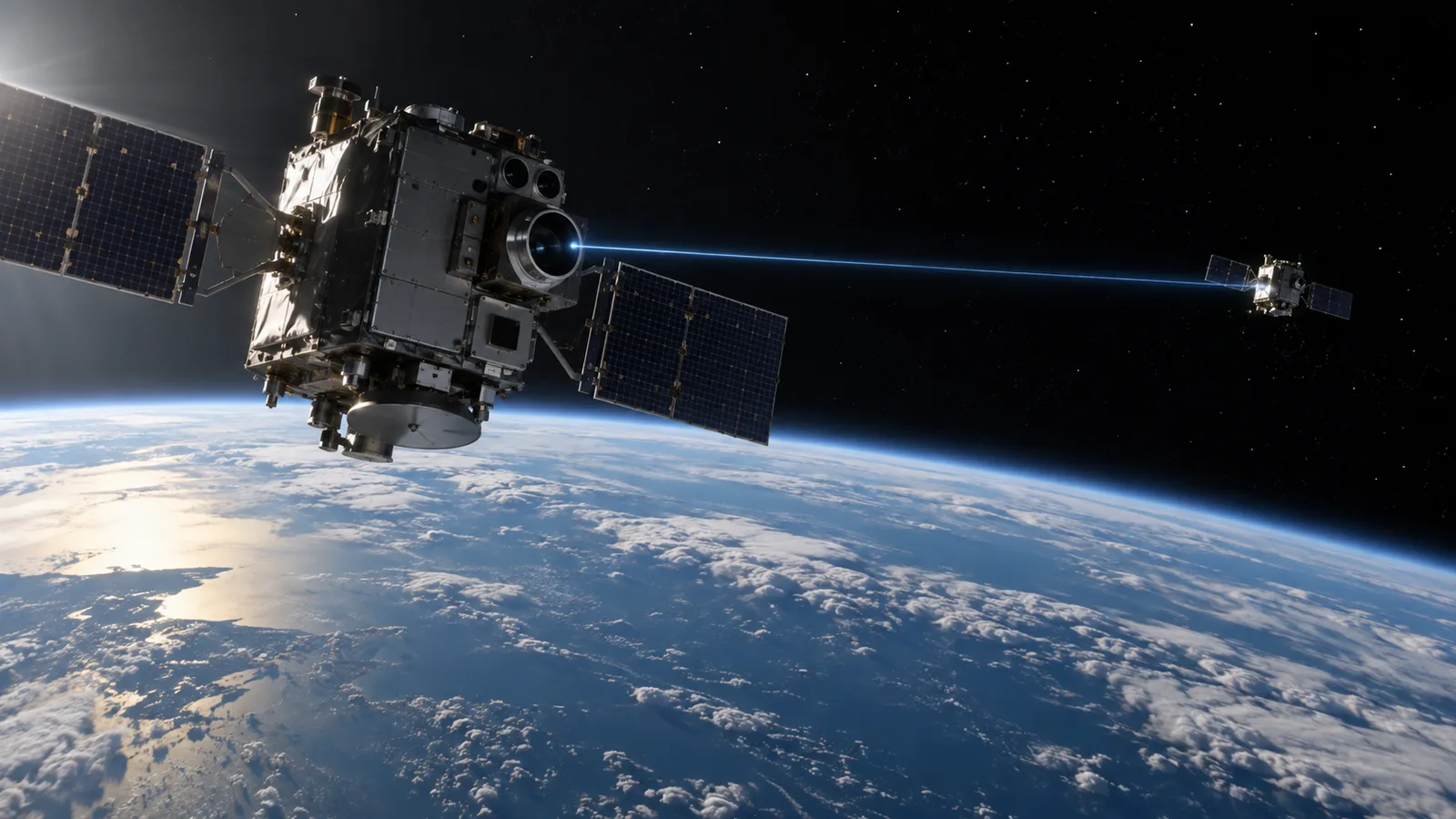
Since 15 September 2026, a report has been circulating that the United States has publicly confirmed “on-orbit space control weapons” for the first time. It has not been substantiated so far: this editorial team holds the US Space Force statement from Vandenberg only as a link, not in full text. That leaves the sender, date, wording and scope of the statement open. The following text therefore sets out what is on the table in the debate – and flags what still needs to be checked.
What the Outer Space Treaty covers – and what it does not
The Treaty on Principles Governing the Activities of States in the Exploration and Use of Outer Space of 1967 is regarded as the central body of rules. In expert discussion, Article IV is read as follows: nuclear weapons and other weapons of mass destruction in Earth orbit, and their stationing on celestial bodies, are prohibited. On this reading, the article does not contain a comprehensive ban on conventional or non-kinetic systems.
This reading needs to be checked against the treaty text at UNOOSA; the wording was not reviewed for this draft. The status of further instruments, such as arms control agreements or the Artemis Accords, is equally open. As long as these foundations are missing, any legal sharpening remains an assertion.
The strategic effect of deliberate ambiguity
The real point lies not in the technology but in the communication. Those who leave the operational scope of orbit systems open create deterrence without naming capabilities: adversaries must reckon with the worst case, allies must ask. Ambiguity is thus an instrument in itself – it works both towards military adversaries and within an alliance.
How far the term “space control” reaches is not defined uniformly in public. In the discussion it covers both the observation and identification of objects in orbit and measures that impair their function. Which systems the United States actually means does not emerge from the available material.
Whether the openness is inherent in the primary source or only arises in secondary reports cannot be decided without the statement text. Nor is the question answered whether the systems act kinetically and thus generate debris. For civilian satellites, collisions and debris fields are the central risk – here expert assessments sit alongside verifiable measurement data, and the two must not be mixed.
Europe, Switzerland and the open points
No official European or Swiss position on orbit weapons appears in the available material. Whether none exists or whether it was simply not gathered is open and must be clarified in the further process. For Switzerland the question is not abstract: it uses satellite services for communication, navigation and weather and climate observation, and hosts research and industrial companies in the space sector.
For reliable reporting, two documents are currently missing: the US Space Force statement in full text, including date, sender and verbatim quotes, and the treaty text of Article IV at UNOOSA. The official title of Troy Meink also needs clarification. The title “Secretary of the Air Force” is rendered inconsistently in German-language reporting; the original title should be used, and the paraphrase marked as such. Until these points are clarified, the matter remains an open report – nothing more.
Sources
- news.google.com (secondary source, researched on 2026-09-15)
- news.google.com (secondary source, researched on 2026-09-15)
- news.google.com (secondary source, researched on 2026-09-15)
- news.google.com (secondary source, researched on 2026-09-15)
- news.google.com (secondary source, researched on 2026-09-15)
- news.google.com (secondary source, researched on 2026-09-15)
- news.google.com (secondary source, researched on 2026-09-15)
- news.google.com (secondary source, researched on 2026-09-15)
- news.google.com (secondary source, researched on 2026-09-15)
- news.google.com (secondary source, researched on 2026-09-15)
- news.google.com (secondary source, researched on 2026-09-15)
- news.google.com (secondary source, researched on 2026-09-15)
- US Space Force / Vandenberg: “SECAF announces on-orbit space control weapons” (primary source, researched on 2026-09-15)
- UNOOSA: Outer Space Treaty (treaty text) (primary source, researched on 2026-09-15)


