Trump Accused of Sowing Election Distrust to Declare Emergency
Critics see a plan to use election claims for an emergency declaration. Allies worry about the consequences.
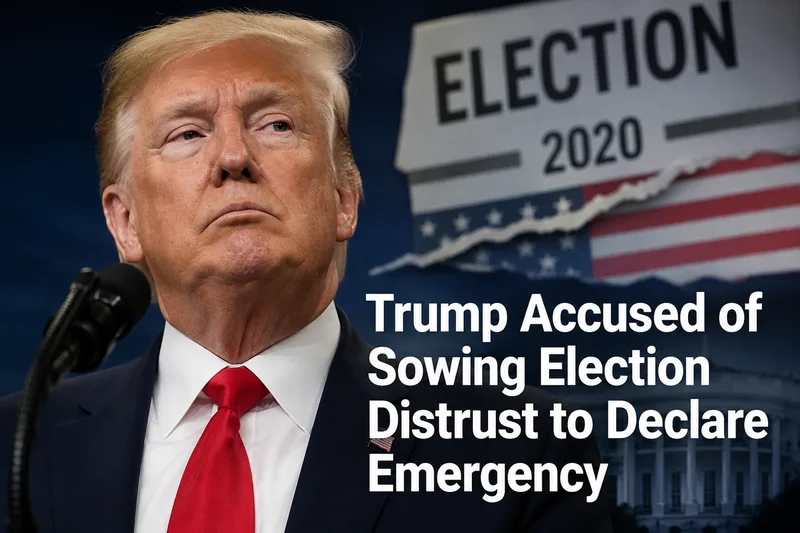
President Donald Trump and his allies are facing growing scrutiny over an increasingly aggressive campaign to question the integrity of US elections. With the November 3, 2026 midterm elections approaching, voting experts and legal scholars are warning that repeated claims about election interference and voting irregularities could undermine public confidence in the electoral system — and potentially create political justification for extraordinary federal action.
Trump has not announced a national emergency over the elections. But he has declined to rule out such a move, while some of his closest political allies have openly discussed the possibility. The combination of increasingly forceful election rhetoric, government investigations and proposals to expand federal authority over elections has therefore become a major source of concern in Washington.
Trump Leaves the Possibility Open
The issue gained renewed attention after conservative commentator Wayne Allyn Root asked Trump whether he would consider declaring a national emergency over the US electoral system.
Trump did not reject the idea. Instead, he responded that “stranger things have happened”. While the comment was not a formal announcement, it was enough to intensify speculation about whether the administration could consider extraordinary measures before or after the midterm elections.
The White House has not confirmed that an emergency declaration is being prepared. Nevertheless, the possibility has become part of the wider political debate surrounding election security and federal authority.
Allies Predict a Possible Emergency
Some of Trump's political allies have gone considerably further. Former Trump strategist Steve Bannon has publicly predicted that the president could declare a national emergency connected to the elections.
According to The Guardian, Bannon has described such an emergency as a possible legal and political basis for further action. The comments have attracted particular attention because they come at a time when the administration is already seeking greater federal involvement in election-related matters.
Former White House lawyer Ty Cobb has also interpreted the administration's recent messaging as potentially laying the groundwork for a future emergency declaration. These interpretations remain contested, and there is no public confirmation that Trump has decided to take such a step.
Documents and Claims About Election Security
The administration has released a growing number of documents and intelligence-related materials concerning alleged foreign interference and weaknesses in the American electoral system.
Trump has repeatedly argued that foreign actors have attempted to interfere with US elections. He has also revived claims surrounding the 2020 presidential election, which he continues to describe as fraudulent despite the absence of evidence that the election result was overturned by widespread voting fraud.
More recent claims about non-citizen voting have also become part of the debate. Critics argue that presenting disputed or unverified allegations as evidence of a systemic crisis could have the effect of weakening confidence in elections before voters go to the polls.
Election officials and voting experts have challenged several of the administration's claims. The central concern is not simply whether individual irregularities exist, but whether isolated or disputed cases are being presented as evidence that the entire electoral system is fundamentally unreliable.
The Save America Act
At the same time, Republicans have promoted legislation known as the Save America Act, which would introduce significant changes to federal election rules, including stricter requirements for voter identification.
Supporters argue that stronger identification requirements are necessary to protect election integrity. Opponents argue that the proposed measures could make voting more difficult for some groups and increase federal control over a process traditionally administered largely by the states.
The debate illustrates the broader conflict at the heart of the current controversy: how far the federal government should be able to go in the name of election security without undermining the constitutional role of individual states.
What Emergency Powers Could Mean
The US president has broad emergency powers under federal law, but those powers are not unlimited. A declaration under the National Emergencies Act can activate specific authorities that Congress has provided for emergency situations.
The Brennan Center for Justice has identified 136 statutory emergency powers across federal law. However, that figure does not mean that a president automatically receives access to all of them after declaring an emergency. The powers available depend on the particular laws invoked and the circumstances of the declaration.
Most importantly, declaring a national emergency would not automatically give the president unlimited authority over state elections.
US elections are administered primarily by state and local authorities. Any attempt to take broad federal control over election administration would therefore face significant legal and constitutional challenges.
A Potential Constitutional Showdown
If the Trump administration were to declare a national emergency over elections and then attempt to impose extraordinary federal measures, lawsuits would almost certainly follow.
State governments, civil rights organizations and political opponents could challenge the measures in federal court. Depending on the nature of the action, the dispute could eventually reach the US Supreme Court.
The courts would have to determine whether the president had acted within the authority granted by Congress and whether the measures were compatible with constitutional protections and the division of powers between the federal government and the states.
Legal experts therefore emphasize that an emergency declaration itself would not settle the question. The specific actions taken under the declaration would be just as important.
Why the Midterm Elections Matter
The timing makes the issue particularly sensitive. The US midterm elections are scheduled for November 3, 2026, with control of Congress at stake.
A close or disputed election could create an environment in which allegations of fraud or foreign interference gain renewed political importance. If doubts about the results were widespread, pressure for extraordinary federal intervention could increase.
That scenario remains hypothetical. There is currently no evidence that Trump has decided to reject the results of the 2026 midterms or that a national emergency declaration is inevitable.
Nevertheless, election officials and voting-rights organizations are closely monitoring the administration's actions. The Department of Justice has also announced plans for an expanded election-monitoring operation, which has generated additional debate about the appropriate role of the federal government in state elections.
<h