Blood Moon over Switzerland: Partial Lunar Eclipse on August 28
What Amateur Astronomers Can Expect on Friday Morning
Blood Moon over Switzerland: Early Rise Rewarded on Friday Morning
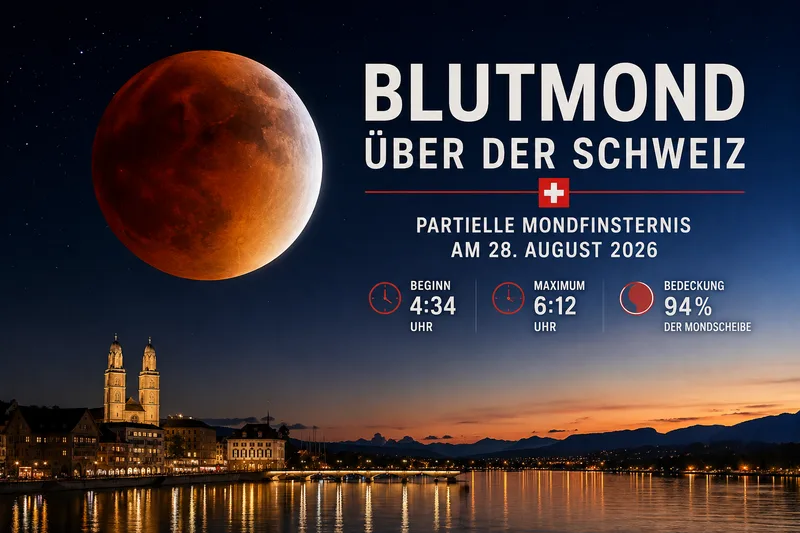
On Friday, August 28, 2026, Switzerland awaits a special celestial spectacle. In the early morning hours, Earth's shadow will pass over the full moon. At 6:12 AM, the partial lunar eclipse will reach its peak: Approximately 94 percent of the lunar disk will then be covered by Earth's shadow. In clear skies, the moon may turn distinctly reddish to coppery.
Those wishing to observe the event primarily need one thing: an early alarm. The actual partial lunar eclipse begins at 4:34 AM. Until the maximum at 6:12 AM, Earth's shadow will steadily advance across the lunar disk. After that, the shadow will recede. SRF has compiled the most important observation times.
At 6:12 AM, Nearly the Entire Moon is Covered
During a lunar eclipse, Earth is positioned between the Sun and the Moon. The Sun, Earth, and Moon are nearly aligned. The Moon is near its full moon phase during the event, as Earth's shadow falls upon its surface.
On Friday, Earth's umbra begins to visibly cover the moon at 4:34 AM. The darkening then steadily increases. The maximum is reached at 6:12 AM: Approximately 94 percent of the lunar disk will then be in the umbra. Only a narrow area at the edge remains directly illuminated by sunlight. After that, the eclipse recedes.
This is explicitly a partial lunar eclipse. The moon will therefore not be completely engulfed by Earth's shadow. Nevertheless, the spectacle can visually appear almost like a total lunar eclipse because most of the lunar disk appears reddish.
Why the Moon Turns Red
The moon's coloration is expected to be particularly striking. Although it is partially in Earth's shadow, sunlight still reaches it. This light is scattered and refracted as it passes through Earth's atmosphere.
Specifically, the red components of light can penetrate the Earth's shadow and reach the moon. This is why the lunar disk can appear dark red, brownish, or coppery during the eclipse.
However, the exact intensity of the coloration cannot be precisely predicted. Physicist and amateur astronomer Beat Meier from Sternwarte Rümlang points out that the atmospheric composition and the amount of volcanic ash, among other factors, can influence the color. Weather conditions also play a role.
The Best Time is Just Before Sunrise
The maximum at 6:12 AM is both the most exciting and most challenging moment for observation. At this time, the moon is already very low above the horizon. Shortly after, the sun rises, and the increasing daylight makes it harder to spot the moon.
Therefore, those who want to see the maximum should not wait until 6:12 AM to go outside. It is best to find a suitable observation spot significantly earlier.
A clear view towards the west-southwest is particularly important. Houses, trees, or mountains can obstruct the low-hanging moon. Therefore, a location with as clear a horizon as possible significantly improves the chances.
Weather Conditions Also Play a Role
Whether the lunar eclipse will actually be visible on Friday morning largely depends on cloud cover. According to current forecasts, it may be quite cloudy at times. However, there is a chance of clearings.
The weather situation can still change until Friday. Therefore, those who wish to observe the celestial event should check the forecasts again on Thursday evening and into Friday morning.
Some observatories in Switzerland also plan to open their doors early on Friday morning. Whether this is actually possible depends on the weather and the specific conditions. A phone inquiry before visiting can therefore be advisable.
No Protective Eyewear Required
Unlike a solar eclipse, a lunar eclipse is harmless to the eyes. Therefore, no special protective eyewear is necessary.
The event can generally be observed with the naked eye. Binoculars or a telescope can reveal additional details. For photographers, a tripod may also be worthwhile, as the moon requires a steady camera in challenging light conditions.
Why the Full Moon Doesn't Simply Disappear During an Eclipse
That the moon remains visible during an eclipse may initially seem surprising. Earth's shadow does not mean that no sunlight at all reaches the moon.
Earth's atmosphere directs a portion of sunlight into the shadowed area. In this process, blue light components are scattered more strongly, while red light passes through the atmosphere more effectively. This reddish light eventually reaches the lunar surface.
The same physical effect is also responsible for the red colors of sunrises and sunsets on Earth. During a lunar eclipse, this effect is, to some extent, transferred to the moon.
An Event for Early Risers
The lunar eclipse on August 28 is therefore less an event for spontaneous observers and more for early risers. Anyone who only looks out the window shortly after six o'clock might partially miss the most interesting part.
An ideal location offers a clear view towards the west-southwest, with as little artificial light as possible and an unobstructed horizon. The phase between the start of the umbra and the maximum is likely to be particularly interesting, as the shape and color of the lunar disk will continuously change during this time.
Key Times at a Glance
- 4:34 AM: Start of the partial lunar eclipse by Earth's umbra
- 6:12 AM: Maximum of the eclipse
- 94 Percent: Proportion of the lunar disk covered by Earth's shadow at maximum
- Direction: West-Southwest
- Protective Eyewear: not required
Conclusion
On Friday morning, Switzerland will witness a rare and impressive celestial spectacle. The partial lunar eclipse begins at 4:34 AM and reaches its peak at 6:12 AM. At that point, approximately 94 percent of the lunar disk will be in Earth's shadow.
It is particularly interesting that the moon can appear reddish to coppery despite the significant darkening. The intensity of the color depends, among other factors, on Earth's atmosphere and weather conditions.
Those who wish to see the maximum should get up early and choose a location with a clear view towards the west-southwest. Shortly after the peak, the sun rises – and the bright morning sky increasingly competes with the Blood Moon.
Sources
- Schweizer Radio und Fernsehen (SRF): "Blood Moon in the Early Morning – When and Where to See the Lunar Eclipse on Friday", August 26, 2026.
- SRF Wissen: Information on the partial lunar eclipse of August 28, 2026.
- Sternwarte Rümlang: Observation and astronomical classification of the lunar eclipse.