CDU fails in Mecklenburg-Vorpommern, AfD wins but may not govern
In Schwerin the chancellor's party falls below five percent. The AfD becomes the strongest force, yet a government without it remains arithmetically possible.
The CDU faces a historic rupture after the Landtag election in Mecklenburg-Vorpommern: according to the preliminary result of the state returning officer, it wins 4.9 percent of second votes — the party vote that decides how seats are distributed. It thus falls below the five-percent threshold and is not represented in a German state parliament for the first time. At the same time, the AfD wins the election with around 38.2 percent, ahead of the SPD with around 35.5 percent. First place, however, does not amount to a mandate to govern with a secured majority. It is precisely this distinction that makes the evening politically consequential.
A tenth of a point, with major consequences
The threshold in Mecklenburg-Vorpommern separates parties with at least five percent of valid second votes from those below it. For the CDU, the preliminary result means the loss of all seats, not merely a smaller parliamentary group. Bündnis Sahra Wagenknecht also fails to enter, on 4.8 percent according to the preliminary result. The CDU won no direct mandate either; according to NDR, the 36 direct mandates went to the AfD and the SPD.
In the Landtag election, 36 seats are awarded directly and further seats via party lists. The five-percent threshold for list votes is therefore decisive for the distribution of parliamentary power. Five years ago, the CDU reached 13.3 percent of second votes and twelve seats. The decline of around 8.4 percentage points is consequently more than narrowly missing a technical threshold: an actor that was once mid-sized has lost considerable support in this state. Because turnout this time, at around 78 percent, is higher than in 2021, the loss cannot simply be explained by all previous CDU voters staying away. Where individual voters switched to is not revealed by the official aggregate result alone.
The figure 4.9 is rounded; the result becomes binding only when the responsible electoral committees certify it. Politically, the magnitude is already unambiguous: a party that supplies the chancellor at federal level no longer has a parliamentary voice in this state. That says something first about this Landtag election, not automatically about support for the federal government across the whole of Germany.
The AfD wins – yet the government question stays open
The AfD is ahead of the SPD but does not reach an absolute majority. According to the preliminary result, the SPD, the Left and the Greens together can form a majority, as NDR assesses on the basis of the seat distribution. The previous red-red government under Minister-President Manuela Schwesig needs a third partner for that. Whether such a coalition comes about will be decided only in talks between the parties; the arithmetic option must not become a government that is already agreed.
The result also shows a peculiarity of proportional representation with a threshold: votes for parties just below five percent do not contribute to the distribution of seats via the state lists. A coalition can therefore reach a parliamentary majority despite a clear AfD lead in second votes. It follows neither that the election winner must form the government nor that the votes of its supporters would be worthless. In such a constellation, the AfD would be a strong opposition.
Berlin sends a second, different signal
On the same Sunday, the CDU also lost significantly in Berlin. The preliminary result of the Berlin state returning officer shows 25.7 percent of second votes for the Left and 18.8 percent for the CDU. Compared with the previous election, that means a decline of 9.5 percentage points for the CDU, while the Left gains 13.4 points. Unlike in Mecklenburg-Vorpommern, the CDU remains represented in the Berlin House of Representatives. The two state elections are therefore not identical defeats, but both show considerable pressure on the Union.
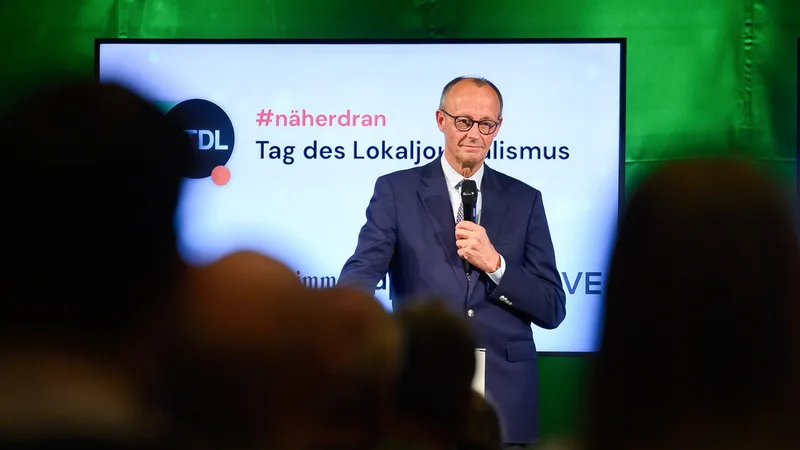
Chancellor Friedrich Merz cannot ignore the development politically. Deriving a single cause from two regional results would, however, be too simple. State-level figures, government records, campaigns and competition differ. The result proves a heavy defeat for the CDU and a changed party landscape; on its own it does not prove which single decision by the federal government persuaded voters.
Original sources
- State returning officer Mecklenburg-Vorpommern: results of the 2026 Landtag election
- Landtag of Mecklenburg-Vorpommern: electoral system and the 2026 Landtag election
- State returning officer Berlin: preliminary result of the House of Representatives election
- State returning officer Mecklenburg-Vorpommern: notes on the status of the result
- State returning officer Mecklenburg-Vorpommern: 2021 result