
Clean-Up Day: Why Full Litter Bags Don't Prove Success
On 19 September Switzerland cleans up. What matters is what stays lying on the ground afterwards.
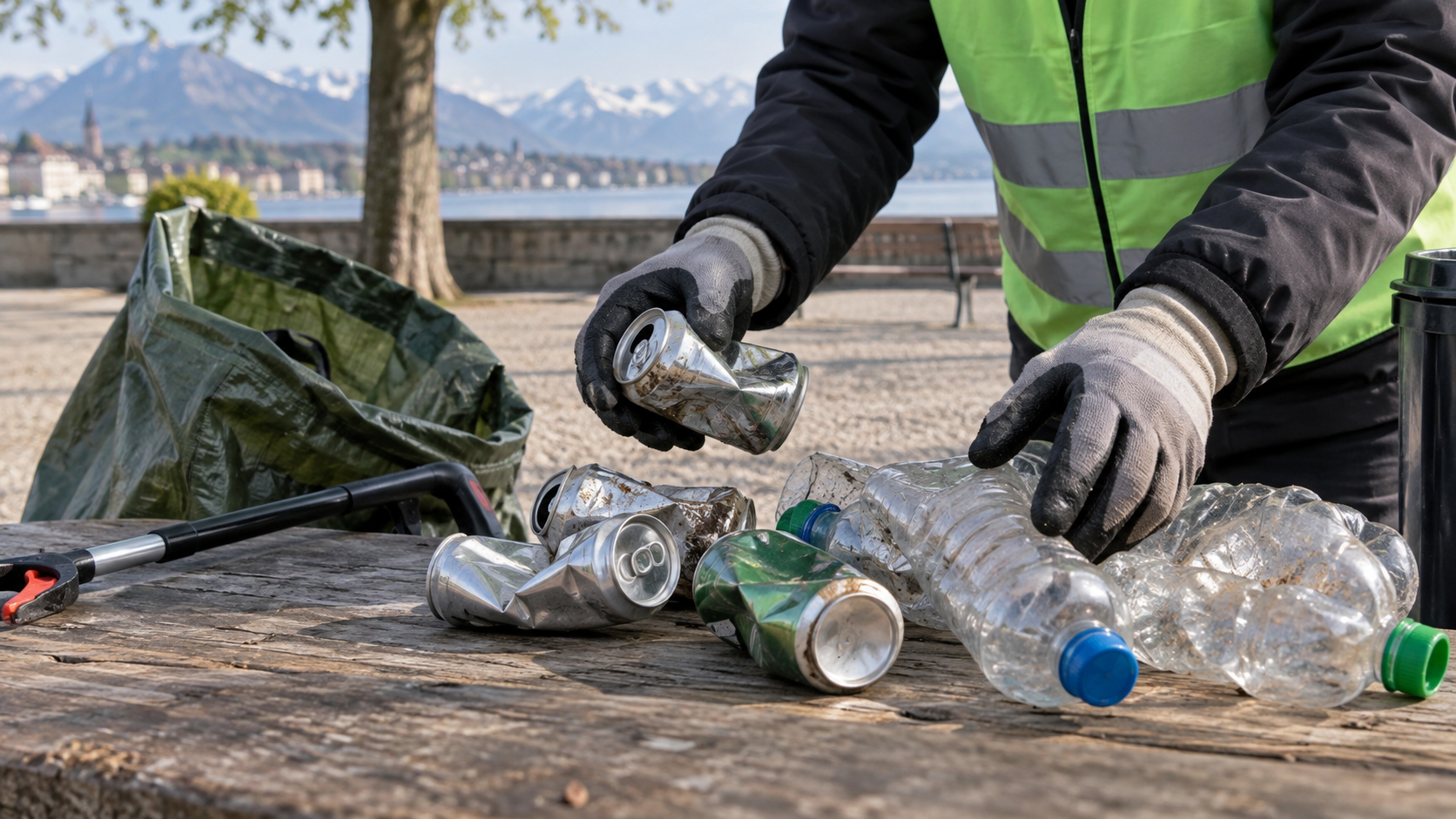
At the end of a clean-up day, the bags can be counted. That produces a vivid photo and a simple tally. For the volunteers at the national Clean-Up Day on 18 and 19 September 2026, the litter they collect is also a visible result of their work. But whether a municipality is shrinking its littering problem is not answered by that number. For that, less new waste would have to end up on the ground later on.
The difference is more than a statistical nicety. A particularly large haul can stand for a thorough effort, for many helpers, or for an area that was heavily littered beforehand. A small amount, by contrast, can already indicate good conditions. Without details on area, time and prior cleaning, such tallies are barely comparable.
What a field experiment actually shows
More concrete indications come from a study published by IGSU, the interest group for a clean environment (Interessengemeinschaft für eine saubere Umwelt). In 2025, different measures were tested over ten weeks at 26 recreational sites in nine Swiss cities. The results presented in January 2026 concern picnic areas, for example. Across the measures examined, littering fell by roughly one third on average, according to IGSU.
For a combination of measures, the organisation states a reduction of 49 percent. That is a notable finding. But it is neither a success rate for the Clean-Up Day nor a promise that every municipality can halve its litter. Specific sites, interventions and periods were studied. Even a follow-up observation lasting two weeks does not yet prove a lasting change in behaviour over years.
Still, a practical question can be derived from the experiment: which combination suits the particular site? A badly placed bin is a different problem from a lack of attention to discarded packaging. Anyone who lumps both together under the blanket accusation of insufficient discipline overlooks possible local improvements.
An old cost figure is often read as a new one
The Federal Office for the Environment puts the annual cost of cleaning up litter at around 200 million francs. This frequently cited order of magnitude goes back to a study published in 2011. It is not a freshly compiled set of accounts for 2026. Anyone who turns it into a current per-capita calculation conveys a precision that the source does not provide.
The costs do illustrate why voluntary efforts cannot replace regular cleaning. The FOEN relies on an interplay of different approaches: infrastructure, information, awareness-raising and further measures. A collection removes the litter that is there. Prevention is meant to stop new litter appearing immediately afterwards. Both tasks complement each other, but they require different measures of success.
What municipalities could check after Saturday
For a more meaningful tally, comparable areas would have to be observed repeatedly. How much new litter lies there after a similar period of use? Were the same number of people around? Was the area cleaned in the meantime, did it rain, was there a festival? Such circumstances make the analysis more laborious. But they prevent a quiet day from appearing falsely as the effect of a campaign.
That is an editorial conclusion drawn from the differing informative value of the indicators, not a proven effect of any single municipal programme. The interests of the sources are part of the picture too: IGSU organises the day of action and runs litter prevention work. Its study is a useful finding, but not an independent national evaluation of the success of its own Clean-Up Day.
Taking part still makes sense
Joining in does not require settling this fundamental debate. IGSU coordinates local actions; municipalities publish meeting points and organisational details. In Lengnau, for example, a joint effort is announced for Saturday. Anyone who wants to take part should follow the details given by the respective organiser instead of inferring identical procedures everywhere from the national date.
The immediate benefit remains undisputed: what is collected properly is no longer lying on the bank or in the square afterwards. The more demanding kind of success only shows afterwards. Perhaps the most convincing photo of the next Clean-Up Day would therefore not be a mountain of bags, but the same place a week later – clean, even though people were there again.
Sources
IGSU: national Clean-Up Day · IGSU: field studies and 2025 results · FOEN: Littering · Confederation: cost study of 5 May 2011 · Municipality of Lengnau: 2026 action


