DDPS Focuses on Drones and Robotics
New Centre and Drone Battalion Planned from 2028
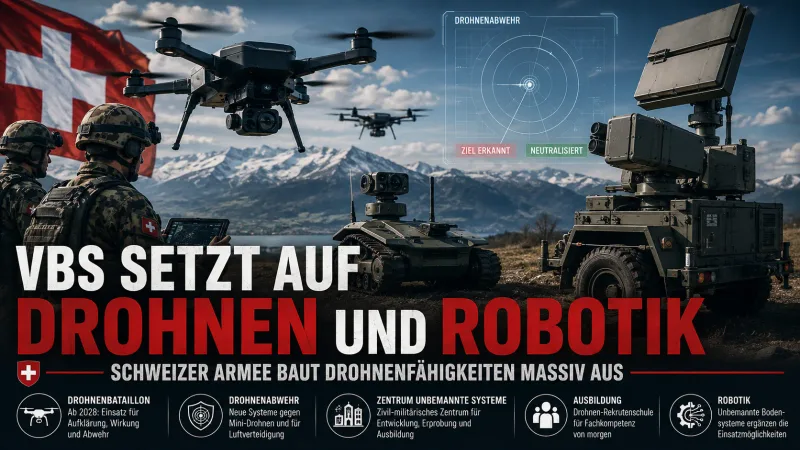
Swiss Army Massively Expands Drone Capabilities
The Swiss Army is adapting to warfare where drones, counter-drone measures, and robotics play a central role. The Federal Department of Defence, Civil Protection and Sport (DDPS) is establishing a new civil-military centre for this purpose. It is also setting up its own drone battalion and a drone recruit school.
The DDPS announced on August 27, 2026, that drones, counter-drone measures, and robotics will constitute a strategic focus in the future. This initiative is part of the army's reorientation, decided in June. The Federal Council then determined that a first drone battalion should be established by 2028. :contentReference[oaicite:8]{index=8}
A New Centre for Drones and Robotics
The core of the new strategy is the Uncrewed Systems Centre. It aims to merge civil and military expertise and comprises a Tech Hub and a military command.
The Tech Hub will link the troops' needs with the technical knowledge of armasuisse, universities, start-ups, and industry. New systems are to be jointly developed, tested, and made operational for military use as quickly as possible. The military command will handle realistic testing and training for the new drone battalion, among other tasks.
The centre will not be exclusively for the army. Other departments, cantons, and emergency services will also have access. The DDPS aims to improve collaboration between military and civil authorities this way.
Drone Battalion to Arrive in 2028
From 2028, the army plans to deploy its own drone battalion. It is intended for reconnaissance, effect, and defence. Concurrently, a dedicated drone recruit school will build the necessary expertise and supply the battalion with appropriately trained army personnel.
The term "drone battalion" is somewhat narrow. The army also includes ground robotics under uncrewed systems. According to the DDPS, the new battalion will therefore consider the entire spectrum of relevant capabilities.
This decision is part of the army's reorientation, decided in June. At that time, the Federal Council identified counter-drone measures, electronic warfare, intelligence gathering, and the deployment of uncrewed systems as capabilities requiring priority expansion given the current threat situation. :contentReference[oaicite:9]{index=9}
Switzerland Already Invests in Counter-Drone Measures
The new strategy does not start from scratch. The army already possesses drones of various sizes for reconnaissance and has introduced initial counter-drone systems. Further investments are planned with the Armament Programme 2026.
For the defence against mini-drones alone, the Federal Council is requesting an appropriation credit of 70 million Swiss francs. A mobile, modular system designed to detect, identify, and neutralise small drones is planned. Various sensors and effectors are to be used. Implementation with the troops is scheduled from 2028. :contentReference[oaicite:10]{index=10}
Furthermore, ground-based air defence is to be expanded. Approximately one billion Swiss francs are allocated in the Armament Programme 2026 for two additional fire units of the IRIS-T SLM system. Another 800 million Swiss francs are earmarked for short-range ground-based air defence. These systems are also intended for use against drones, among other threats. :contentReference[oaicite:11]{index=11}
Procurement to Become Faster
The DDPS draws a conclusion from rapid technological developments: The army aims to procure drone and counter-drone systems more targeted, in smaller quantities, and with shorter procurement cycles in the future.
This approach aims to prevent the army from clinging to a system for years while technology has already advanced. Systems proven in practical use are to be rapidly further developed and integrated into the troops.
This approach differs from traditional large armament projects. Particularly with drones, technical capabilities can change significantly within a few years. Therefore, the army plans to rely more on trials and smaller procurements.
Swiss Industry to be More Involved
Another focus is collaboration with the Swiss technology sector. The army already established a Drone Task Force in 2024. Its objectives include promoting the development and production of drones in Switzerland and reducing reliance on foreign suppliers. :contentReference[oaicite:12]{index=12}
ETH Zurich also sees a need for action. A study by the Center for Security Studies concludes that Switzerland could establish a production network for military small drones in case of tension or defence. Private and state actors should cooperate more closely. :contentReference[oaicite:13]{index=13}
Thus, the drone strategy acquires an industrial and technological policy dimension in addition to its military aspect. Switzerland aims not only to purchase ready-made systems but also to build its own knowledge and capabilities.
Who May Counter a Drone?
However, a central question remains unresolved: Who is responsible in Switzerland when a drone is detected over a sensitive object?
Currently, various authorities, agencies, and sometimes private infrastructure operators are involved. The DDPS has therefore established an interdepartmental working group to review existing responsibilities and legal bases.
The issue is also the subject of parliamentary motion 25.4410. It calls for clear responsibilities in protecting Swiss airspace in normal and extraordinary situations. The Senate's Security Policy Committee unanimously supported the motion in May. :contentReference[oaicite:14]{index=14}
This involves more than just technology. The question of who may detect, interfere with, or, if necessary, combat a drone must also be clearly regulated by law.
Part of a Broader Reorientation
The drone strategy is linked to a broader reorientation of the Swiss Army. The Federal Council aims to better align the army with defence and the most likely threats.
In the defence guidelines adopted in June, the Federal Council specifically names hybrid threats and attacks from a distance. By 2039, approximately 80 percent of investments are to be directed towards defending against the most likely threats. These include air defence, drones and counter-drone measures, and the protection of networks and critical systems. :contentReference[oaicite:15]{index=15}
Drones are therefore no longer just a standalone armament topic. They are becoming an integral part of the Swiss Army's future operational concept.
From the War in Ukraine to Switzerland
This development is strongly shaped by the experiences of modern conflicts. Small and inexpensive drones are increasingly used for reconnaissance, surveillance, and attacks. Concurrently, new forms of counter-drone measures are emerging.
The DDPS therefore also refers to the increasing importance of uncrewed systems for hybrid conflicts. According to the Department, drones are now increasingly detected over military and critical infrastructures in Switzerland. :contentReference[oaicite:16]{index=16}
However, the exact extent of this threat cannot be determined from the information published so far. The DDPS does not provide detailed statistics on detected drone flights.
Many Details Remain Open
Details such as the exact size of the drone battalion, its deployment location, and the total costs of the new centre are not yet known. Which specific drone systems will be procured in the future is also not yet fully determined.
The DDPS is consciously adopting a more flexible approach. Technology is to be tested first and then procured in shorter cycles. Concurrently, Parliament and the Federal Council must decide on the corresponding armament programmes and financial resources.
However, with the new centre, the drone battalion, and the drone recruit school, the strategic direction is clear: The Swiss Army no longer wants to treat uncrewed systems as a niche capability but aims to integrate them systematically into training, procurement, and operations.
Sources
- DDPS: Drones, Counter-Drone Measures and Robotics: DDPS Sets Strategic Focus to Strengthen Defence Capability
- DDPS: Guidelines for Defence – Federal Council Aligns Army with Defence Capability
- Swiss Army: Armament Programme 2026
- Swiss Army: Army Dispatch 2026
- armasuisse: Drone Task Force
- armasuisse: Questions and Answers on the Drone Task Force
- ETH Zurich, Center for Security Studies: A "Drone Production Network" for the Swiss Army
- Parliament: Senate Security Policy Committee on Motion 25.4410