Digital Customs in Switzerland: What's Changing at the Border
Less Paper, More Digital Control: How Swiss Customs are Evolving.
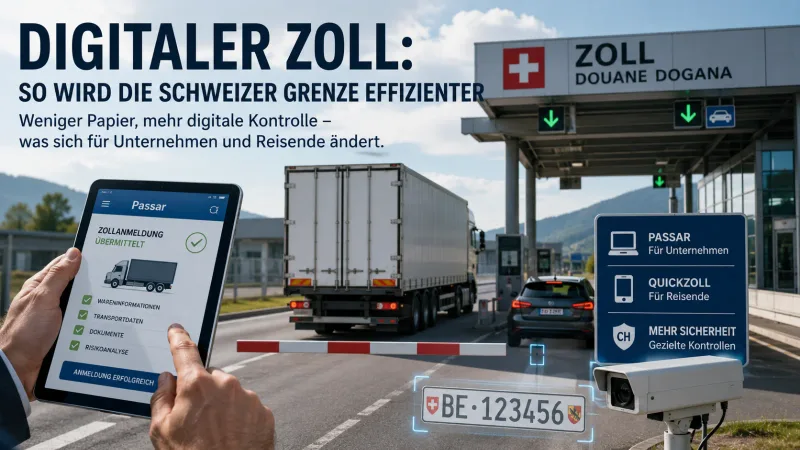
Today, those importing goods at the Swiss border often notice little of the digital transformation. For businesses, however, the change is already significant. Customs declarations, transport data, and security information are increasingly processed electronically. The goal: fewer administrative interruptions, faster processes, and more opportunities for targeted controls.
This is driven by the transformation program DaziT of the Federal Office for Customs and Border Security. The program will formally conclude at the end of 2026. However, the digitalization of customs and border processes will be far from over.
Passar Gradually Replaces Old Systems
A key component is Passar. This new goods traffic system aims to standardize the digital processing of customs procedures and gradually replace existing applications.
The transition to Passar is already complete for transit and export. For imports, however, the transition phase is still underway. The first companies are already testing the new system. The complete replacement of e-dec Import is scheduled for the end of 2027.
This is important: Passar is not yet a fully completed system as of September 1, 2026. Particularly for imports, digitalization is still being expanded. Companies are being transitioned to the new procedures step by step.
Border Processes to Become More Predictable for Businesses
For goods traffic, digitalization primarily means a change in procedures. Information can be transmitted and processed electronically even before the actual border crossing.
This aims to make customs clearances more efficient. Instead of processing all information only at the border, certain data can be available beforehand. This allows the FOCBS to assess risks more precisely and implement controls where they truly seem necessary.
For businesses, this can offer advantages, especially with regular goods flows. The better the data is prepared and processes are automated, the less frequently a shipment should be delayed at a border crossing due to purely administrative issues.
More Digital Control Does Not Mean Fewer Customs Controls
This is a crucial point: digitalization does not mean that the Swiss border will be controlled less.
Instead, the nature of controls is expected to change. The FOCBS intends to utilize existing data more effectively to identify risks before or during the border process. This allows for more targeted controls, while un problematic goods can proceed as smoothly as possible.
This also aligns with the core idea of DaziT: customs processing and duty collection should become more efficient, while border security should be strengthened. For the state, this involves two goals that appear contradictory at first glance: less administrative friction and more targeted control.
What Does the EU Have to Do With It?
Switzerland is not digitalizing its customs in isolation. Cooperation with the European Union on goods traffic security plays a vital role.
This specifically includes ICS2, the European Import Control System for goods from third countries. Certain freight information is collected before import. Switzerland is integrated into this common security area due to the agreement on customs facilitation and security with the EU.
However, this does not mean that Switzerland simply aligns its entire customs system with that of the EU. Passar is the Swiss goods traffic system of the FOCBS. ICS2, in contrast, serves a different function: it primarily concerns advance information and security analyses for goods from third countries.
And What Do Travellers Notice?
For private individuals, digitalization partly involves other applications. One example is QuickZoll. With the official FOCBS app, travellers can independently declare goods for private use or as gifts and pay due duties before crossing the border.
Those who meet the requirements can simplify customs clearance without having to stop at a staffed customs counter. QuickZoll, however, is not the same as Passar: the app is aimed at private individuals, while Passar concerns professional goods traffic.
QuickZoll was further developed in 2026 for VAT as well. The app now considers both the standard VAT rate of 8.1 percent and the reduced rate of 2.6 percent.
Automated Border Processes Are Not Yet Widespread Reality
Automated border processes are frequently mentioned in connection with DaziT. One should distinguish between already introduced digital procedures and future automation steps.
For example, the automated activation of goods declarations plays an important role in Passar. The aim is that certain processes can be triggered without manual intervention at the border crossing.
However, fully automated border crossings are not an overnight reality. The FOCBS is developing corresponding systems step by step. Therefore, the digitalization of customs clearance is more of a long-term transformation than a single deadline when everything suddenly works automatically.
Data Protection Becomes More Important
With digitalization, the importance of data simultaneously grows. The more customs and security processes rely on electronic information, the more crucial questions surrounding access, processing, and protection of this data become.
For businesses, the transition therefore means not only new technical possibilities but also, in some cases, adaptations to their own systems and processes. They must provide data correctly and on time for automated procedures to function.
DaziT Concludes – Digitalization Continues
The conclusion of DaziT at the end of 2026 thus marks a transition rather than the end of digitalization. Many key projects are already implemented, while others are still being introduced.
Especially for imports, a major step is still ahead with the replacement of e-dec Import by Passar by the end of 2027. For the economy, how smoothly this transition functions will be crucial.
For Switzerland, this involves more than just paperless customs forms. Digital customs aim to move goods faster across the border, reduce administrative burdens for businesses, and simultaneously enable authorities to identify risks earlier and more precisely.
The border does not disappear – it becomes more digital. For travellers and businesses, this could long-term mean that less of the control is visible. For customs authorities, however, it means more data, more automated processes, and new opportunities to look closer where a risk exists.
Sources
- Federal Office for Customs and Border Security (FOCBS): DaziT and Digital Transformation
- Federal Office for Customs and Border Security (FOCBS): Passar
- Federal Office for Customs and Border Security (FOCBS): Passar Import and Roadmap
- Federal Office for Customs and Border Security (FOCBS): Import Control System 2 (ICS2)
- Federal Office for Customs and Border Security (FOCBS): QuickZoll