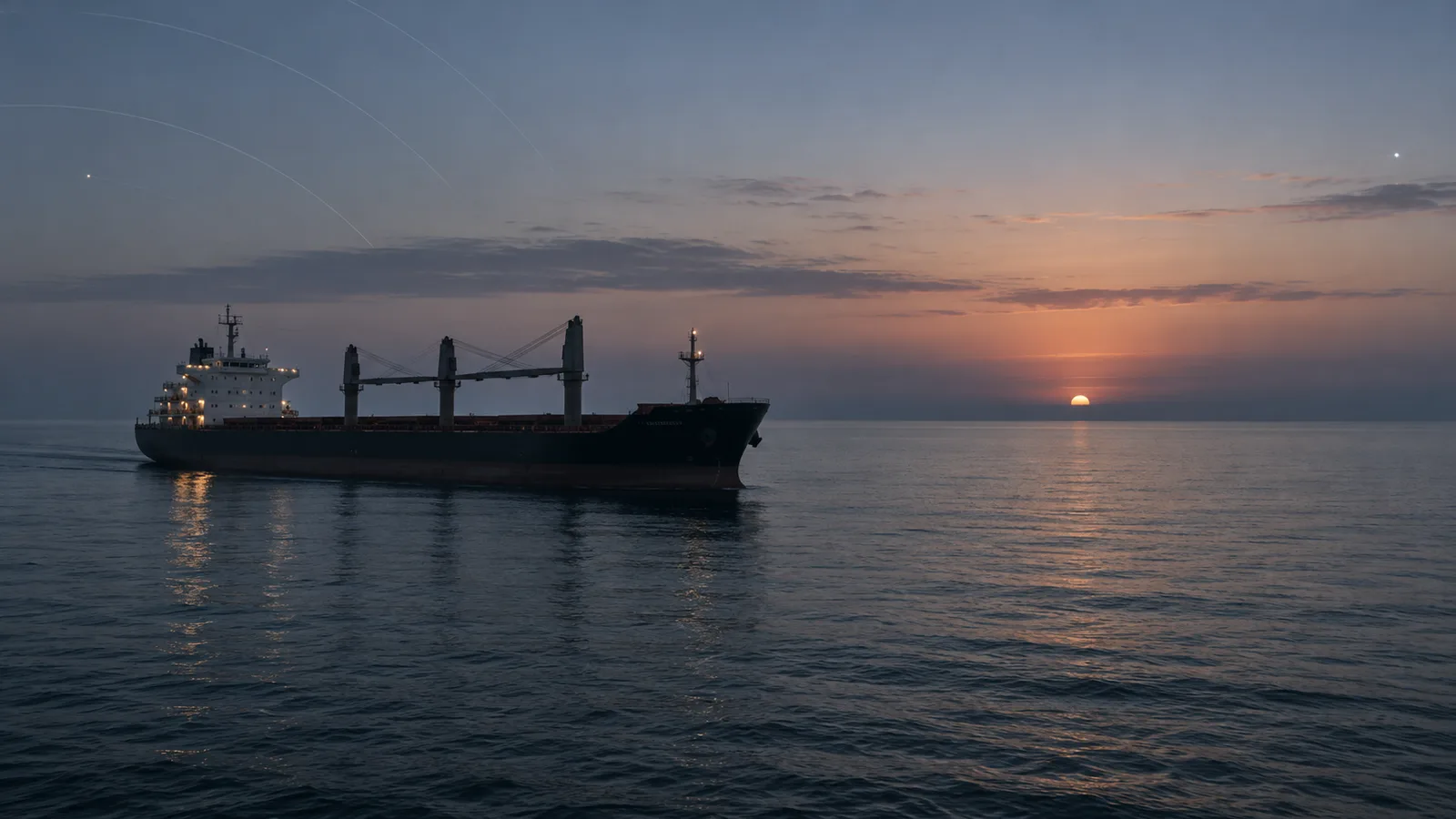
Drones in the Black Sea: Why Swiss firms must read the facts first
After attacks on merchant ships off Romania and Bulgaria, the situation in the Black Sea has become more dangerous. But the authorship of individual incidents was initially not officially clarified.
After a fatal ship fire in Romania's exclusive economic zone and confirmed drone attacks on two merchant ships off Bulgaria, the assumption of a connected escalation is close at hand. Yet precisely with incidents at sea, the first duty of reporting is not to outrun the investigation. What happened in the western Black Sea in early October is grave enough — even without a hasty attribution of blame.
Romania's interior ministry reported on 5 October the rescue of eleven crew members and two deaths after a fire broke out on a merchant ship in the exclusive economic zone. The initial statement names neither a cause nor those responsible. For this incident, therefore, only the narrower factual basis is established: fire, rescue operation and deaths. At that point the authority could make no conclusive statement about the trigger or the authorship.
The following day, the Bulgarian government stated that two merchant ships had been attacked in its exclusive economic zone with aerial and naval drones. One ship had sunk, the second had been damaged; a rescue operation was under way. The Bulgarian statement named no responsible party. The phrase «Moscow under suspicion» is therefore only journalistically sound if it remains marked as suspicion — not as fact.
Two incidents, two different levels of evidence
This distinction is not a linguistic quibble. It determines whether the public, shipping companies and authorities react to verifiable findings or to conjecture. The Romanian case is officially documented as a fire on a merchant ship with a rescue operation. In the Bulgarian case, the use of aerial and naval drones is officially confirmed. For both events, the statements cited lacked a conclusive public attribution.
The fact that no responsible party has been officially named neither relativises the danger nor the claim to protection of civilian seafarers. The International Maritime Organization (IMO) explicitly condemns attacks on merchant ships in the Black Sea and the Sea of Azov. It points to dangers for crews, navigation, supply chains and the marine environment. Its statements also show why careful language is necessary: in a war zone, individual reports, technical findings and political assessments can diverge in timing.
For the crews, the threat is immediate. For trade, higher premiums, stricter security requirements, detours or the temporary suspension of certain port calls often follow. A price impulse can emerge from this. It is not automatic: whether Swiss households pay more for bread, oil or other goods also depends on harvests, inventories, exchange rates, contracts and alternative routes.
It is precisely this chain that makes robust information economically valuable. A shipowner plans a route differently from a trader who hedges the timing of a cargo. Insurers distinguish between a single event, a persistent danger zone and a proven escalation. Different premiums and contract terms follow from this. That describes a mechanism, not a forecast of a specific price or an imminent supply gap in Switzerland.

Switzerland has no sea, but it is present in trade
The Swiss perspective does not end at the Rhine. The State Secretariat for Economic Affairs (SECO) describes Switzerland as a major hub of international commodities trading. Many of the goods traded by companies based here do not physically cross Switzerland. Their financing, inspection, insurance or contract settlement, however, can take place here. When a route becomes less secure, the demands on risk assessment and information quality rise — including for firms in Geneva, Zug or Lugano.
Add to that the Confederation's support for Ukraine. According to its own statement, Switzerland supports an FAO project to secure the Ukrainian grain harvest. The federal government names attacks on ports, transport ships and agricultural infrastructure as obstacles to exports. From this follows a Swiss humanitarian and economic interest in functioning transport routes, without Switzerland thereby becoming a party to the conflict.
For companies, the practical question is therefore not whether to treat every report as certainty at once. What matters are robust situational assessments, clear insurance terms and an examination of which routes and contracts are actually affected. The same applies to policy: first the confirmed incident, then the documented authorship, then the appropriate consequence.
The events off Romania and Bulgaria show how close the war is moving to Europe's civilian infrastructure. For the average Swiss citizen this does not necessarily mean an immediate jump in prices at the shop. But it does mean that secure sea routes, reliable information and resilient supply chains are part of Switzerland's economic security. Precision here is not a gesture of caution but the precondition for an appropriate response.
Sources
- Romanian interior ministry: rescue operation after ship disaster in the Black Sea, 5 October 2026
- Bulgarian government: attack on two merchant ships in Bulgaria's economic zone, 6 October 2026
- International Maritime Organization: attacks on civilian merchant ships in the Black Sea
- IMO: security situation and inconclusive attributions in the Black Sea and the Sea of Azov
- Federal communication: Switzerland supports the safeguarding of the Ukrainian grain harvest
- SECO: the significance of commodities trading for Switzerland