EU and Canada: Summit draft sets 2027 as partnership target
According to Bloomberg, the scope of an associated membership is to be defined by the next summit in 2027. The report concerns a declaration text at draft stage – not a completed EU accession.
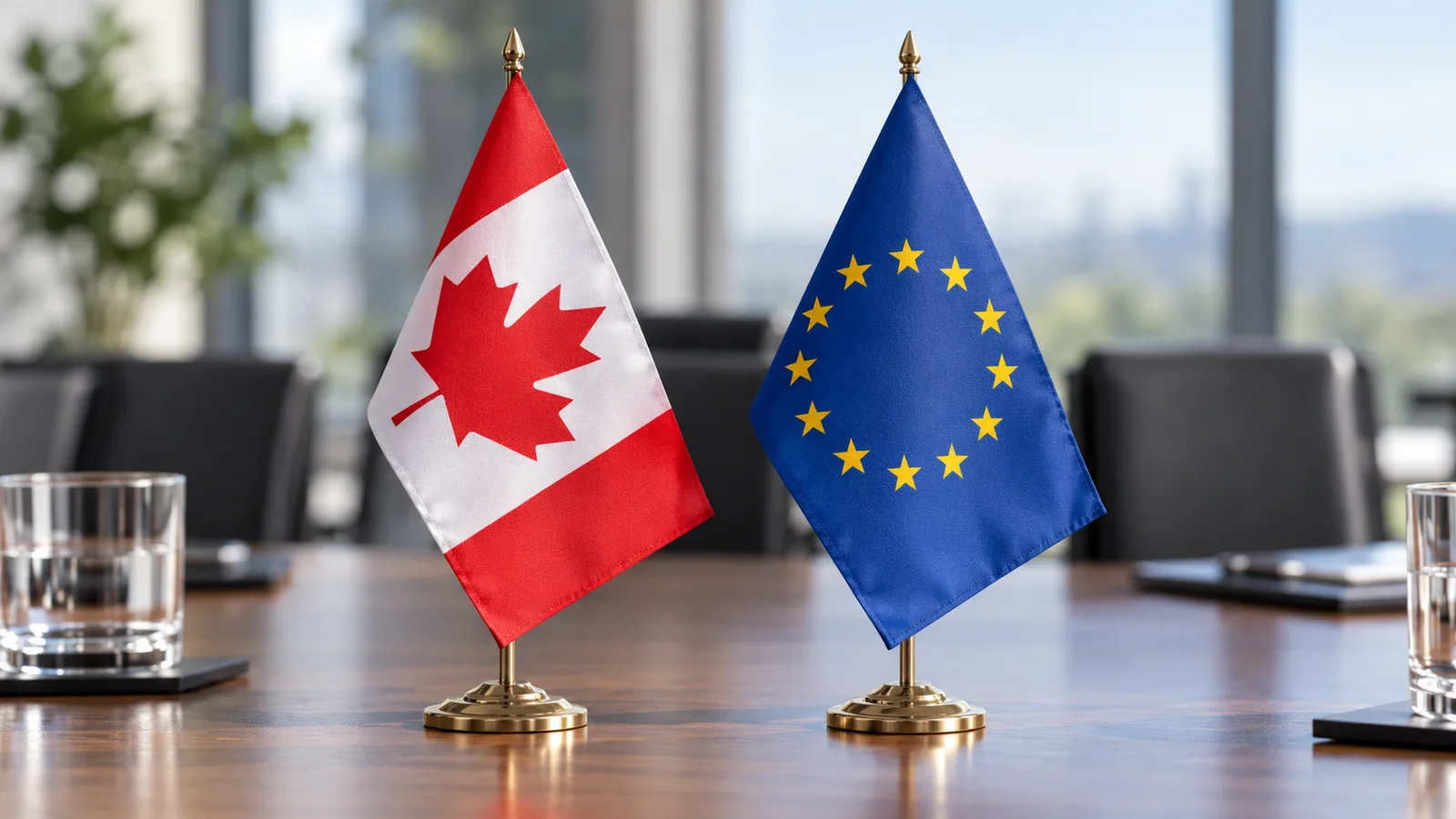
The European Union and Canada intend to define their new partnership more precisely by the 2027 summit, according to a report by Bloomberg. In its report of 20 October 2026, the agency cites the draft of a joint declaration for the upcoming meeting in Montreal. The timetable mentioned there is therefore a reported negotiating goal, not an agreement already in force.
The European Council confirms the summit for 29 and 30 October. The European Commission likewise describes the intention to deepen relations with Canada substantially. For companies, researchers and travellers this does not yet mean any immediately usable new rights. What matters is which provisions both sides actually adopt and subsequently implement.
An invitation is not yet a legal status
Commission President Ursula von der Leyen had held out the prospect of a first associated membership for Canada in September. Canada's Prime Minister Mark Carney welcomed this approach on 17 September in the European Parliament. At the same time he spoke of an alliance that both sides would have to define together.
That very definition is still outstanding. In the public statements reviewed, the term denotes a political project, not an already adopted uniform catalogue of rights and obligations. It therefore supports neither the conclusion that Canada will become a regular EU member in 2027, nor the claim that the new cooperation will necessarily remain purely symbolic.
The EU treaties distinguish between different paths. Article 217 of the Treaty on the Functioning of the EU enables association agreements with third countries, combined with mutual rights and obligations, common action and special procedures. Accession to the Union, by contrast, is governed by Article 49 of the EU Treaty. What legal architecture the new Canadian partnership is to receive cannot be determined from the political name alone.
Where binding rules already apply today
Research offers a concrete example. Canada has participated in the second pillar of Horizon Europe since 2024. The associated protocol sets out the scope of participation and the financial contribution. It concerns joint projects on global challenges and industrial competitiveness – not general membership of the EU.
According to the Commission, Canadian entities can receive funding directly in this programme part and coordinate research consortia. The conditions are therefore far more tangible than the general announcement of closer relations. At the same time, the restriction to one programme part shows why an association must always be read closely.
A separate agreement already exists for defence procurement as well. The Council of the EU decided to conclude it on 15 June 2026. It governs the participation of Canadian companies and products in procurement under the SAFE instrument. Canada is the first non-European participant. That is a sectoral opening, not blanket access to all European markets.
Ambitions are not to be confused with entitlements
In his September speech, Carney proposed deeper cooperation in areas including critical raw materials, energy, artificial intelligence and payment systems. He also named better opportunities for young people to live, work and study on both sides of the Atlantic as a goal.
These are political proposals. The speech creates neither general freedom of movement nor automatic mutual recognition of all professional qualifications. Anyone planning a concrete investment, application or course of study must still follow the rules currently in force. Only a binding text could show which hurdles actually fall and which remain.
The Commission, for its part, names possible priorities such as raw material investment, the removal of digital trade barriers and closer links between the defence industries. The common denominator is economic and strategic resilience. How far rules should be aligned, contributions made or decision-making procedures shared remains to be worked out.
What matters in Montreal
The journalistic test of the summit is therefore not solely whether the phrase «associated membership» appears in the final declaration. What matters are concrete mandates: which areas are to be negotiated, who decides, and which deadlines become binding?
A target year of 2027 can structure the process. But it replaces neither negotiations nor the legal steps for individual agreements. Only when the political invitation turns into verifiable commitments can it be judged how new this partnership actually is.
Sources
- European Council: EU–Canada summit on 29 and 30 October 2026
- European Commission: relations with Canada and the planned partnership
- Prime Minister of Canada: Carney's address to the European Parliament
- EUR-Lex: Article 217 – association agreements
- EUR-Lex: Article 49 – accession to the European Union
- EUR-Lex: agreement on Canada's participation in EU programmes
- European Commission: conditions of Canadian participation in Horizon Europe
- Council of the EU: conclusion of the SAFE agreement with Canada
- Bloomberg: report on the summit draft and the 2027 target year