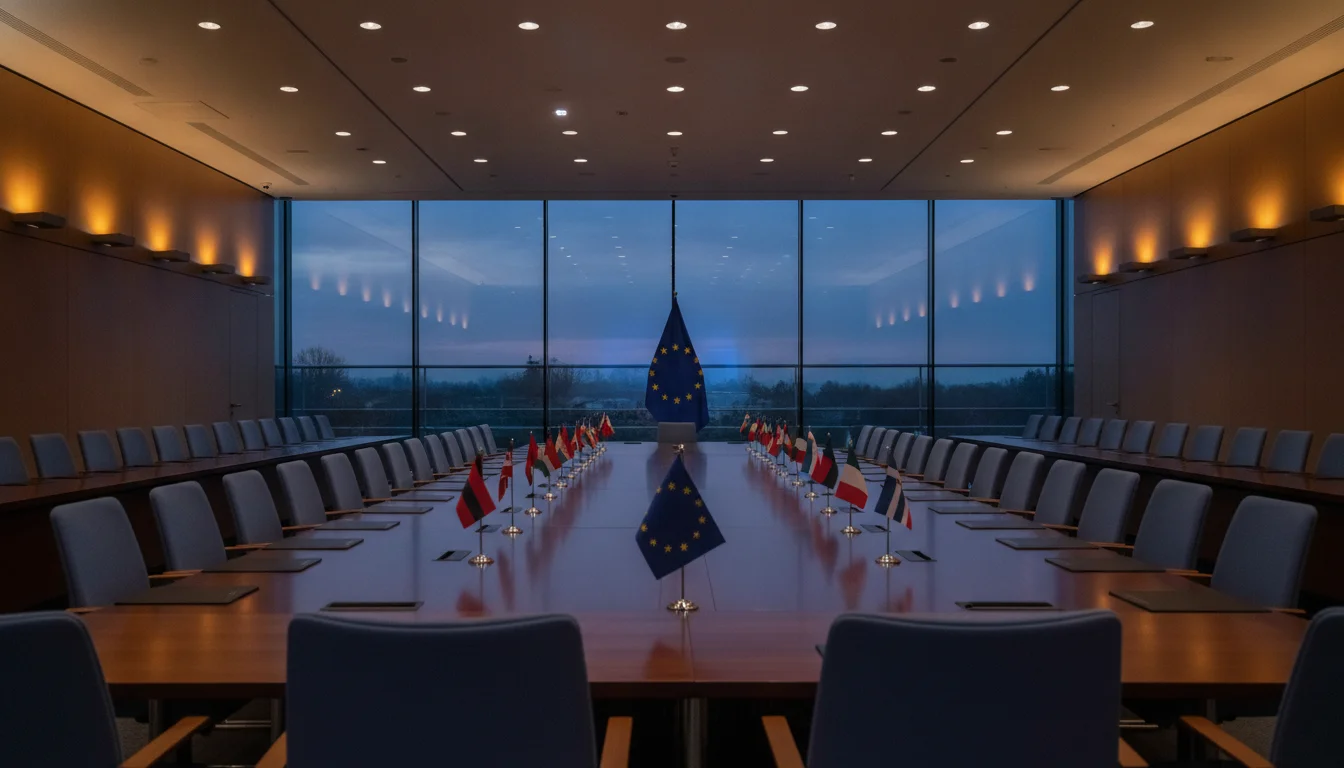
EU enlargement: when a veto overshadows reform progress
EU states can block accession talks even when the dispute is not directly tied to the reform criteria. The debate over majority voting targets exactly this gap.
A consensus procedure with political leverage
Joining the European Union is a long process. Candidates must bring their law, institutions and economy closer to the EU acquis; the European Commission assesses the progress. Politically, however, the Council remains decisive: key steps in the accession negotiations require unanimity. Every member state therefore holds a veto. That right protects national interests, but it can also carry conflicts into the enlargement process that have only a marginal connection to a candidate's reform record.
In its overview, Deutsche Welle describes several such blockades. The cases differ; a blanket accusation would therefore be wrong. But the pattern is familiar: bilateral disputes, minority policy, historical questions or domestic political signals can influence a candidate's timetable. For candidates, that is hard to convey. Reforms can be implemented and monitored – the political consent of a single member state cannot be «worked through» technically.
Why the EU is debating majorities
In October, the European Commission proposed allowing the opening of negotiation chapters by qualified majority in future. Concluding an accession would still require unanimity. The idea therefore does not remove the protective mechanism entirely; it aims to prevent talks from getting stuck right at the start. Whether member states want to change the necessary rules for this is open.
Supporters see this as a response to the geopolitical situation. The EU has opened a European perspective to Ukraine, Moldova and several Western Balkan states. If the path is perceived as arbitrary or unpredictable, that weakens incentives for reform. Critics counter that enlargement cuts deep into national sovereignty, budgets and security. Precisely for that reason, no state should be bypassed.
A veto is not a quality check
Both can be true: a veto can bundle legitimate concerns and still, in a specific case, answer the wrong question. The rule of law, anti-corruption efforts and independent courts must be assessed against traceable criteria. Bilateral demands should not invisibly take the same place. Transparent reasoning and verifiable milestones would be more credible for candidates and for the EU alike than years of uncertainty.
Institutional reform alone does not solve the political difficulty. Even with majority decisions, member states remain responsible for admitting a new country. Moreover, faster negotiations can raise false expectations if implementation lags behind. The purpose of a reform would therefore have to be to make procedures more predictable, not to lower standards.
The view from Switzerland
Switzerland is not a candidate for accession but is closely tied to the EU through its bilateral treaties. For Bern, the enlargement debate is therefore not remote: it influences how the Union organises its neighbourhood, its internal market and its strategic capacity to act. Swiss companies and universities also watch whether rules and market opportunities in the candidate countries converge.
The actual lesson is: a veto right does not replace a reasoned enlargement policy. Where political blockades and technical criteria are mixed, both lose credibility. For Europe – and for its neighbours – a procedure is valuable that remains true to high standards and still visibly works according to rules.
Reform pace needs verifiable signals
For candidate countries, not only the outcome matters but the feedback along the way. When chapters are opened or closed, it should be clear which rule-of-law and economic requirements were decisive. It should likewise remain visible when a member state raises a bilateral question that lies outside these criteria. That creates no entitlement to accession. But it prevents enlargement policy from losing its incentive function.
The EU itself also gains from this. It can explain to its citizens why it is bringing a country closer to the internal market or why it is applying the brakes. Credible enlargement does not rest on speed at any price, but on traceable stages and honest communication about political trade-offs.
Sources
- Deutsche Welle: flood of vetoes against EU candidates
- European Commission: enlargement policy
- Council of the EU: enlargement
- FDFA: Switzerland–EU relations