Ratko Mladić Dead: War Criminal Dies at 84 in The Hague
Former Bosnian Serb army chief sentenced to life in 2017. His death raises questions about international criminal justice.
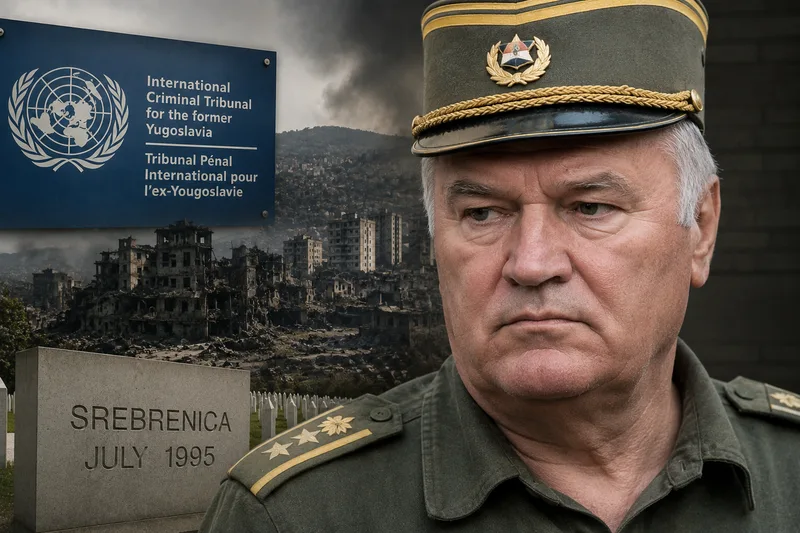
Ratko Mladić is Dead: The Man Behind Srebrenica and the Siege of Sarajevo
Ratko Mladić, former commander-in-chief of the Bosnian Serb army, has died at the age of 84. Mladić was serving a life sentence in The Hague for genocide, crimes against humanity, and war crimes. He was a central figure of the Bosnian War.
Serbian media initially reported his death. International news agencies and media then picked up the story. According to several sources, Mladić died in a United Nations prison hospital in The Hague. A high-ranking UN official confirmed his death to the German Press Agency.
A Key Figure of the Bosnian War
Ratko Mladić was born in Bosnia in 1942 and pursued a military career after World War II. In May 1992, he took command of the General Staff of the Army of Republika Srpska. He held this position for most of the Bosnian War.
Under his command, Serbian forces controlled large parts of Bosnia. The international war crimes tribunal later found that Mladić played a leading role in campaigns to expel Bosnian Muslims and Bosnian Croats.
Key charges also included the years-long Siege of Sarajevo. Serbian troops shelled the Bosnian capital and threatened it with snipers. The court determined the campaign's goal was to spread terror among the civilian population.
Srebrenica Became a Symbol
Mladić gained international notoriety for his role in the Srebrenica massacre in July 1995. Bosnian Serb forces captured the enclave, which the United Nations had declared a safe zone.
In the following days, over 8,000 Bosniak men and boys were murdered. Women, children, and elderly people were forcibly expelled from the region. The massacre is considered genocide and one of the gravest crimes in Europe since World War II.
The subsequent UN war crimes tribunal found that Mladić had a leading role in the operation. International justice viewed his actions as an attempt to permanently eliminate the Bosnian Muslim population of Srebrenica.
16 Years on the Run
Mladić was indicted by the International Criminal Tribunal for the former Yugoslavia in 1995. He was accused of genocide, crimes against humanity, and war crimes, among other charges.
After the war, he evaded arrest for years. He remained at large for approximately 16 years in total. In May 2011, he was arrested in Serbia and then transferred to The Hague.
The trial before the International Criminal Tribunal for the former Yugoslavia began in 2012. In November 2017, Mladić was sentenced to life imprisonment for genocide, crimes against humanity, and violations of the laws and customs of war.
Verdict Confirmed in 2021
Contrary to a previous version of this article, the conviction did not remain in an open appeal process. The Appeals Chamber of the International Residual Mechanism for Criminal Tribunals upheld the judgment on June 8, 2021.
Thus, the convictions for genocide, persecution, extermination, murder, deportation, and other inhumane acts, as well as for further war crimes, were confirmed. The life sentence also remained in force. The UN Mechanism now considers the proceedings closed.
The judges thereby confirmed Mladić's central responsibility for the crimes in Srebrenica, the campaign against the civilian population of Sarajevo, and other crimes during the Bosnian War.
No Remorse Until the End
Mladić denied the legitimacy of the proceedings and showed no remorse for the acts he was accused of during the trial. At the same time, he remained a controversial symbolic figure for a part of the Serbian population. While victims' associations and international institutions viewed him as responsible for severe war crimes, sections of the Serbian and Bosnian Serb communities continued to portray him as a military leader and national hero.
His death thus concludes the life story of a man whose name is linked to the crimes of the Bosnian War like few others.
A Case of Historical Importance for International Justice
The trial against Mladić was one of the most significant cases in international criminal justice following the Yugoslav Wars. The proceedings meticulously documented military operations, expulsions, attacks on civilians, and the events in Srebrenica.
With the confirmation of the verdict in 2021, it was definitively established that Mladić was criminally responsible for central crimes of the Bosnian War. His death therefore changes nothing regarding the legal outcome of the proceedings.
For the victims and their families, addressing the crimes remains a long-term task. Srebrenica, in particular, remains a central reference point for remembering the Bosnian War and for understanding the limits, but also the possibilities, of international criminal justice.