SNB Faces Difficult Balancing Act: Strong Franc, Oil Prices, and Uncertain Global Economy
Strong Franc, Oil Prices, and US Tariffs Pose New Challenges for Swiss Monetary Policy
Lausanne – The Swiss National Bank currently faces a problem that other countries might envy Switzerland for: inflation is low. Very low, in fact. However, this is not automatically good news for the SNB.
While prices remain relatively stable in Switzerland, the Swiss economy is simultaneously influenced by a strong franc, high global economic uncertainty, new trade barriers, and fluctuating energy prices.
Petra Tschudin, a member of the SNB Governing Board, outlined the current challenges at an EPFL event in Ecublens on August 31. Her message can be summarized simply: Monetary policy works – but the environment has become more unpredictable.
The Policy Rate Stands at Zero
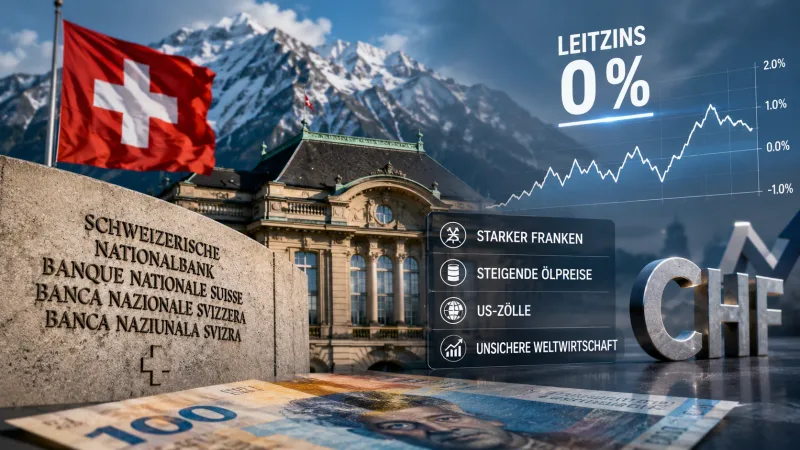
The SNB has kept its policy rate at 0 percent since June 2026. This means the scope for further interest rate cuts is virtually exhausted.
This is a unique situation for monetary policy. The policy rate is the SNB's most important instrument. Through it, the SNB influences financing costs in Switzerland, lending, and indirectly, the exchange rate.
With a policy rate of zero percent, another instrument becomes particularly important: the Swiss franc exchange rate. The SNB can intervene in the foreign exchange market if necessary to counteract a rapid and excessive appreciation.
The Franc Is Strong – But the Story Is More Complex
The strong franc is a double-edged sword for Switzerland.
For consumers, a strong franc initially has pleasant aspects. Imports can become cheaper, as can holidays abroad or purchases in Euro and Dollar countries.
For companies selling goods abroad, the calculation looks different. Swiss products become more expensive for foreign customers if the franc appreciates against their currency.
However, the SNB points out an important distinction: Nominally, the franc has appreciated since 2021. In real and trade-weighted terms, its development has been significantly more stable. This means that the competitiveness of the Swiss economy cannot be judged solely by the exchange rate against the Euro or Dollar.
Another factor is that Switzerland has had significantly lower inflation than many other countries in recent years. Part of the nominal franc appreciation therefore also reflects the differing price developments.
For Switzerland, This Is Both Good and Bad News
A strong franc makes imported goods cheaper, thereby dampening inflation. This assists the SNB in its statutory mandate to ensure price stability.
At the same time, a strong currency can slow down the economy. Export-oriented companies, in particular, face tougher international competition.
This is precisely where the monetary policy balancing act lies: What is good for consumers can become a problem for parts of the economy.
Therefore, the SNB does not simply try to keep the franc as weak as possible. Its mandate is price stability. The exchange rate is an important instrument and a factor that the central bank must consider in its decisions.
Then Came the Oil Price
A second source of uncertainty comes from commodity markets.
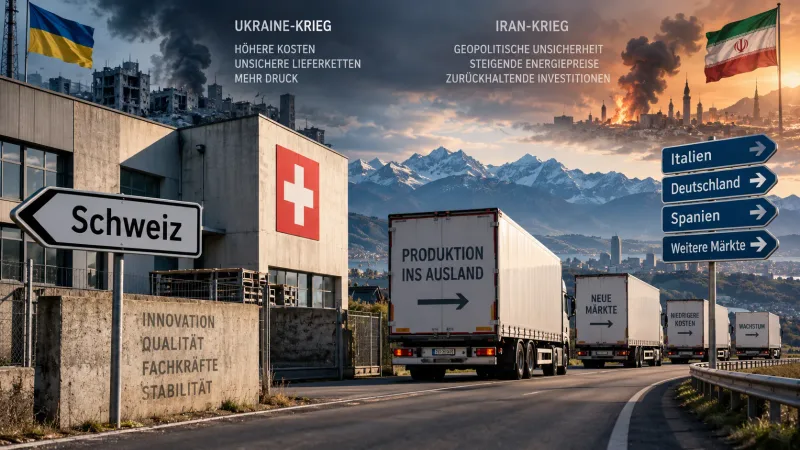
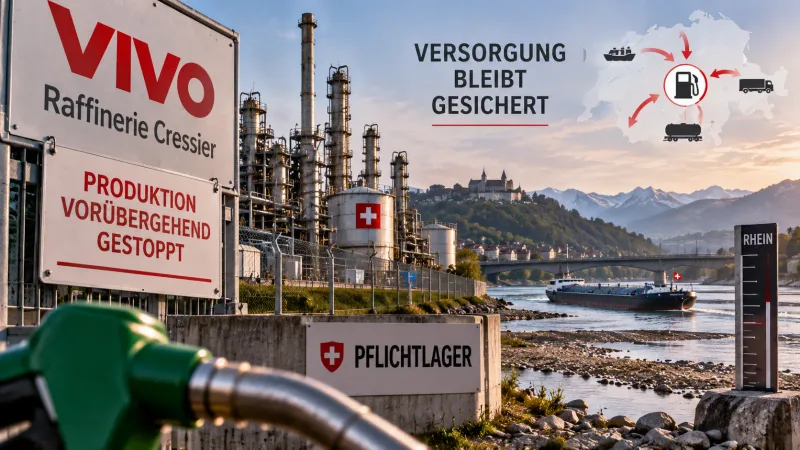
The escalation in the Middle East has driven up energy prices. The SNB had already noted in June that the rise in Swiss inflation at the time was mainly due to higher prices for petroleum products.
The problem for monetary policy: Rising oil not only makes petrol and heating energy more expensive. Higher energy costs can ripple through the economy via transport, production, and services.
At the same time, high energy prices weaken household purchasing power. Those who pay more for fuel, energy, or specific goods have less money for other expenses.
The SNB must therefore observe two developments simultaneously: Is inflation rising sustainably – or is it merely a temporary surge in energy prices?
Inflation Is Still Far From Spiraling Out of Control
Here, Switzerland differs significantly from many other countries.
The SNB defines price stability as inflation below two percent, also not ruling out some negative inflation. Its current conditional inflation forecast remains within the range of price stability throughout the entire forecast period.
In June, the SNB expected an annual average inflation of 0.6 percent for 2026, 0.6 percent for 2027, and 0.7 percent for 2028.
Petra Tschudin's presentation at the end of August confirms: Medium-term inflationary pressure has hardly changed compared to the last assessment. The SNB continues to project inflation within its price stability range.
Therefore, there is currently no talk of a new wave of inflation.
Why the SNB Is Still Not Simply Cutting Rates
With a weak economy and low inflation, an interest rate cut would normally be an obvious step. It would tend to make loans cheaper and stimulate the economy.
However, the SNB policy rate is already at zero percent.
Further easing would therefore be more difficult and would have to work through other instruments or the exchange rate. At the same time, an even more expansionary monetary policy could intensify certain risks.
For this reason, the SNB is currently maintaining its existing stance. It describes monetary conditions as appropriate and intends to continue monitoring the situation.
What Does This Mean for Swiss Households?
The SNB's monetary policy initially sounds like a topic for banks, stock markets, and economists. In reality, it affects everyday life.
Those with a mortgage observe interest rates particularly closely. The SNB policy rate influences short-term money market rates and thus, especially, the financing costs for money market mortgages. Fixed-rate mortgages depend more on expectations of future interest rates and capital markets.
Those with money in a savings account feel the other side of the zero-interest rate policy. Banks have less incentive to offer high savings rates. For savers, this means that returns on classic account balances tend to remain low.
Those traveling abroad, however, can benefit from the strong franc. A Euro or Dollar costs comparatively few francs, which can make holidays and certain purchases abroad cheaper.
Those working in export-oriented industries may experience the situation quite differently. A strong franc can burden the competitiveness of Swiss companies. This can affect investments, margins, and in the long term, employment.
And for all households: Stable inflation protects purchasing power. If prices rise slowly, income loses value less quickly.
The USA Also Plays a Role in Swiss Monetary Policy
Switzerland cannot view its monetary policy entirely independently of the global economy.
The USA and Europe are particularly important. If inflation develops significantly differently there than in Switzerland, international interest rate differentials change. This, in turn, can influence capital flows and exchange rates.
The SNB also points to the effects of American trade policy. High US tariffs and the associated uncertainty can burden global trade and thus affect the Swiss export industry. At the same time, Swiss exports have recovered after a significant decline in 2025.
This is particularly relevant for Switzerland because it is heavily dependent on international trade.
The SNB Still Has an Instrument Up Its Sleeve
If the franc were to suddenly appreciate sharply, the National Bank could intervene in the foreign exchange market.
Simply put: the SNB can buy foreign currencies and thus sell francs. This allows it to counteract appreciation pressure.
It has already used this instrument in recent years and expressly keeps the option open today.
However, interventions are not a free pass. The SNB must carefully consider when intervention is appropriate. An overly strong or persistently incorrect reaction could create new problems.
The Next Interest Rate Decision Will Therefore Be Closely Watched
The next monetary policy assessment will show whether the SNB's appraisal has changed. Key factors will include the further development of inflation, energy prices, the franc, and the global economy.
In any case, an automatic interest rate hike cannot be inferred from the SNB's current statements. Nor is there currently a signal for an imminent cut.
Rather, the message is: The National Bank wants to keep all options open.
An Unusually Difficult Balance
Switzerland is thus in a unique situation. Inflation is low, the franc is strong, interest rates are at zero – and at the same time, external risks are considerable.
For the SNB, this means it must be careful not to react to a single problem while exacerbating another.
A stronger franc can curb inflation but burden exporters. Higher oil prices can drive inflation, yet also weaken household purchasing power. Low interest rates support the economy, but do not necessarily help savers.
That is precisely why current monetary policy is less a matter of pressing the right button and more a question of the right timing.
For Swiss households, this primarily means one thing: the current calm in inflation is good news. However, it is not guaranteed. The SNB must simultaneously monitor the franc, energy prices, international trade conflicts, and the economic situation.
As long as inflation remains low, there is no immediate reason for an abrupt change in policy. However, should the environment change significantly, the franc could regain prominence – and with it, the question of whether the SNB must intervene in the foreign exchange market.
Therefore, the next interest rate decision will not only be important for financial markets. It indirectly affects mortgages, savings rates, consumption, exports, and thus everyday economic life in Switzerland.
Sources
- Swiss National Bank (SNB): "Current challenges of monetary policy," Petra Tschudin, August 31, 2026
- Swiss National Bank: Monetary Policy Assessment of June 18, 2026
- Swiss National Bank: Interview with Petra Tschudin, August 24, 2026