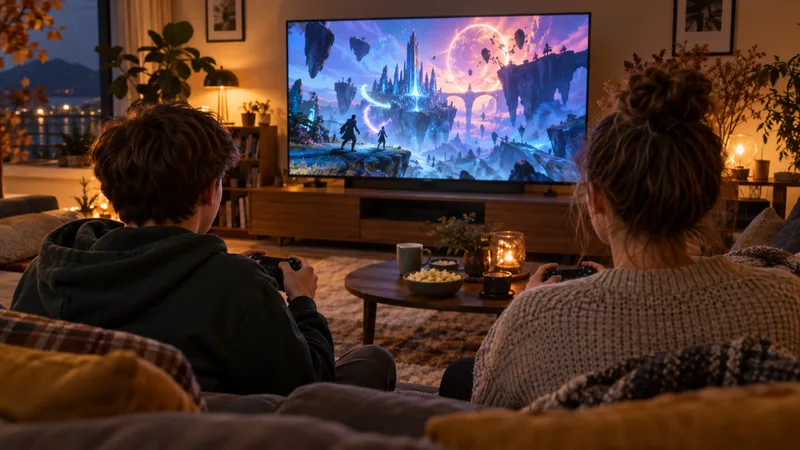
The big games of autumn 2026: pre-ordering is rarely needed
From Control Resonant to Gears of War: E-Day, the season ranges from horror to family sport. Deciding factors: platform, age rating and real follow-up costs.
Autumn 2026 in video games is not a single blockbuster moment but a traffic jam of new releases. In little more than five weeks, horror, action role-playing, shooters and family sport overlap. For players in Switzerland, the most important question is therefore not only «What is coming out?» but: on which platform, for which age – and at what real price?
Late September: the calendar tightens unusually
On 24 September, according to the current state of information, two notable titles launch at the same time on PlayStation 5: Control Resonant and Silent Hill: Townfall. At Remedy, Control relies more on close combat and role-playing elements in a Manhattan transformed by the paranormal. Townfall, by contrast, promises narrative horror and puzzles in a small, foggy Scottish town. One day later comes Onimusha: Way of the Sword, Capcom's return to historical demon hunting.
That is an appealing selection, but not a reason to buy three games at once. Scope, technical quality and monetisation can only be judged to a limited extent before release. Anyone who waits for reviews from independent editorial teams and feedback from the first days of play may miss out on cosmetic pre-order bonuses – but gains considerably more information.
October: E-Day, Modern Warfare and Nintendo sport
Microsoft releases Gears of War: E-Day on 6 October on Xbox Series, PC and cloud; the title is also announced for Game Pass. For subscribers the calculation changes: a full-price purchase may be unnecessary, but an additional subscription is only worth it if it is actually used and cancelled in time.
On 22 October comes Nintendo Switch Sports Resort on Switch 2 – a more family-oriented counterpoint to the dark action games. One day later, Call of Duty: Modern Warfare 4 is announced, and on 29 October Phantom Blade Zero. Especially with online shooters, it is worth looking beyond the retail price: season passes, cosmetic items and limited-time offers can turn a one-off purchase into a permanent stream of spending.
The age rating is not a detail
Since the beginning of 2025, the Swiss federal act on the protection of minors in the film and video games sector has been partially in force. It creates more uniform minimum requirements across Switzerland for age labelling, content descriptors and controls. This is relevant for parents and young people, because several major titles this autumn contain violence, horror or threatening scenes.
The definitive label must be checked on the Swiss sales site or on the packaging. A trailer does not replace that check. Age ratings assess the suitability of content, not the level of difficulty – and they also do not indicate whether a game works with aggressive purchase incentives.
Four questions before buying
- Is the date confirmed? Release dates can still change up to publication.
- Does the game run on the existing device? «Switch» and «Switch 2», or different console generations, are not automatically interchangeable.
- How much does use cost after purchase? Online subscriptions, DLC, season passes and virtual currency are part of the total calculation.
- Is the content suitable? Check the age classification and the content descriptors before buying.
The real recommendation: choose rather than collect
Autumn offers a convincing candidate for almost every audience: Control Resonant for curious action fans, Silent Hill: Townfall for horror, Gears of War: E-Day for co-operative action and Nintendo Switch Sports Resort for playing together. That is precisely why restraint pays off. One good game that is actually played is a better purchase than three expensive icons in a digital library.
Status of dates: 14 September 2026. Release dates and platform details can change.
For Swiss buyers there is one more point: digital prices can vary by shop, currency and edition, and returns are often restricted. Physical versions, by contrast, can be lent or resold, but sometimes require large updates. Families can agree in advance on a fixed monthly budget and a rule for in-game purchases. That is more effective than arguing after every purchase – and it makes it transparent whether a supposedly free game ends up costing more than a full-price title.


