Unemployment Among University Graduates Rises
FSO Survey of 2024 Graduating Class Shows Increase Between 2023 and 2025
University Graduates Struggle to Find Jobs – Even in Tech and Economics
Entering the workforce is becoming more challenging for university and university of applied sciences graduates in Switzerland. Between 2023 and 2025, the unemployment rate one year after graduation rose significantly for both university and university of applied sciences graduates. Fields long considered close to the job market are now also strongly affected.
This is shown by the university graduate survey published on August 27, 2026, by the Federal Statistical Office (FSO). The survey examined the professional situation of the 2024 graduating class in 2025. For comparison with previous results, the corresponding values of the 2022 graduating class are used.
Unemployment for University Master's Graduates Rises to 6.4 Percent
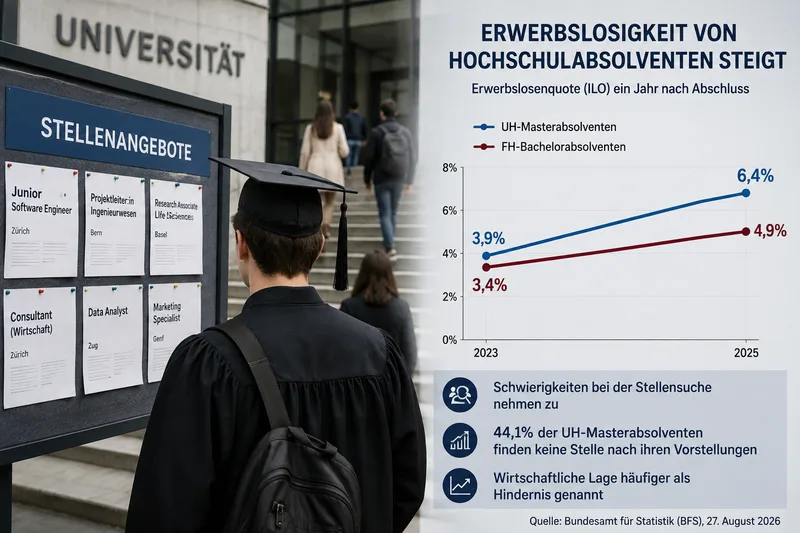
For graduates with a master's degree from a university, the unemployment rate, according to the International Labour Organization (ILO) definition, rose from 3.9 to 6.4 percent. For bachelor's graduates from universities of applied sciences, it increased from 3.4 to 4.9 percent.
Universities of teacher education are an exception. There, the unemployment rate remained virtually at its previous low level of 0.7 percent.
The ILO definition is not equivalent to the unemployment rate registered with the State Secretariat for Economic Affairs (SECO). According to the ILO, unemployed individuals are those who are not employed, are actively seeking work, and would be available for work at short notice.
Technology and Economics Also Face Pressure
It is particularly noteworthy that the deterioration is not limited to traditional problem areas. Fields that previously had relatively easy entry into the workforce are now also more affected.
For graduates with a master's degree from a university, the unemployment rate in technical sciences rose from 2.1 to 4.8 percent. In economic sciences, it increased from 3.5 to 8.5 percent. The rate also significantly increased in humanities and social sciences, as well as in exact and natural sciences.
A similar trend is evident at universities of applied sciences. In technology and IT, the unemployment rate for bachelor's graduates rose from 3.0 to 6.4 percent. In the field of economics and services, it also increased from 4.5 to 6.4 percent.
The highest rates for university of applied sciences bachelor's degrees were recorded in music, theater, and other arts with 10.8 percent, design with 10.0 percent, and applied linguistics with 9.4 percent. For university master's degrees, the highest rate was in the "Interdisciplinary and Other" subject group at 8.6 percent.
Medicine and pharmacy at universities continued to perform best with 1.6 percent, as did health and social work at universities of applied sciences with 1.7 and 1.5 percent, respectively.
Many Cannot Find Jobs Matching Their Expectations
The change in job searching is even more evident than the pure unemployment rate. More and more university graduates report difficulty finding a job that meets their expectations.
Among university master's graduates, this share increased from 30.0 to 44.1 percent. For university of applied sciences bachelor's graduates, it rose from 24.2 to 36.9 percent.
The situation in technical sciences worsened particularly significantly. For university master's graduates, the proportion experiencing job search difficulties rose from 22.9 to 43.3 percent. In economic sciences, it increased from 26.8 to 43.9 percent.
For university of applied sciences bachelor's graduates in technology and IT, the share also increased from 18.8 to 39.6 percent.
Lack of Professional Experience Remains Biggest Obstacle
The difficulties are not only related to the economic situation. Graduates most frequently cite a lack of professional experience as the reason.
In 2025, approximately two-thirds of university master's graduates and almost three-quarters of university of applied sciences bachelor's graduates cited this reason.
However, the economic situation now carries significantly more weight. Among university master's graduates, 42.5 percent cited the economic situation as a reason for their job search difficulties. For the previous graduating class, this figure was 23.8 percent.
For university of applied sciences bachelor's graduates, the share rose from 19.5 to 37.9 percent.
No General Collapse of the Swiss Labor Market
However, the figures do not suggest that the Swiss labor market generally no longer needs university graduates.
In the second quarter of 2026, total employment in Switzerland increased by 2.0 percent compared to the same quarter of the previous year. Companies simultaneously reported 98,700 job vacancies – 2.7 percent more than a year earlier. Employment prospects also improved.
At the same time, finding qualified employees remains challenging for many companies: 33.9 percent of employees in the second quarter of 2026 worked for a company that reported difficulties in recruiting skilled labor.
The picture is thus contradictory: on the one hand, employment is growing, and companies continue to seek skilled workers. On the other hand, young academics face significantly greater difficulties entering the labor market.
Between Skilled Worker Shortage and More Difficult Job Entry
The FSO figures therefore suggest a more nuanced discussion about the shortage of skilled workers. The fact that companies struggle to find qualified employees does not automatically mean that every graduate will easily find a suitable position.
The field of study, professional experience, and the specific demand from companies can be crucial. Current data also show that difficulties are now spreading to areas previously less affected.
The FSO does not establish a direct cause-and-effect relationship between the economic cycle and rising unemployment. However, the fact that significantly more graduates cite the economic situation as an obstacle provides an important indication of the changed framework conditions.
What the Figures Mean for University Graduates
For young academics, the transition from university to career is becoming more demanding. While a university degree remains an important qualification, it does not automatically guarantee quick entry into a suitable position.
Practical experience appears particularly important. FSO data show that a lack of professional experience remains the most frequently cited obstacle. Internships, professional experience gained during studies, and early contact with potential employers can therefore play a greater role in career entry.
At the same time, universities and policymakers face the question of how well education and the labor market align. The differences between fields of study are considerable. A blanket statement about the job market opportunities for "academics" would not do justice to these differences.
Development Requires Further Observation
The current figures refer to the 2024 graduating class and their professional situation in 2025. They show a clear increase compared to the previous observation period. Upcoming surveys will reveal whether this is a temporary deterioration in career entry or a longer-term trend.
One thing is clear: the Swiss labor market generally remains receptive, while entry for some university graduates has become more difficult. It is particularly striking that this development now also affects technical and economic fields.
Sources
- Federal Statistical Office: Unemployment among university graduates increased between 2023 and 2025
- Federal Statistical Office: Increase in employment in Q2 2026
- FSO: Definitions of unemployment rate according to ILO
- FSO SwissStats: Indicators of the university graduate survey
- SECO: Labor market situation July 2026
- SRF: Swiss labor market continues to grow despite skilled worker shortage