US intelligence: Saudi Arabia has not ruled out nuclear weapons
A classified US assessment sees a military nuclear option as still possible. That is no proof of a decision to build – but it shifts attention to enrichment and safeguards in the new civilian agreement.
A classified assessment by the US intelligence community concludes, according to the Washington Post, that Saudi Arabia has not ruled out developing a nuclear weapons programme. The document itself is not public. Neither its exact wording nor the evidence behind it, nor its intelligence classification level, can be independently verified.
That sets an important boundary: the assessment describes a possible risk. It proves neither a Saudi decision to build nor an ongoing weapons programme. Between a political option deliberately kept open, the build-up of technical capabilities and the actual development of a bomb lie decisive differences.
Civilian cooperation – with sensitive technologies
The debate falls in a delicate phase. In July 2026 the United States and Saudi Arabia signed a so-called 123 agreement on civilian nuclear cooperation. The US Department of Energy describes it as the basis for a peaceful partnership and points to safety and non-proliferation standards.
Such an agreement does not automatically authorise the construction of a reactor, nor every later delivery. It creates the legal framework for cooperation. Further decisions on technology, fuel, financing and export licences follow separately. In doing so, the US Congress is examining not only an energy project but also the consequences for the regional non-proliferation order.
Initially below 5 percent, later up to 20 percent
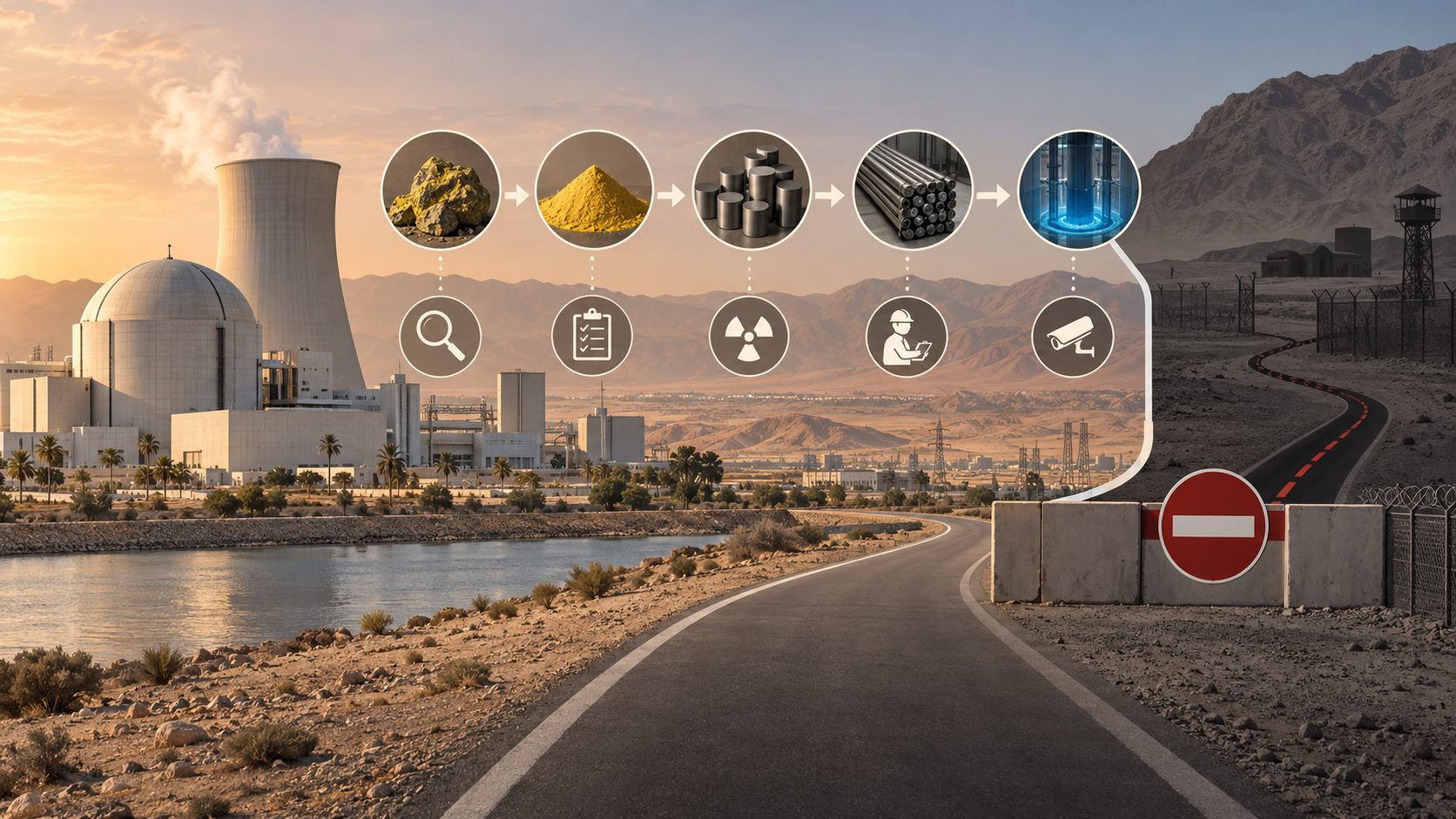
The most sensitive point is uranium enrichment. Under the contractual framework described by the Washington Post, Saudi Arabia is initially to be allowed to enrich uranium to less than 5 percent of the fissile isotope uranium-235. After an additional review and a further written agreement between the two states, the limit could rise to up to 20 percent.
Low-enriched uranium is not the same as weapons material. Even uranium enriched to 20 percent is not yet weapons-usable material. Such infrastructure is nevertheless relevant to security policy: the same technical facilities and know-how can, in the event of a political change of course, shorten the remaining work on the path to significantly higher, weapons-grade enrichment.
That is why the question “civilian or military?” alone is not enough. What matters is which facilities may be operated, how nuclear material is accounted for, which data must be reported and how comprehensively international inspectors are granted access.
The IAEA Additional Protocol remains open
Particularly contentious is that, according to published analyses, the agreement does not oblige Saudi Arabia to adopt the so-called Additional Protocol of the International Atomic Energy Agency. This additional protocol expands the IAEA's information and access rights. It can help the agency detect undeclared nuclear activities and clarify open questions at additional locations.
The agreement instead provides for bilateral safeguards between the United States and Saudi Arabia. According to the Arms Control Association's analysis, these apply primarily to sites and material connected with American-Saudi cooperation. They therefore do not replace all the further-reaching possibilities of the IAEA Additional Protocol.
For critics this is a central weakness. They argue that Saudi Arabia should not face weaker non-proliferation requirements for enrichment, reprocessing and international inspections than comparable agreements impose.
Washington relies on influence through cooperation
The US government applies a different risk logic. A programme with American technology, contractual supply chains and bilateral controls could create more transparency than Saudi cooperation exclusively with other supplier states. The Department of Energy explicitly describes the treaty as peaceful cooperation with high standards for safety and non-proliferation.
This position is a political and regulatory assessment, not proof that every risk has been eliminated. Conversely, the classified US assessment alone does not prove that Riyadh has decided to build a bomb. What remains publicly unknown is which statements, plans or procurement data the assessment is based on.
What counts is verifiable control
The case should therefore be read neither as proof of a Saudi atomic bomb nor as inconsequential speculation. Three separate levels matter: the reported intelligence assessment, the technical capabilities made possible by the treaty, and the controls intended to detect or complicate misuse.
Concrete questions now determine the political review: Does enrichment remain permanently below clear thresholds? What additional conditions apply to a rise to 20 percent? Which facilities may IAEA inspectors see? And what consequences would a violation have?
Only the answers to these questions show whether civilian cooperation strengthens non-proliferation or creates new uncertainty. Political assurances alone are not enough with a dual-use technology; what counts are rules, measurement data and verifiable access.
Sources
- Washington Post: Saudis have not ruled out developing nuclear weapons, U.S. intelligence assesses
- US Department of Energy: United States and Saudi Arabia Reach Historic Nuclear Cooperation Agreement
- Arms Control Association: Nonproliferation Risks in the U.S.-Saudi Nuclear Cooperation Agreement
- IAEA: Additional Protocol
- Anadolu: Summary of the US intelligence assessment