Volunteering is unpaid, but not free
Two thirds of the population get involved, according to the Volunteer Monitor. Turning that into reliable help takes organisation and clear limits.
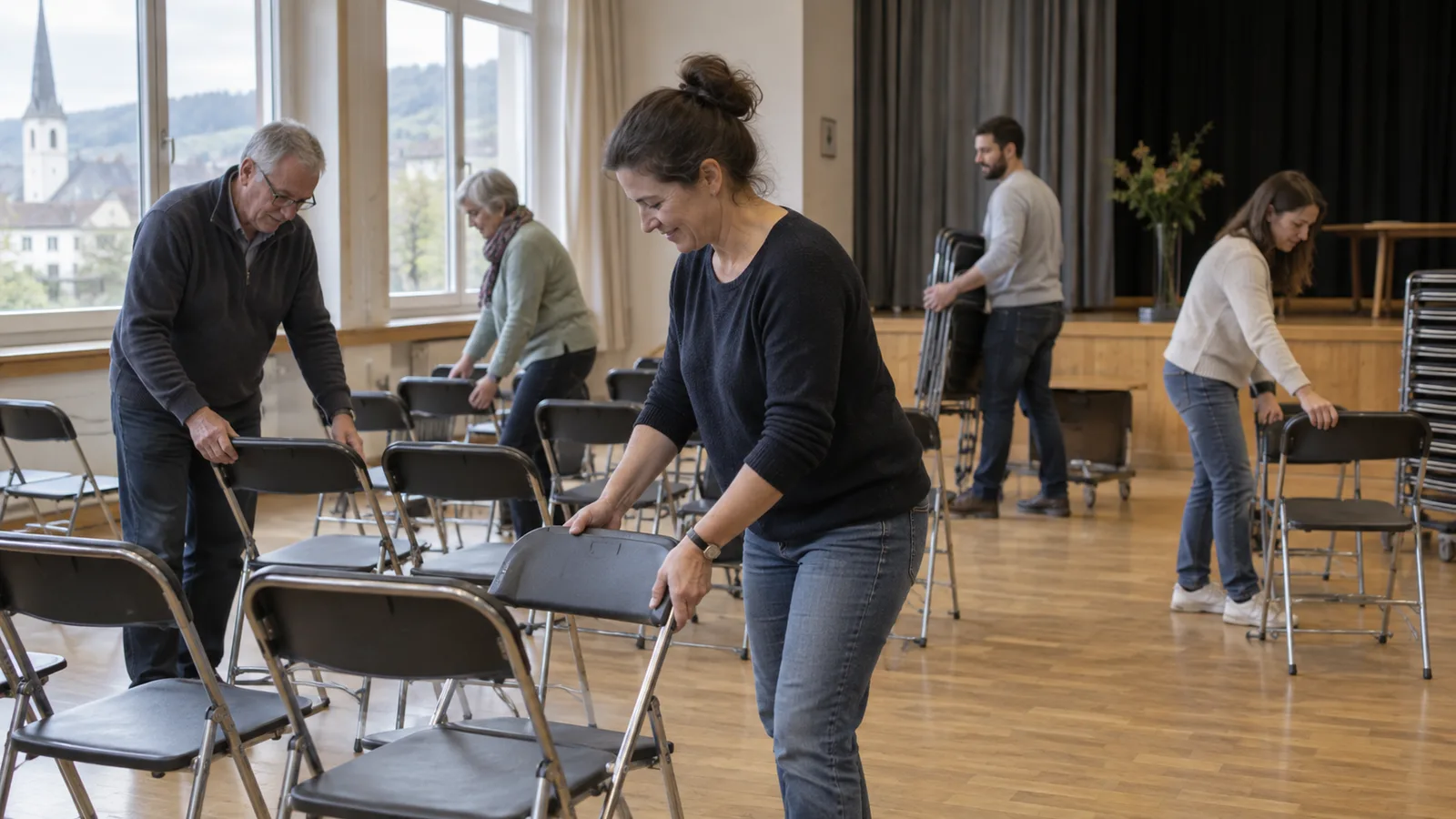
A club festival begins long before the first guest arrives. Someone sets up the tables, organises keys, explains the procedure to new helpers and stays behind at the end to clean up. Part of this work is visible. Another part disappears behind the phrase that it is all done voluntarily anyway.
In Switzerland, this engagement is not a marginal phenomenon. The 2025 Volunteer Monitor puts the share of the population aged 15 and over who volunteer formally or informally at 66 percent. The underlying survey ran from March to June 2024 and covered around 5,000 people. The 2025 publication therefore does not describe a snapshot newly collected in the same year.
Two forms, many overlaps
The Monitor distinguishes engagement within organisations from informal help. It gives 41 percent for formal volunteering and 51 percent for informal volunteering. Together these figures add up to more than 66 percent, because people can do both. Someone who helps out at a club and also helps outside it does not suddenly become two different people.
Even higher figures appear when a broader concept of engagement is used and donations, for instance, are counted in. For a debate about available working time, equating such categories would be misleading. Giving money and taking on a regular commitment are both contributions, but they are not interchangeable resources.
Comparisons over the years also require care. The 2025 Monitor was collected entirely online; earlier editions used other survey formats. The method description is therefore part of the interpretation. A catchy figure alone explains neither how many additional assignments would be possible nor which tasks people are willing to take on.

Good intentions need a structure
The specialist organisation Benevol sets out in its standards what matters at the level of a concrete assignment: a clear task, a contact person, induction, support and a rule on expenses. Insurance questions and recognition are part of it too. These are quality standards for volunteering, not statutory rules that apply across the board to every club.
Benevol also recommends limiting the time to an average of six hours per week across the year. This guidance is meant to prevent voluntary engagement from becoming a concealed substitute post. It is neither an official threshold nor a judgment about how a person may spend their personal free time.
In a position paper from June 2025, the organisation spells out the economic consequence: unpaid work does not relieve providers of costs. Coordination and support take time and money. A service can be free for its users and still need a sound budget.
The decisive question is who is responsible
This raises a planning question for clubs and municipalities that is often overlooked. Who looks after the people who help? If that task is also meant to be handled only on the side, the burden shifts onwards. In the end, a small group may simultaneously carry the actual work, the organisation and the gaps left by others.
A clearly defined brief, by contrast, makes the decision easier. Helping for two hours with setting up is different from permanently taking responsibility for every event. Anyone who names the difference in advance makes it easier to get started and makes a later no less fraught with conflict. Reliability grows out of a realistic commitment, not out of the biggest possible promises.
This includes an honest boundary between voluntary addition and indispensable permanent task. The fact that people want to get involved does not prove that a public or social service can do without paid professional work. Which responsibilities must be professionally secured has to be clarified separately for each activity.
Engagement should remain a pleasure
Emphasising the organisational side is not meant to talk down voluntary work. Precisely because it enables encounters, personal initiative and shared projects, it deserves reliable conditions. Anyone who speaks only about potential savings overlooks these qualities.
For those interested, a manageable first assignment can be a good way to get to know the task and the setting. For organisations, the challenge is to take such limited commitments seriously. Not every engagement has to end immediately in a board seat or an open-ended weekly commitment.
The high participation rate in the Monitor is one of Switzerland's strengths. But it is not a stock from which working hours can be drawn at will. For the willingness to help to hold up, someone must also organise the work behind the voluntary work.


