
When the State Co-Determines Prices
Why regulated tariffs protect purchasing power – and can also hinder competition
Not every price is formed where supply and demand meet. Health insurance premiums, electricity prices, public transport ticket prices, medication prices, or rental market rules are set, approved, or strongly influenced by the state. A new Federal Council report examines whether such administered prices harm purchasing power.
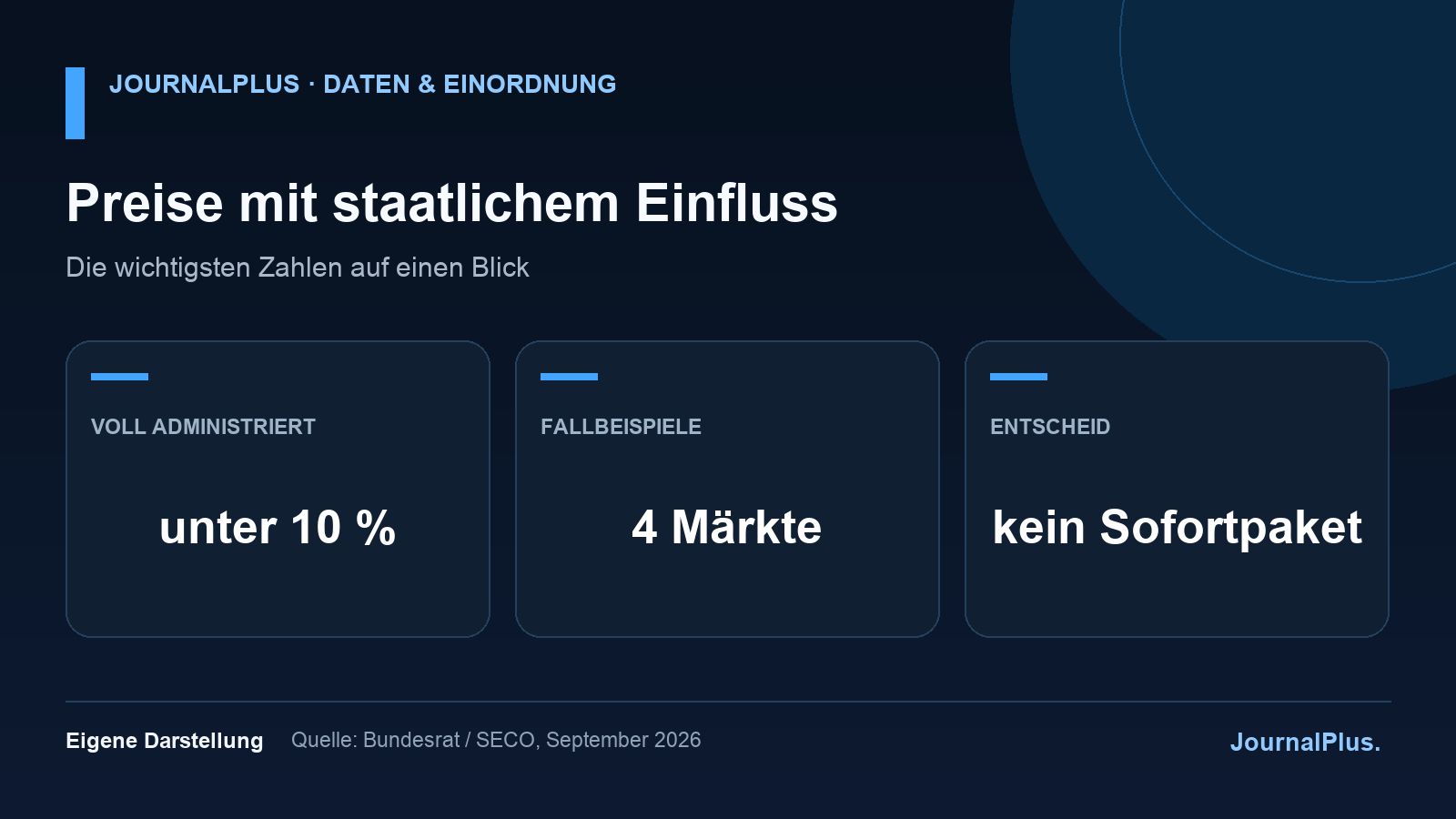
The short answer is: sometimes – but not fundamentally. Fully administered prices account for less than ten percent of the household budget in Switzerland, which is roughly on par with the European Union. The proportion of partially regulated prices is higher in this country. One reason is the healthcare system: many services are financed directly through household premiums and cost sharing, while in other countries, they are largely funded by taxes.
Regulation Can Protect Against Market Power
State intervention is not automatically a price driver. Where natural monopolies exist or nationwide supply is required, regulation can prevent a provider from exploiting its market power. Building power grids, railway lines, or basic postal services twice on every street corner is not sensible.
Administered prices can also cushion shocks. Long-term procurement and fixed tariff periods ensure, for example, that international energy price surges do not immediately fully impact households. The flip side: falling market prices are also passed on with a delay. Anyone who only considers the price of a single month can therefore confuse the protective and delaying effect.
Where Competition is Lost
The federal report examines case studies for Post (Swiss Post), rental apartments, seasonal import rules for fruits and vegetables, and health-insured medicines. It identifies potential for more competition in several areas. Rigid rules can deter new providers, hinder innovation, or obscure costs. They can also protect those who have established themselves in the existing system.
However, more market does not automatically lead to lower bills. For medicines, high price pressure can affect supply security. In the rental market, regulation protects existing tenancies, while insufficient return prospects can dampen investments. For the Post (Swiss Post), a low flat rate contrasts with the expensive mandate to reliably serve sparsely populated regions.
Household Budgets Are Individual
The average share says little about how much a specific household is affected. A family with regular therapies, high electricity consumption, and a public transport subscription experiences regulated prices differently from a healthy single-person household with a short commute. Financing through taxes, premiums, or direct tariffs also changes who pays how much and when.
Therefore, transparency is crucial for consumers. Bills should clearly indicate which part is an actual service, which part is a levy, and which part is politically determined. Only then can one assess whether relief truly reaches the household or reappears elsewhere as a tax or contribution.
What This Means for Switzerland
The Federal Council is not currently planning any additional immediate program. Reform work is already underway in the areas of Post (Swiss Post), rent, and pharmaceuticals. This is understandable but must not become an excuse for stagnation. Every regulation should regularly pass three questions: Does it achieve its supply or social objective? Is it cheaper than realistic alternatives? And does sufficient competition remain for efficiency and innovation?
For the Swiss population, there is no single lever that lowers all administered prices. Good policy must differentiate market by market. Where genuine competition is possible, it should be facilitated. Where it structurally fails, comprehensible rules are needed. Purchasing power does not arise from the label “state” or “private,” but from a system that provides services efficiently and discloses costs.
Particular care must be taken with international comparisons. A lower direct bill can be financed by higher taxes; conversely, a higher tariff can contain targeted benefits. Therefore, anyone promising reforms should not only show the list price but also the total burden on different household types. Only this distribution calculation shows who truly benefits and who pays more.