ZiviConnect: Civilian Service Goes Digital, Faces Further Changes
New Online Portal for Civilian Service Providers
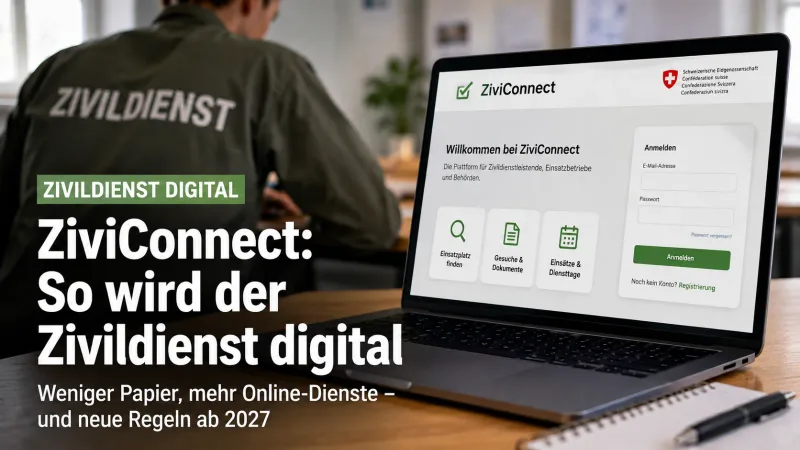
Civilian service paperwork is gradually disappearing. The Federal Government created ZiviConnect, a central digital platform connecting civilian service providers, assignment organizations, and authorities. The system has been operational since late 2024. It is now being continuously expanded, while new civilian service regulations are also pending.
Anyone organizing their civilian service knows the challenge: finding assignments, submitting applications, managing documents, reporting service days. What used to involve various channels and some paper processes will increasingly happen in one place. That place is ZiviConnect.
The Federal Office for Civilian Service (ZIVI) launched the new specialized application on December 9, 2024. It replaced the previous E-ZIVI system and connects civilian service providers, assignment organizations, and authorities. Approximately 30,000 users are expected to benefit. The Federal Government aims to manage processes without media disruptions – avoiding constant switching between paper, email, and various systems.
Digital Civilian Service is Already a Reality
Contrary to initial impressions, ZiviConnect is not a portal launching in 2027. The platform is already available today. New functions have been gradually added since its introduction.
Civilian service providers can use the system to organize assignments and digitally submit requests for service postponements or leave abroad. Assignment organizations also manage their job descriptions and report service days via the platform.
Further functions are still under development. These include the electronic assignment agreement. The Federal Government is thus gradually expanding ZiviConnect into a central digital hub for civilian service.
Less Paper, Fewer Detours
For civilian service members, this might initially sound unspectacular. In daily life, however, the change can make a difference. Those who need to submit an application or organize an assignment should be able to do so directly online.
Travel organization also became more digital. For assignments starting in 2026, eligible civilian service providers receive an SBB e-ticket through the digital process, instead of using special paper or PDF tickets as before.
Since June 2026, the previously paper-based EO reporting card has also been gradually replaced by a digital process via the EO-Portal of the Central Compensation Office. This eliminates another paper process from the daily administrative routine of civilian service members.
Assignment Organizations Must Also Become More Digital
ZiviConnect changes more than just the side of the civilian service providers. Institutions employing civilian service members must also maintain their information digitally.
They can manage their job descriptions via the platform and define for which activities, locations, and requirements an assignment is suitable. For civilian service members to find the offers, organizations must actively record and publish their available assignment slots.
This aims to simplify the search for a suitable assignment. At the same time, a key responsibility remains with civilian service members: they must generally find a suitable assignment placement themselves and submit the necessary agreements on time.
Digitalization Brings New Requirements
Wherever more personal information is digitally consolidated, data protection gains importance. ZiviConnect processes, among other things, personal data of those obligated to civilian service. ZIVI is responsible for data processing.
The corresponding regulation specifies which entities may access which data. Simultaneously, authorities and participating institutions must implement technical and organizational measures to protect data from loss, theft, and unauthorized access.
For users, digitalization therefore means more than just convenience. It also requires that the digital infrastructure functions reliably and personal data is handled securely.
2027 Will Be a Key Year for Civilian Service
Digitalization coincides with a period of political change for civilian service.
In June 2026, the Federal Council adopted amendments to the Civilian Service Ordinance, which will generally come into force on January 1, 2027. These include stricter requirements for certain assignments, training adjustments, and a higher fee for assignment organizations.
For example, assignments in IT, human resources, communication, marketing, and gastronomy will generally be excluded. At the same time, requirements for occupational safety and health protection are being tightened.
This means additional adjustments for assignment organizations. The basic daily fee will also increase by 7.5 percent per service day. The Federal Government justifies this with wage developments and the goal of ensuring the labor market neutrality of civilian service assignments.
Between Digitalization and Stricter Regulations
Civilian service thus experiences two developments simultaneously: administration becomes simpler and more digital, while the legal framework in certain areas becomes stricter.
This is relevant for Switzerland because civilian service has long been more than an administrative alternative to military service. Civilian service providers work in social services, healthcare, schools, and environmental and nature conservation, among other areas. Their assignments thus make a concrete contribution in sectors where many institutions rely on additional support.
Modern digital administration can help organize these assignments more efficiently. However, what matters is not how modern the platform looks. What matters is whether a civilian service member can actually find a suitable assignment faster, an organization has less administrative effort, and authorities can process applications more efficiently.
The Practical Test Is Already Underway
ZiviConnect is therefore less a future project and more an ongoing administrative restructuring. Since its introduction in late 2024, several functions have been added, with more to follow.
The direction is clear: the Federal Government aims to manage civilian service as digitally as possible throughout. For users, this means less paper and more online services. For the state, it simultaneously presents the challenge of reliably operating a central digital infrastructure and protecting sensitive data.
Whether ZiviConnect ultimately saves time and costs will not be determined by the number of digital functions, but by whether processes become simpler for those who use them daily.
Status: August 31, 2026. ZiviConnect is continuously being developed.