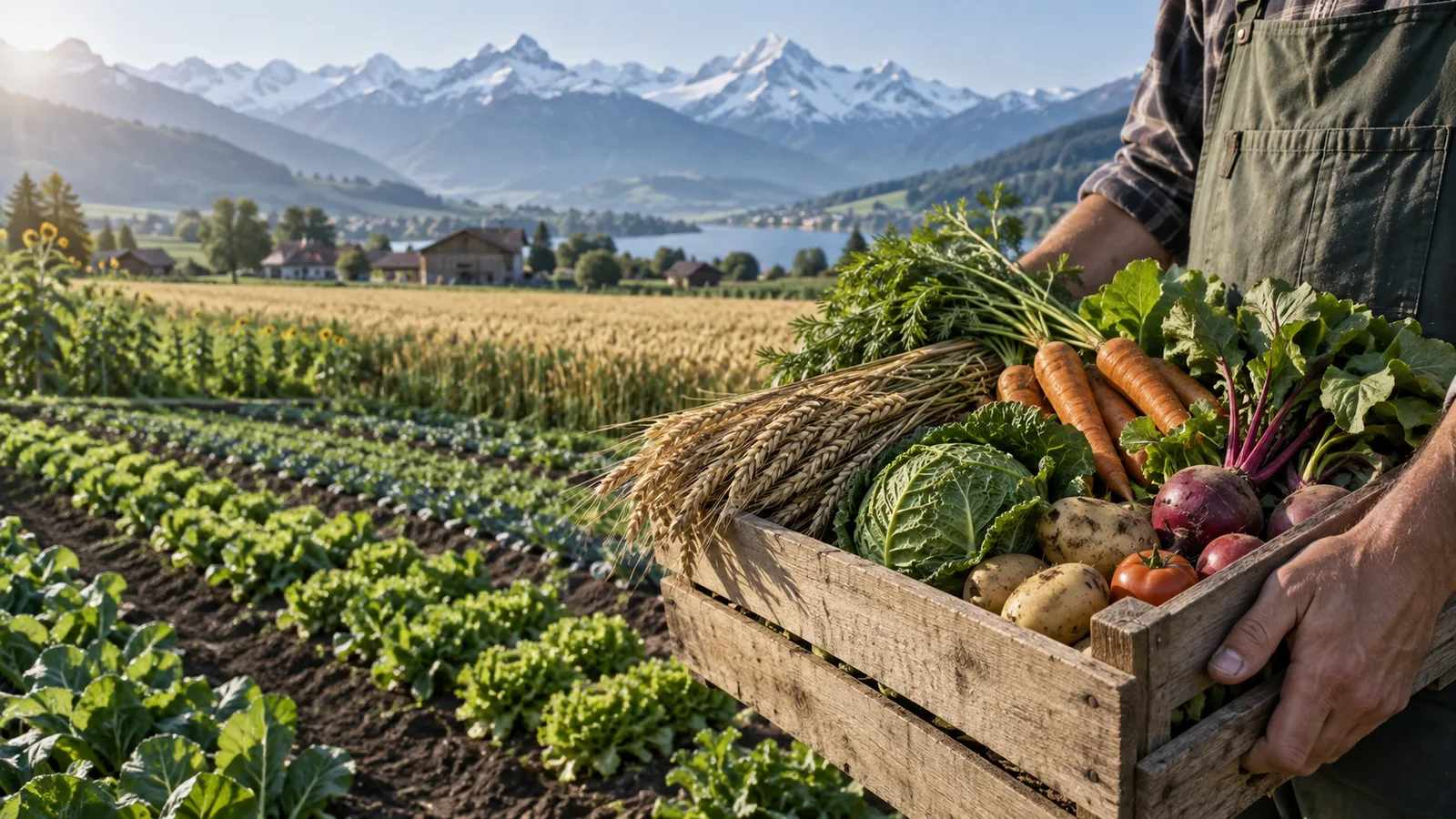
70 Percent Domestic: What the Food Initiative Would Change
The initiative demands that Switzerland produces at least 70 percent of its consumed food domestically within ten years. The goal promises greater crisis resilience but requires far-reaching interventions.
Switzerland imports a large portion of its food. This dependency becomes a political issue, especially during crises. The Food Initiative aims to enshrine a clear mandate in the constitution: within ten years, at least 70 percent of food consumed in Switzerland should be produced domestically. Currently, agriculture covers slightly less than half of this demand.
On September 27, 2026, citizens will vote on the proposal. Behind the seemingly simple percentage lies a complex transformation of production, consumption, and trade.
More Self-Sufficiency – Not at Any Cost
The initiative does not merely seek more calories from Swiss soil. It links supply security with ecological requirements. Production should focus more on plant-based foods, reduce the use of fertilizers and pesticides, and lower the impact on water, soil, and biodiversity.
This is an important point: those aiming to increase self-sufficiency might be tempted to intensify production as much as possible. The initiative consciously excludes this path. More domestic production should be achieved with less environmental impact. This requires productivity gains, different cultivation methods, and altered demand.
Why 70 Percent is Ambitious
Switzerland has little arable land; many soils are primarily suitable for grassland. A significant portion of agriculture is therefore focused on milk and meat. Plant-based foods generally provide more directly usable nutrition per area, but a transition requires time, investment, and markets.
Measurement is also not trivial. Self-sufficiency can be calculated gross or net. Are imported feedstuffs deducted? How are losses, processed products, or calorie content considered? Parliament would have to define the specific implementation in laws after a 'yes' vote.
The ten-year deadline increases pressure. Agricultural businesses invest over decades. Stables, machinery, fruit crops, and irrigation systems cannot be reoriented overnight. At the same time, consumers decide with each purchase whether new offerings are economically viable.
Arguments of Proponents
The initiative committee promises a more crisis-resistant Switzerland. Shorter supply chains could reduce reliance on geopolitically unstable trade routes. More arable farming for direct human consumption should utilize existing land more efficiently. Fewer pesticides and fertilizers should protect drinking water and soil.
Proponents also point to the vulnerability of the current system: seeds, feedstuffs, fertilizers, energy, and machinery partly come from abroad. A higher quota alone does not eliminate these dependencies but can direct political focus towards robust production foundations.
Objections from the Federal Council and Parliament
The Federal Council and Parliament recommend a 'no' vote. They consider the 70 percent target hardly achievable within the given timeframe. The Confederation would have to regulate consumption and production much more strongly with subsidies, regulations, or levies. This could incur high costs and limit selection in stores.
Trade is another factor. Switzerland relies on reliable imports for items like coffee, cocoa, rice, citrus fruits, or edible oils, which can only be cultivated to a limited extent here. At the same time, it exports high-quality foodstuffs. A policy heavily focused on domestic quotas would have to be compatible with international obligations and the interests of the export economy.
The government argues that existing agricultural and food policy already pursues goals such as supply security, resource protection, and sustainable production. In its view, a fixed constitutional value is too rigid.
What This Could Mean for Shopping
A 'yes' vote would not lead to empty shelves the next day. First, the legislator would have to determine instruments. Possible measures include additional funding for arable farming and legumes, stricter environmental regulations, fewer incentives for feedstuff imports, requirements for public procurement, or information campaigns against food waste.
For households, two opposing effects are possible. A more efficient, plant-focused diet can lower costs. However, production under Swiss wage, animal welfare, and environmental standards is often more expensive than imported goods. How much prices rise or fall therefore depends more on the implementation than on the constitutional figure itself.
The selection could also become more seasonal. Those expecting the same product variety in winter as in summer will remain dependent on imports. The initiative does not prohibit them; however, it shifts the political benchmark in favor of the domestic share.
The Crucial Consideration
The proposal poses a strategic question: Should Switzerland align its food policy with a binding, measurable self-sufficiency target – even if significant interventions become necessary? Or should it continue to pursue supply security with a mix of domestic production, trade, and mandatory reserves?
A 'yes' vote is a mandate for transformation, but not yet a complete blueprint. A 'no' vote preserves existing flexibility but does not automatically solve the known problems of dependencies, environmental impact, and land competition. For the vote, it is therefore crucial whether one gives more weight to the 70 percent target than to the risks of a costly and difficult-to-plan implementation.
Sources
- Swiss Federal Chancellery: Voting Information on the Food Initiative – https://www.admin.ch/ernaehrungsinitiative
- Federal Government: Message and Media Release on the Popular Initiative for Secure Food Supply – https://www.big.admin.ch/de/newnsb/z52n62bGj5-YxxmcCS18p
- Swiss Parliament: Federal Popular Votes – https://www.parlament.ch/de/services/volksabstimmungen
As of: September 9, 2026.