Switzerland's Agricultural Land Shrinks: Cultivated Areas Lost
New figures reveal a long-term decline in agricultural land use.
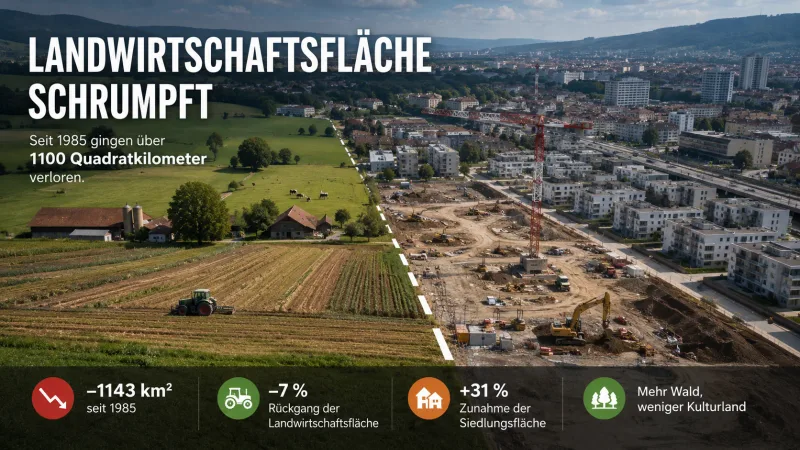
Switzerland grows, but its land does not. New houses, roads, and commercial areas claim space. Simultaneously, agricultural areas in the mountains disappear due to reforestation and abandoned use. Figures from the Federal Statistical Office (BFS) show how much the landscape has changed since 1985.
Between 1985 and 2018, Switzerland's agricultural area shrank from 15,667 to 14,525 square kilometers. This represents a decrease of 1143 square kilometers or about seven percent. In other words, an average of 13 football fields of agricultural land were lost per day. Agriculture remained the largest of the four main categories of land use.
Where Cultivated Land Disappears
The loss is not evenly distributed across the country. In the Central Plateau, agriculture faces pressure primarily from settlements, transport, and industry. At the same time, forests increase in mountain regions when land is no longer cultivated.
Of the agricultural areas converted to other uses between 1985 and 2018, more than half became settlement areas. Lower elevations were particularly affected. In the Central Plateau, the decline was about eight percent. In Southern Switzerland, it was even greater: around 20 percent of agricultural land was lost on the southern flank of the Alps.
Land loss is not solely a result of the building boom. In the Alps, the abandonment of agricultural use plays a significant role. Where meadows and pastures are no longer regularly managed, shrubs and forests spread. This changes the landscape, and agricultural land decreases.
Arable Land Particularly Affected
The composition of agricultural land has also changed. Between 1985 and 2018, the area of arable land decreased by 482 square kilometers or eleven percent. Alpine agricultural areas shrank by 401 square kilometers. For fruit, vine, and garden cultivation areas, the decline was even 35 percent.
For Switzerland, this is not merely a matter of landscape aesthetics. Arable land is where food is directly produced. Switzerland also relies on imports for many foodstuffs. Each additional loss of fertile soil thus long-term exacerbates the conflict of objectives between agriculture, settlement development, and food security.
More Houses, More Transport – Also More Forest
While agricultural land decreased, settlement areas significantly increased. Between 1985 and 2018, they grew from 2495 to 3271 square kilometers – an increase of 31 percent. Forested areas, particularly forests, also increased.
Thus, the statistics show a more complex picture than the simple formula "construction destroys agriculture." Switzerland loses cultivated land in various ways. In agglomerations, land is built upon; in mountain regions, it partly reverts to forest.
Precisely for this reason, the question of land management is difficult. The population needs housing, businesses require space, and infrastructure must expand. Simultaneously, agriculture should retain sufficient land, and the landscape should remain ecologically valuable.
Spatial Planning Under Pressure
Swiss spatial planning has therefore pursued the goal of using land as judiciously as possible for years. Settlements should be developed inwards before additional cultivated land is claimed. Particularly valuable agricultural soils are protected as crop rotation areas.
However, pressure remains high in economically dynamic regions. There, population growth, rising housing demand, and jobs meet limited space. A new residential area may be socially necessary, but it can also lead to the loss of agriculturally usable land.
A Non-Renewable Resource
The BFS figures make one thing clear above all: land is not an arbitrarily reproducible resource. What is built upon today is generally no longer available for agriculture tomorrow.
At the same time, it would be incorrect to view every change in agricultural land as a loss. The statistics also show that individual areas can revert to agricultural land—for example, through clearings and shrub removal or the recultivation of former construction sites and other usable areas. However, the long-term trend remains clearly negative.
What This Means for Switzerland
The challenge is not to preserve every single meadow under all circumstances. Rather, the crucial factor is which areas are lost and what they are used for.
Particularly valuable arable soils are more important for food production than areas with low agricultural productivity. At the same time, compact settlement development can help limit land consumption. The question of how mountain areas can be agriculturally managed also remains relevant.
The development of recent decades shows that the Swiss landscape has already changed significantly. Since 1985, around seven percent of agricultural land has disappeared. Simultaneously, settlement area has grown by almost one-third.
Therefore, the decisive question for the coming decades is not only how much Switzerland can still build. It is also how much fertile soil it can afford to lose.
Sources
- Federal Statistical Office (BFS): Area Statistics – Agricultural Land and Land Use
- Federal Statistical Office (BFS): Agricultural Land – Decrease of more than 1000 km² in three decades
- Federal Statistical Office (BFS): Area Statistics Standard 1985, 2009, and 2018