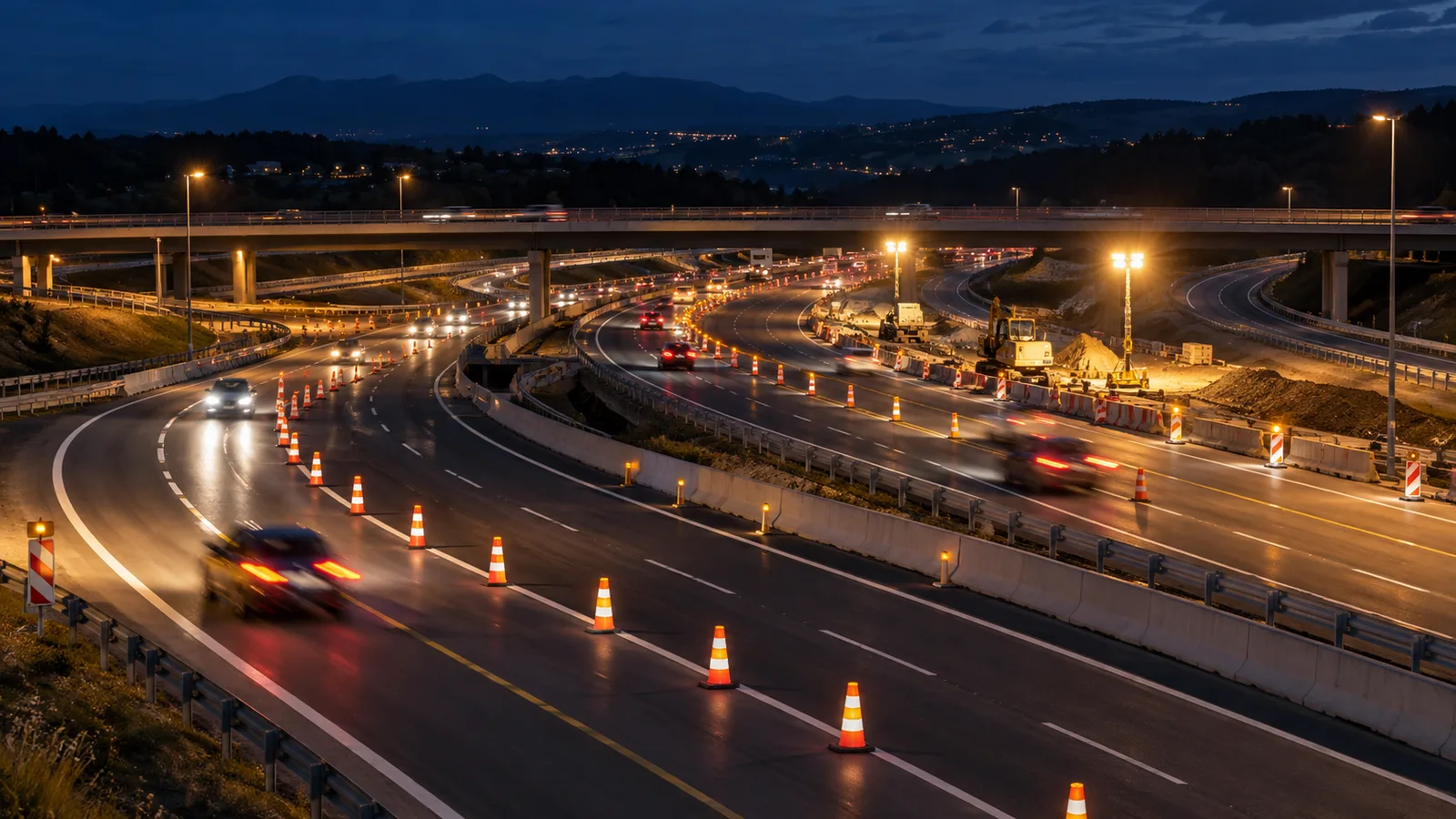
A1 at Luterbach: four nights show how the upgrade grips daily life
At the Luterbach junction, four ramps on the A1 will be closed at night in October. The short restriction is part of a structure that by 2032 is meant to change traffic, noise protection and safety in the Mittelland.
Four overnight ramp closures on a large motorway construction site are not spectacular news. For commuters, delivery services, night-shift workers and local residents they can nonetheless be decisive. Anyone who wants to drive from Solothurn towards Zurich or Bern at the wrong time has to turn back or follow a signposted diversion. This is exactly where the everyday reality of a long-term project becomes visible: a motorway does not simply get wider while traffic keeps running unchanged.
At the Verzweigung Luterbach, the Federal Roads Office (ASTRA) is adjusting traffic management on the A5 in the direction of Solothurn in October. At the same time, the construction site is being prepared for winter operation. This requires temporary vehicle restraint systems to be moved or dismantled. ASTRA is announcing lane changes and four ramp closures.
Four nights, four specific connections
Which ramps are affected and when
The closures begin at 20:00 and end at 05:00 the following morning. On the night of 12 to 13 October, the Solothurn–Zurich ramp is affected. From 13 to 14 October, Solothurn–Bern follows. On the night of 18 to 19 October, the Zurich–Solothurn connection is closed, and from 19 to 20 October, Bern–Solothurn.
The announcement therefore concerns individual ramps at the junction, not an announced full closure of the entire A1. That is an important distinction for travel planning. The diversions are to be signposted. In unfavourable weather, individual dates may each be postponed by one night, according to ASTRA. Anyone who depends on a specific connection should therefore not rely only on a saved route plan, but also watch the current signage and ASTRA's notices.

The exact direction of travel matters more here than the place name alone. The first half of the work concerns journeys from Solothurn onto the A1, the second half journeys from Zurich or Bern towards Solothurn. Anyone who overlooks this distinction may plan an unnecessarily long detour. For companies with night logistics and people with fixed shift times, a check before departure is therefore particularly worthwhile.
The small closure belongs to a major intervention
The upgrade between Luterbach and Härkingen covers around 22 kilometres of the A1, from the A1/A5 junction near Luterbach to the A1/A2 junction near Härkingen. The section dates from the 1960s and has to be renovated after more than half a century in operation. At the same time, the facilities are to be brought into line with today's requirements for water protection, noise protection and major-accident safety.
The project is divided into three construction stages: the western part between Luterbach and Wangen an der Aare runs from 2025 to 2027. Then follow Wangen–Oensingen until 2030 and Oensingen–Härkingen until 2032. In addition to six lanes, ASTRA plans 14 replacement structures and six new builds, including a third Aare bridge, wildlife crossings and adjustments at junctions.
Around 93,000 vehicles use the section today; for 2030, ASTRA expects about 113,000. These figures explain the pressure to act, but they are not a promise of congestion-free journeys. The office names fewer hours of congestion, smoother traffic at peak times and less through traffic in villages as its goals. Whether and when these effects materialise in everyday life also depends on construction progress, general traffic development and the future use of the route.
Safety during construction is part of the project
Temporary crash barriers, shifted markings and changed entry and exit points seem mundane. In a narrow construction corridor, however, they are central: they separate traffic from the work area, keep lanes comprehensible and create space for the next construction stages. The night windows shift restrictions out of peak hours, but they do not remove them. Especially at night, detours, lighting, noise and unfamiliar lanes can be a burden for those affected.
ASTRA puts the cost of the overall project at around 1.06 billion Swiss francs. It is financed through the National Roads and Agglomeration Transport Fund. This creates a legitimate benchmark for the public: in the end, not only the new lane but also safety, environmental protection, traffic management and the lowest possible burden on surrounding municipalities have to be convincing.
For Swiss road users, the immediate message is therefore simple: during those four nights it is not "the A1" or "Luterbach" as a whole that is closed, but clearly designated ramps. Anyone who checks the right connection and the current signals avoids unnecessary detours. The bigger story, by contrast, continues until 2032: it will decide whether an important traffic artery becomes more efficient without putting additional strain on the villages along the route.
Sources
ASTRA: A1 Luterbach–Härkingen – overnight ramp closures and traffic management