How Bern handles Russia, Hamas and Iran under three legal regimes
Russia, Hamas/PIJ and Iran are not treated in Bern by a single formula. Which rules apply, and why neutrality does not mean indifference.
How neutral is Switzerland when it adopts sanctions against Russia, sanctions supporters of Hamas and Palestinian Islamic Jihad, and screens war material exports in the Iran conflict? The question is legitimate, but it often leads to a false comparison. It conflates the law of neutrality, neutrality policy, economic sanctions and war material exports.
These fields overlap, but they follow different rules. So the fact that Bern acts in one dossier and acts differently in another does not by itself point to an inconsistent or coerced foreign policy. What matters in each case is the addressee, the legal basis, the type of measure and the specific conflict.
Sanctions are not adopted automatically
Switzerland is permanently neutral. In international armed conflicts, the law of neutrality obliges it, among other things, not to take part militarily on one side and not to treat war-relevant goods unequally. Economic sanctions, however, are in principle not covered by this. Under Swiss practice they can be compatible with the law of neutrality.
Switzerland, as a member state, is obliged to implement binding sanctions of the UN Security Council. For sanctions outside the UN, the Embargo Act applies. On that basis, the Federal Council decides case by case whether to adopt measures of the EU, the OSCE or major trading partners in full, in part or in adapted form.
That is also the substantive standard for the claim that the EU forced Bern to adopt the Russia sanctions. The official documents describe a Federal Council decision under Swiss law. They do not document a legally binding instruction from the EU to Switzerland. Political or economic pressure from partners can be part of international relations; a concrete act of blackmail would, however, be a separate allegation that would have to be substantiated.
Russia: a comprehensive regime based on a Federal Council decision
After the Russian attack on Ukraine, the Federal Council decided on 28 February 2022 to join the EU sanctions against Russia. In August 2026 it implemented further parts of the 20th EU sanctions package in line with previous practice. These include measures in the energy, trade and financial sectors as well as provisions against circumvention.
These decisions are not equivalent to arms deliveries. For private exports of war material and other specifically regulated war-relevant goods, additional requirements under the law of neutrality apply. If Switzerland restricts these for one party to a conflict, it must apply the same restrictions to the other party as well. In addition, the stricter rules of the War Material Act apply.
Hamas/PIJ and Iran: different addressees, different instruments
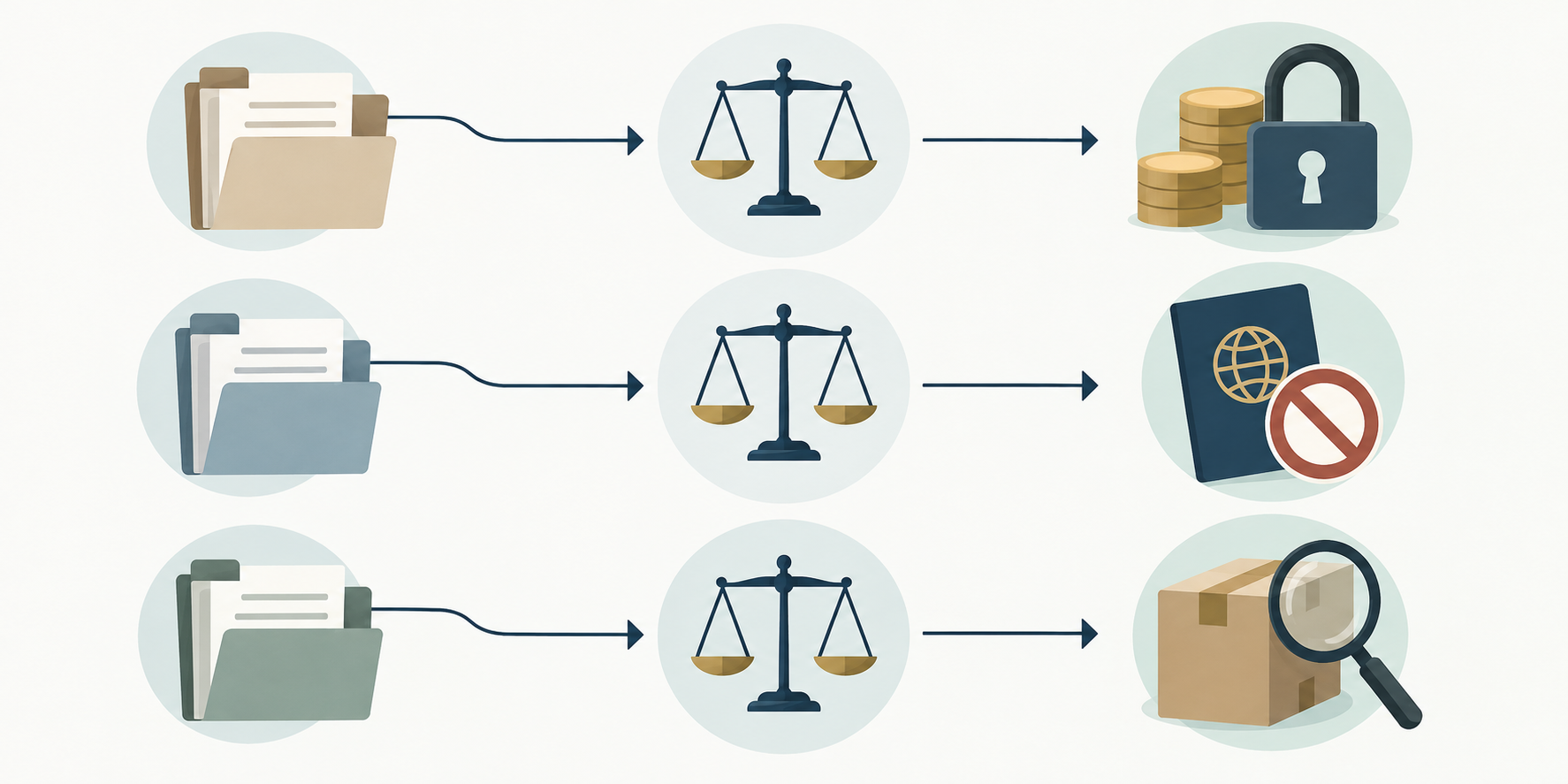
The Swiss ordinance on Hamas and Palestinian Islamic Jihad is not directed generally against Israel or against the Palestinian population. It concerns persons and organisations that support Hamas or PIJ. It provides, among other things, for asset freezes, bans on making funds available, reporting obligations and entry and transit bans.
The Iran ordinance is, in turn, a separate dossier. It implements UN resolutions that have re-entered into force and partly takes over reactivated EU measures. It covers goods, financial and travel sanctions. Its purpose and its legal structure therefore differ from the Russia regime and from the targeted measures against supporters of Hamas and PIJ.
In March 2026 the Federal Council additionally assessed the effects of neutrality on exports to states involved in the international armed conflict with Iran. Exports of war material to those states cannot be authorised for the duration of the conflict. No new authorisations have been granted for the USA since the escalation; definitive war material exports to Israel and Iran have not been authorised for years, according to the Federal Council. Existing authorisations and exports of other goods are regularly reviewed by an interdepartmental group of experts.
Neutrality does not require identical labels
The comparison of the three dossiers is not a ranking of human suffering and not a final legal assessment of the states involved. It merely shows why "identical sanctions for everyone" is not a workable legal standard. In the case of war-relevant goods, the law of neutrality requires equal treatment of the parties to a conflict. It does not automatically require identical financial or trade sanctions in every international crisis.
For Swiss banks, export firms, logistics companies and private individuals, this distinction is practical. Sanctions lists, asset freezes, export controls and travel bans can trigger direct obligations. Anyone with business partners, supply chains or assets abroad must check the regulation currently in force instead of inferring the legal situation from a political headline.
Neutrality is therefore neither indifference nor an automatic binding to the policies of other states. Its credibility depends on whether Bern justifies its decisions transparently, applies the rules in force correctly and maintains equal treatment for war-relevant goods.
Sources
- FDFA: Neutrality and sanctions – questions and answers
- SECO: Switzerland implements the 20th EU sanctions package against Russia
- FDFA: Equal treatment under the law of neutrality in the case of sanctions against Russia
- SECO: Measures against persons and organisations that support Hamas or PIJ
- SECO: Measures against the Islamic Republic of Iran
- FDFA: Iran conflict – effects on war-relevant exports