After Record Drought: 71.5 Million for Forests and Agriculture
Federal Council plans to increase 2027 forest credit and boost farm aid. Parliament's approval is pending.
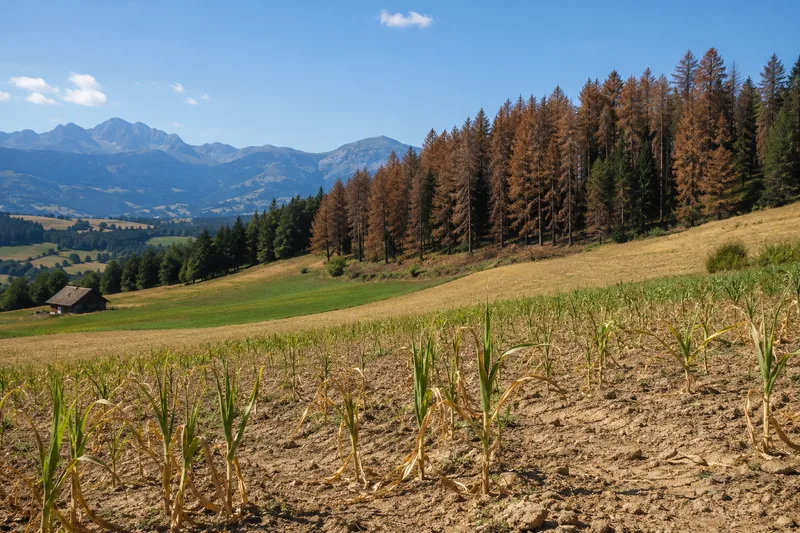
Federal Council requests over 70 million francs for drought impact
Exceptional heat and drought continue to affect Switzerland. The Federal Council responds with additional funds for forests and agriculture. It requests 17.5 million francs more from Parliament for forest adaptation to climate change. An additional 54 million francs are to be provided once in 2026 for interest-free operational aid credits for affected farms.
The two amounts total 71.5 million francs. However, the funds are not yet definitively approved: Parliament will decide on the additional resources. At the same time, the Federal Council is reviewing further measures. The development of the heat and drought situation will be re-evaluated by the end of October.
Switzerland experiences exceptional drought
The situation is serious. According to the Federal Council, Switzerland received the lowest summer half-year precipitation since measurements began by mid-August 2026. Several heatwaves further intensified the persistent dry period.
The effects are now visible in many parts of the country. Forest trees turned brown as early as July, and rivers and lakes partly carry record-low water levels. Groundwater is also affected: In August, about half of the federally monitored measuring stations were below the long-term average.
The national drought platform recently classified the situation for all of Switzerland at the highest hazard level. On August 24, it also warned that expected precipitation would not provide lasting relief from the drought.
17.5 million francs for forests
Forests are particularly under significant drought stress. The Federal Council therefore proposes to increase the credit for forests in 2027 by 17.5 million francs.
The additional funds are intended for adapting forests to climate change. The goal is to increase the forests' resilience to heat and drought.
From 2028, the Federal Department of the Environment, Transport, Energy and Communications (UVEK) should also be authorized to request additional funds of the same amount annually. This aims to support the adaptation of Swiss forests not only short-term but over several years.
The additional funds also have a political history. Funding for climate-adapted forest conversion had previously come under pressure in connection with federal austerity measures. The now requested supplementary credit therefore follows a period of political discussions about financing forest adaptation.
54 million francs for affected agricultural businesses
Agriculture also receives additional support. The Federal Council intends to increase funds for operational aid under Article 78 et seq. of the Agriculture Act by 54 million francs once in 2026.
These are not direct compensations for crop failures. The additional funds are used as interest-free loans. They aim to help agricultural businesses overcome liquidity bottlenecks caused by the exceptional drought.
The loans must be repaid. An agricultural business must also prove that the liquidity bottleneck arose through no fault of its own and that repayment of the loan remains sustainable in the long term. The cantons review individual applications.
The drought has concrete consequences for numerous farms. In the Alps, some farms had to bring their animals down to the valley earlier than usual due to water and feed shortages. Others already had to use their winter fodder reserves during the summer. In some cases, livestock numbers were therefore reduced.
Water remains scarce
The consequences of the drought are not limited to forests and agriculture. Bodies of water, groundwater, shipping, and partly electricity production are also affected.
According to WSL and SLF, several bodies of water already reached record-low levels in July. Lake Hallwil also registered its lowest water level since records began in July. Low water levels also stress ecosystems. High water temperatures significantly increase the mortality of many fish species.
Rhine shipping is also affected. With low water levels, cargo ships between the North Sea and Switzerland can only transport a fraction of their normal load. This means that the effects of the drought can be felt in Switzerland's supply chains.
Brief rain is not enough
A rapid return to normalcy is not expected. Experts from WSL and SLF point out that short precipitation events only partially improve the situation.
Rivers and surface waters react relatively quickly to rain. However, groundwater and deeper soil layers take significantly longer to recover. Therefore, sustained and widespread precipitation would be necessary for lasting relief.
Intense rain can simultaneously cause new problems. On severely dried-out soils, water may infiltrate poorly and run off superficially. This also increases the local risk of floods and erosion.
Further measures under review
Beyond the two financial packages, the Federal Council wants to examine what further measures are necessary. UVEK, together with WBF, EDI, and VBS, will continue to monitor the situation's development.
By the end of October, it will be specifically examined whether additional measures against the consequences of heat and drought are required. The EDI will also investigate how nationwide standardized heat maps and so-called worst-case analyses can be implemented.
The protection of human and animal health will also be examined more closely. UVEK also plans a roundtable on specific agricultural issues. Furthermore, the development of the existing national drought platform will be reviewed.
The Confederation must make long-term provisions
The current drought highlights that Switzerland cannot limit itself to short-term aid alone. Forests need time to adapt to changing climatic conditions. Agriculture, water supply, and infrastructure must also prepare for more frequent heat and dry periods.
The additional 17.5 million francs for forests are therefore not intended as immediate aid in the classical sense. They primarily aim to make forests more resilient in the long term. The 54 million francs for agriculture, however, pursue a shorter-term goal: they are intended to help farms with acute liquidity problems through the current crisis.
Decision lies with Parliament
Whether the additional funds will actually flow is still open. The Federal Council has approved the corresponding proposals; now it is Parliament's turn.
At the same time, the development of the weather and water situation remains crucial. Should the drought worsen further, the Confederation could decide on additional measures in autumn.
The current situation thus shows two sides: In the short term, affected agricultural businesses are to be financially relieved, and forest adaptation supported. In the long term, however, the larger question arises of how Switzerland prepares for recurring heat and dry periods.
The 71.5 million francs are therefore more than a short-term financial injection. They also signal that the consequences of drought have now reached areas where the Confederation and cantons must make permanent provisions.
Sources
- Federal Council: "Federal Council decides on additional funds for forests and agriculture", August 26, 2026.
- Federal Council / WSL / SLF: "Drought 2026: Frequently Asked Questions and Answers", August 24, 2026.
- National Drought Platform of the Confederation: Situation assessment, updated August 24, 2026.
- Keystone-SDA / SWI swissinfo.ch: Report on measures requested by the Federal Council against heat and drought, August 26, 2026.