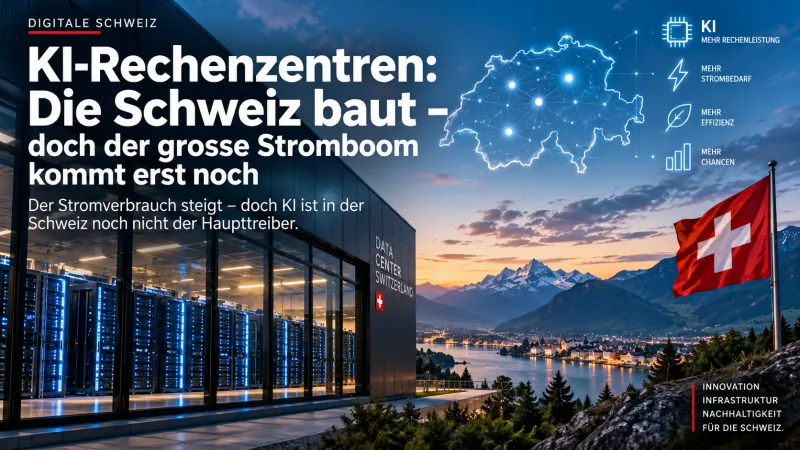
AI Data Centers: Switzerland Builds – But the Big Power Boom is Yet to Come
Electricity consumption is rising, but AI is not yet the main driver in Switzerland.
In the US, data centers are increasingly becoming a local political issue. Where new artificial intelligence facilities are to be built, the debate is no longer just about jobs and technological competitiveness. Residents are concerned about electricity consumption, water requirements, landscape impact, and the strain on local infrastructure.
This development is noteworthy, as data centers were long considered invisible infrastructure for digitalization. Today, they are becoming large-scale projects, comparable in dimension to industrial plants. The rapidly growing demand for computing power for artificial intelligence particularly accelerates this development.
Switzerland is not immune to this. New facilities are being built or planned, and individual projects are reaching dimensions that would have been unimaginable just a few years ago.
However, Swiss figures tell a slightly different story than the international AI debate.
2.1 Terawatt-hours for Data Centers
A study commissioned by the Federal Office of Energy (FOE) and published in May 2026 estimates the electricity consumption of Swiss data centers in 2024 at almost 2.1 Terawatt-hours (TWh). This corresponds to approximately 3.6 percent of Switzerland's total electricity consumption.
This value is significantly higher than a few years prior. With the same system boundary, consumption in 2019 was around 1.77 TWh, or 3.1 percent of the total electricity consumption at that time. Thus, data center consumption increased by approximately 18 percent between 2019 and 2024.
Key figures:
- 2024: approximately 2.1 TWh electricity consumption
- Share of Swiss electricity consumption: approximately 3.6 percent
- 2019: approximately 1.77 TWh with the same system boundary
- Growth 2019–2024: approximately 18 percent
- Forecast 2030: 2.5 to 3.2 TWh
- Maximum scenario: up to 3.5 TWh
The growth is therefore real. However, considering the past five years, one cannot speak of an exponential increase.
The Surprising Figure: AI is Not Yet the Main Driver Today
This is precisely where the Swiss situation differs from the international debate. Although artificial intelligence generates enormous demand for computing power worldwide, AI still plays a subordinate role in the current electricity consumption of Swiss data centers, according to the FOE.
The reason is structural: Switzerland does not yet have large data centers designed for training Large Language Models. Such facilities can reach capacities of several hundred megawatts.
Instead, a large part of Switzerland's data center infrastructure continues to be used for classic cloud applications, colocation, enterprise IT, and other digital services.
This does not mean that AI is unimportant for Swiss data centers. On the contrary: the demand for AI computing power could become an additional growth driver in the coming years. However, this effect is not yet the dominant factor in current Swiss consumption figures.
A large part of the growth to date is rather related to the increasing shift of IT applications to the cloud and the expansion of commercial data centers.
Cloud instead of Server Room
Behind the rising electricity consumption is also a change in the Swiss corporate landscape.
Companies are increasingly less likely to operate their IT entirely in-house. Applications, data, and computing power are increasingly outsourced to specialized providers, colocation data centers, and cloud services.
This shifts electricity consumption: what was previously consumed in a company's own server room is now increasingly consumed in a professional data center.
This development also explains why the consumption of commercial data centers has increased significantly, while the electricity consumption of many in-house corporate data centers has stagnated or decreased.
Almost 40 Percent Efficiency Potential
At the same time, the FOE sees considerable potential to limit additional electricity demand.
The study estimates the remaining energy efficiency potential of Swiss data centers at around 0.8 TWh per year. This corresponds to almost 38 percent of the industry's current electricity consumption.
Potential exists in both IT equipment and building infrastructure, such as cooling and power supply.
This raises an important political question: to what extent must Switzerland expand its electricity production and grid infrastructure for additional data centers – and how much growth can be absorbed through more efficient facilities?
The answer is also relevant because data centers require electricity not only where they are built. Large facilities place high demands on grid connections and may necessitate regional infrastructure projects.
Consumption Could Rise Significantly by 2030
The forecasts show that current consumption is not the end of this development.
The FOE expects Swiss data centers' electricity consumption to be approximately 2.5 to 3.2 TWh by 2030. In a maximum scenario, consumption could even rise to around 3.5 TWh.
That would be about 6 percent of Switzerland's electricity consumption in 2024.
However, the forecast is not a prediction of a specific course of events. Rather, it shows the range in which consumption could develop if demand and expansion continue accordingly.
The further development of AI, in particular, could become increasingly important. Power-intensive AI applications require significantly more computing power than many classic cloud services.
A Different Scale Emerges in Laufenburg
A project in Laufenburg, Canton Aargau, illustrates the potential size of the next generation of data centers.
There, FlexBase is building the Laufenburg Technology Center. Part of the project is a high-performance AI data center. According to project details, the facility could technically draw up to 480 megawatts of power in its final expansion stage.
The project also includes a large redox flow battery storage system. This is intended to achieve a storage capacity of more than 1.6 gigawatt-hours and a power output of more than 800 megawatts.
Important: Power is not storage capacity.
The up to 480 MW refers to the potential electrical power of the AI data center. The more than 1.6 GWh of the battery storage, however, describes the amount of energy stored. The more than 800 MW of the storage refers to its potential power output.
The project thus shows the dimensions that the combination of AI infrastructure and energy supply can reach. FlexBase also plans water cooling and the use of waste heat for a district heating network.
Construction work is now well advanced. In early September 2026, FlexBase announced that the extensive excavation work had been completed and that superstructure construction was now beginning. The company had originally announced the full commissioning of the Technology Center for summer 2028.
Beringen Shows: The Conflict is Already Here
While Laufenburg primarily demonstrates the technological dimension of the development, Beringen in Canton Schaffhausen clarifies the questions that can arise locally.
In Beringen, Stack Infrastructure is building a large data center. The facility is expected to reach an electrical output of approximately 30 to 36 megawatts in its final expansion stage, depending on the planning level assumed.
The water demand is particularly controversial. The municipality of Beringen expects a cooling water demand of approximately 55,000 cubic meters per year. Originally, a significantly higher demand of 300,000 to 400,000 cubic meters per year had been requested. According to the municipality, this value could be reduced by around 86 percent after a revision of the cooling concept.
The municipality states that the existing water supply can generally cover the currently expected demand. At the same time, the water supply contract regulates how much water can be provided; the security of supply for the population has priority.
Nevertheless, the issue causes political and social resistance. In July 2026, activists protested against the data center, criticizing its electricity and water consumption in particular. At the end of August, Beringen once again became the scene of a broader debate about the impact of large data centers.
The case shows: the discussion about data centers is no longer just a question of digitalization. It also concerns water, electricity grids, spatial planning, and the question of what benefits such facilities bring to a region.
Electricity is Not the Only Problem
Therefore, when planning large data centers, several resources are simultaneously in focus.
Power Supply
High-performance data centers require large and, if possible, stable amounts of electricity. The higher a facility's output, the more important grid connection, grid capacity, and the question of who pays for necessary infrastructure become.
Cooling and Water
Servers generate large amounts of heat. This must be continuously dissipated. Depending on the cooling technology, considerable water may be required. The actual consumption depends, among other factors, on the data center's design, the cooling system, and climatic conditions.
Waste Heat
At the same time, an interesting opportunity arises from the perspective of energy planning: the heat generated during server operation could be used for buildings, industry, or district heating networks.
In practice, however, this is not automatically possible. It requires suitable consumers, distribution networks, and a timely demand. Thus, while a data center can continuously produce heat, not every region can use this heat effectively.
Switzerland Does Not Need to Run from AI – But It Must Plan Ahead
Current figures give no reason to portray the Swiss data center market as an acute electricity crisis. At around 3.6 percent of Switzerland's electricity consumption, the share is relevant but still far from a situation where data centers would dominate the Swiss electricity system.
At the same time, it would be wrong to underestimate the development. The industry is growing, individual new buildings are reaching a completely different scale than previous facilities, and the global expansion of AI infrastructure could further increase demand for computing power.
Precisely for this reason, the crucial question should not be whether Switzerland should permit or prevent data centers.
Rather, the decisive question is under what conditions they are built.
This includes transparent information on electricity and water requirements, early coordination with grid infrastructure, the most efficient cooling possible, and binding concepts for using waste heat. Likewise, the question arises of what economic and infrastructural benefits a region actually gains from a major project.
The Big AI Power Surge Could Still Be Ahead
Perhaps the most important finding of the new FOE study therefore does not lie solely in the 2.1 TWh of electricity consumption.
It lies in the combination of two developments: Swiss data centers already consume a lot of electricity – but current consumption is not yet primarily driven by AI.
That could change.
If large AI data centers truly gain a foothold in Switzerland, the dynamic could change significantly. Projects like the one in Laufenburg already show what performance classes are technically possible.
Switzerland is still far from a widespread AI power boom. But the infrastructure for it is already being created.
For politicians, energy suppliers, and municipalities, this means: Those who only react when the large data centers are online may be reacting too late.
Switzerland therefore has less of an acute AI power problem than a planning task. It must decide how much digital infrastructure it wants in the future – and what conditions should apply to its electricity, water, and heat consumption.
At a Glance
- Swiss data centers consumed approximately 2.1 TWh of electricity in 2024.
- This corresponds to approximately 3.6 percent of Switzerland's electricity consumption.
- Since 2019, consumption at a comparable system boundary has increased by approximately 18 percent.
- According to the FOE, AI still plays a subordinate role in the current electricity consumption of Swiss data centers.
- By 2030, 2.5 to 3.2 TWh are expected; up to 3.5 TWh in the maximum scenario.
- The estimated efficiency potential is around 0.8 TWh.
- An AI data center with a planned output of up to 480 MW is being built in Laufenburg.
- In Beringen, approximately 55,000 m³ of cooling water per year are expected.
Sources
Federal Office of Energy (FOE): “Data Centers in Switzerland: Electricity Consumption and Efficiency Potentials”, May 7, 2026.
FlexBase Group: Information on the Laufenburg Technology Center and the AI data center.
Municipality of Beringen: Response to the interpellation “Water Consumption of Data Centers in Beringen”.
Swiss Radio and Television (SRF): Reporting on data centers in Beringen, 2026.
Keystone-SDA / Swissinfo: Reporting on protests against the data center in Beringen, July 2026.